Kirjailija
Anthony Giddens
Kirjat ja teokset yhdessä paikassa: 68 kirjaa, julkaisuja vuosilta 1973–2026, suosituimpiin kuuluu Essential Concepts in Sociology. Vertaile teosten hintoja ja tarkista saatavuus suomalaisista kirjakaupoista.
68 kirjaa
Kirjojen julkaisuvuodet: 1973–2026.
I "Modernitet och självidentitet" diskuterar Anthony Giddens, en av samtidens främsta samhällsteoretiker, förhållandet mellan moderniteten och det individuella jaget. Senmoderniteten är en post-traditionell ordning som enligt Giddens kännetecknas av utvecklad institutionell reflexivitet. Den pågående globaliseringen av moderna institutioner åtföljs av en omvandling av vardagslivet med genomgripande konsekvenser för det personliga livet. Självet blir ett »reflexivt projekt», en strävan, parallell till de moderna institutionernas försök att anpassa sig till globaliseringen, att bemästra framtiden. Men detta självets reflexiva projekt befrämjar också motsatta tendenser och tillhandahåller stoff för en ny politik - det växer fram en »livspolitik» som handlar om människans självförverkligande både på en individuell och en kollektiv nivå. Modernitet och självidentitet ägnas frågor som Anthony Giddens ibland anklagats för att negligera, frågor som rör psykologi och självidentitet. Denna bok utgör på så sätt ett viktig steg i Giddens teoretiska utveckling och kan läsas av alla intresserade av politik, samhällsteori och socialpsykologi.
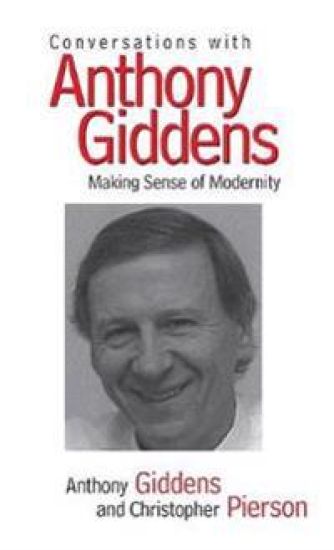
Anthony Giddens has been described as 'the most important English social philosopher of our time'. Over twenty-five years, and even more books, he has established himself as the most widely-read and widely-cited social theorist of his generation. His ideas have profoundly influenced the writing and teaching of sociology and social theory throughout the English-speaking world. In recent years, his writing has become much more explicitly political, and in 1996 he took up his high-profile appointment as Director of the London School of Economics and Political Science. It is in this new position and with these new political ideas that he has been described as the key intellectual figure of New Labour in Britain. Following the astonishing success of Labour in the 1997 General Election, his ideas have been the focus of intense interest. In this series of extended interviews with Chris Pierson, Giddens lays out with customary clarity and directness the principal themes in the development of his social theory and the distinctive political agenda which he recommends. This volume will be of great interest to second- and third-year students in sociology and social theory, politics and political theory, as well as to the general reader.
The idea of finding a 'third way' in politics has been widely discussed over recent months - not only in the UK, but in the US, Continental Europe and Latin America. But what is the third way? Supporters of the notion haven't been able to agree, and critics deny the possibility altogether. Anthony Giddens shows that developing a third way is not only a possibility but a necessity in modern politics.
Conversations with Anthony Giddens
Anthony Giddens; Christopher Pierson
STANFORD UNIVERSITY PRESS
1998
sidottu
Anthony Giddens has been described as “the most important English social philosopher of our time.” Over 25 years, with a dazzling series of books that attest to his unrelenting productivity, he has established himself as today’s most widely read and widely cited social theorist. In recent years, his writings have become more explicitly political, and in 1996 he became Director of the London School of Economics and Political Science. It is in this position that he has been accepted as the key intellectual figure of Tony Blair’s New Labour government. Giddens’s interests have always been remarkably diverse, ranging from Continental philosophy to self-help therapy, and his work builds on a critical engagement with an extraordinary array of texts from within and beyond the canon of the social sciences. His ideas have profoundly influenced the writing and teaching of the central ideas of the rapidly changing study of modernity. These seven extended interviews with Christopher Pierson, conducted shortly after Giddens’s arrival at the LSE, seek to cover the full range of his thought since the early 1970’s, beginning with his engagement with the makers of “classical” sociology and concluding with his thoughts on the nature of world politics under what Giddens terms “reflexive modernity.” The style of the interviews is conversational, and Giddens sets forth his ideas with his customary clarity and directness. In addition to the interviews, four short pieces at the end of the book give examples of Giddens’s recent thought, treating Tony Blair’s political philosophy, the risk society concept in the context of British politics, and the dangers of chemical contamination. The volume concludes with a conversation between Giddens and European financier and philanthropist George Soros.
Is there a future for sociology? To many, sociology seems to have lost its way. Born of the ideas of Auguste Comte in the nineteenth century, sociology established itself as 'the science of modernity', linked to a progressive view of history. Yet today the idea of progress has more or less collapsed; with its demise, some say, sociological thought has moved to the margins of contemporary intellectual culture. In this book the author challenges such an interpretation, showing that sociology continues to hold a central position within the social sciences. Looking both to the past of sociology and the diversity of intellectual trends found in the present-day, Giddens explores many aspects of the sociological heritage. Comte, Durkheim, Parsons, Marshall, and Habermas are among the figures covered. Giddens also connects sociological work directly to current political issues and places the discipline of sociology in the context of broad questions of social and political theory. This book will be of interest to undergraduates and professionals in the fields of sociology, anthropology and political science.
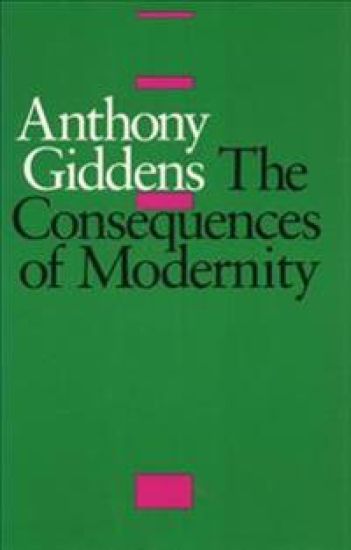
Den brittiske sociologiprofessorn Anthony Giddens är en av samtidens mest inflytelserika samhällsteoretiker. I Modernitetens följder redogör han för sin syn på det moderna samhällets tveeggade karaktär. Han menar att utvecklingen av de moderna samhällsinstitutionerna visserligen har lett till större möjligheter för människorna att leva ett tryggt och rikt liv, men samtidigt har moderniteten också en dyster sida som kommer till uttryck i bl.a. hoten om miljöförstöring och den militära och vapenteknologiska utvecklingen. Giddens menar att vi ännu inte nalkas ett postmodernt samhälle, utan att vi mot slutet av det tjugonde århundradet i stället är på väg mot det han kallar ett högmodernt samhälle i vilket följderna av moderniteten är mer påtagliga och universella än någonsin tidigare i historien. Modernitetens följder vänder sig till alla som är intresserade av det moderna samhällets utveckling. Boken lämpar sig utmärkt på universitets- och högskolekurser på alla nivåer inom de samhälls- och beteendevetenskapliga ämnena.
Built upon a series of critical encounters with major figures in classical and present-day social and political thought, this volume offers not only a challenging critique of major traditions of social and political analysis, but unique insights into the ideas which Giddens has developed over the past two decades.
What, if anything, is valid in Marx's work today, following the events of 1989 and after in Eastern Europe? The second edition of this highly regarded critical encounter with historical materialism and other major perspectives in social thought, shows how a critical theory of the advanced societies can still draw on marxism - if only sparingly - and remains an endeavour of fundamental importance in the social sciences at the present time.
Intimitetens omvandling : Sexualitet, kärlek och erotik i det moderna samhället
Anthony Giddens
Bokförlaget Nya Doxa
1995
nidottu
Den sexuella revolutionen; en suggestiv term. Men vad står den för idag? Hur uppstår sexualitet, och vilka är sambanden med de förändringar som har påverkat privatlivet på ett mer generellt plan?
Politics, Sociology, and Social Theory
Anthony Giddens
Stanford University Press
1995
pokkari
Halvin toimitettuna 30,30 €
This book is built upon a series of critical encounteres with major figures in classical and present-day social and political thought. The volume offers not only a challenging critique of major traditions of social and political analysis, but unique insights into the ideas which Anthony Giddens has developed over the past two decades. The volume includes discussions of politics and sociology in the thought of Max Weber, together with analyses of Durkheim's politlcal sociology and his interpretation of individualism and solidarity in modern societies. Various more contemporary figures are also subjected to critical dissection and appraisal, most notably Habermas, Foucault, Marcuse, Garinkel and Popper. The work therefore serves as a comprehensive introduction to some of the main debates preoccupying the social sciences and politics. A number of unifying themes associated with Giddens's standpoint run through each of the chapters: the methodological reconstruction of social investigation, the reinterpretation of modernity and the reformulation of a critical theory of politics. This book will be of interest to anyone concerned with the major dilemmas faced by social and political theory today, as well as those seeking to follow the overall trajectory of Giddens's thinking.
A series of critical engagements with major figures in classical and present-day social and political thought that offers not only a challenging critique of major traditions of social and political analysis but also unique insights into the ideas that Anthony Giddens has developed over the past two decades.
Reflexive Modernization
Ulrich Beck; Anthony Giddens; Scott Lash
Stanford University Press
1994
pokkari
The theme of reflexivity has come to be central to social analysis. In this book three prominent social thinkers discuss the implications of "reflexive modernization" for social and cultural theory today. Ulrich Beck's vision of the "risk society" has already become extraordinarily influential. Beck offers a new elaboration of his basic ideas, connecting reflexive modernization with new issues to do with the state and political organization. Giddens offers an in-depth examination of the connections between "institutional reflexivity" and the de-traditionalizing of the modern world. We are entering, he argues, a phase of the development of a global society. A "global society" is not a world society, but one with universalizing tendencies. Lash develops the theme of reflexive modernization in relation the aesthetics and the interpretation of culture. In this domain, he suggests, we need to look again at the conventional theories of postmodernism; "aesthetic modernization" has distinctive qualities that need to be uncovered and analyzed. In the concluding sections of the book, the three authors offer critical appraisals of each other's viewpoints, providing a synthetic conclusion to the work as a whole.
How should one understand the nature and possibilities of political radicalism today? The political radical is normally thought of as someone who stands on the left, opposing backward-looking conservatism. In the present day, however, the left has turned defensive, while the right has become radical, advocating the free play of market forces no matter what osbtacles of tradition or custom stand in their way. What explains such a curious twist of perspective? In answering this question, Giddens develops a new framework for radical politics, drawing on what he calls "philosophic conservatism," but applying this outlook in the service of values normally associated with the left. The ecological crisis is at the core of this analysis, but is understood by Giddens in an unconventional way—as a response to a world in which modernity has run up against its independently human intervention, and the end of tradition, combined with the impact of globalization, are the forces which now have to be confronted, made use of and coped with. This book provides a powerful interpretation of the rise of fundamentalism, of democracy, the persistence of gender divisions and the question of a normative political theory of violence. It will be essential reading for anyone seeking a novel approach to the political challenges we face at the turn of the twenty-first century.
New Rules of Sociological Method
Anthony Giddens
Stanford University Press
1993
pokkari
Halvin toimitettuna 29,80 €
This is a new and revised edition of a book which has established itself as a basic text in social theory. The first section of the work provides a concise critical analysis of some leading schools of thought in social philosophy, giving particular attention to phenomenology, ethnomethodology, and Wittgensteinian thought. Giddens concentrates primarily upon the implications of these various perspectives for an account of human action and its intelligibility. An 'action approach' on its own, however, will not do; in human social life, action and structure presuppose one another. The author therefore moves on to provide a series of concepts relevant to understanding the production and reproduction of society. The book concludes with a succinct statement of some 'new rules of sociological method.' Representing the first, and most trenchant, exposition of the principles of structuration theory, this edition also contains a substantial new Introduction in which Giddens replies to some of the more persistent criticisms made of the original version and also addresses some important issues originally discussed only in a cursory way.
The sexual revolution: an evocative term, but what meaning can be given to it today? How does "sexuality" come into being, and what connections does it have with the changes that have affected personal life more generally? In answering these questions, the author disputes many of the dominant interpretations of the role of sexuality in modern culture. The author suggests that the revolutionary changes in which sexuality has become cauth up are more long-term than generally conceded. He sees them as intrinsic to the development of modern societies as a whole and to the broad characteristics of that development. Sexuality as we know it today is a creation of modernity, a terrain upon which the contradictory tendencies of modern social life play themselves out in full. Emancipation and oppression, opportunity and risk-these have become a part of a heady mix that irresistably ties our individual lives to global outcomes and the transformation of intimacy. We live today in a social order in which, for the first time in histroy, women are becoming equal to men-or at least have lodged a claim to such equality as their right. The author does not attempt to analyze the gender inequalities that persist in the economic or political domains, but instead concentrates on a more hisdden personal area in which women-ordinary women, in the course of their day-to-day lives, quite apart from any political agenda-have pioneered changes of greate, and generalizable, importance. These changes essentially concern an exploration of the potentialities of the "pure relationship," a relaitonship that presumes sexual and emotional equality, and is explosive in its connotations for pre-existing relations of power. The author analyzes the emergence of what he calls plastic sexuality-sexuality freed from its intrinsic relation to reproduction-in terms of the emotional emancipation implicit in the pure relationship, as well as women's claim to sexual pleasure. Plastic sexuality is decentered sexuality, freed from both reproduction and subservience to a fixed object. It can be molded as a trait of personality, and thus become bound up with the reflexivity of the self. Premised on plastic sexuality, the pure relationship is not exclusively heterosexual; it is neutral in terms of sexual orientation. The author speculates that the transformaion of intimacy might be a subversive influence on modern institutions as a whole, for a social world in which the dominant ideal was to achieve intinsic rewards from the company of others might be vastly different from that which we know at the present.

This is a new and revised edition of a book which has already established itself as a basic text in social theory. The first section of the work provides a concise critical analysis of some leading schools of thought in social philosophy, giving particular attention to phenomenology, ethnomethodology and Wittgensteinian thought. Giddens concentrates primarily upon the implications of these various perspectives for an account of human action and its intelligibility. An `action approach' on its own, however, will not do; in human social life, action and structure presuppose one another. The author therefore moves on to provide a series of concepts relevant to understanding the production and reproduction of society. The book concludes with a succinct statement of some `new rules of sociological method'. Representing the first, and most trenchant, exposition of the principles of structuration theory, this edition also contains a substantial new Introduction in which Giddens replies to some of the more persistent criticisms made of the original version and also addresses some important issues originally discussed only in a cursory way.
The Constitution of Society
Anthony Giddens
University of California Press
1992
nidottu
Halvin toimitettuna 49,20 €
Anthony Giddens has been in the forefront of developments in social theory for the past decade. In "The Constitution of Society" he outlines the distinctive position he has evolved during that period and offers a full statement of a major new perspective in social thought, a synthesis and elaboration of ideas touched on in previous works but described here for the first time in an integrated and comprehensive form. A particular feature is Giddens' concern to connect abstract problems of theory to an interpretation of the nature of empirical method in the social sciences. In presenting his own ideas, Giddens mounts a critical attack on some of the more orthodox sociological views. "The Constitution of Society" is an invaluable reference book for all those concerned with the basic issues in contemporary social theory.
Modernity differs from all preceding forms of social order because of its dynamism, its deep undercutting of traditional habits and customs, and its global impact. It also radicallly alters the general nature of daily life and the most personal aspects of human activity. In fact, one of the most distinctive features of modernity is the increasing interconnection between globalizing influences and personal dispositions. The author analyzes the nature of this interconnection and provides a conceptual vocabulary for it, in the process providing a major rethinking of the nature of modernity and a reworking of basic premises of sociological analysis. Building on the ideas set out in the author's The Consequences of Modernity, this book focuses on the self and the emergence of new mechanisms of self-identity that are shaped by-yet also shape-the institutions of modernity. The author argues that the self is not a passive entity, determined by external influences. Rather, in forging their self-identities, no matter how local their contexts of action, individuals contribute to and directly promote social influences that are global in their consequences and implications. The author sketches the contours of the he calls "high modernity"-the world of our day-and considers its ramifications for the self and self-identity. In this context, he analyzes the meaning to the self of such concepts as trust, fate, risk, and security and goes on the examine the "sequestration of experience," the process by which high modernity separates day-to-day social life from a variety of experiences and broad issues of morality. The author demonstrates how personal meaninglessness-the feeling that life has nothing worthwhile to offer-becomes a fundamental psychic problem in circumstances of high modernity. The book concludes with a discussion of "life politics," a politics of selfactualization operating on both the individual and collective levels.
The Consequences of Modernity
Anthony Giddens
Stanford University Press
1991
nidottu
Halvin toimitettuna 31,40 €
In this major theoretical statement, the author offers a new and provocative interpretation of institutional transformations associated with modernity. What is modernity? The author suggests, "As a first approximation, let us simply say the following: 'modernity' refers to modes of social life or organization which emerged in Europe from about the seventeenth century onwards and which subsequently became more or less worldwide in their influence." We do not as yet, the author argues, live in a post-modern world. The distinctive characteristics of our major social institutions in the closing years of the twentieth century suggest that, rather than entering into a period of post-modernity, we are moving into a period of "high modernity" in which the consequences of modernity are becoming more radicalized and universalized than before. A post-modern social universe may eventually come into being, but this as yet lies on the other side of the forms of social and cultural organization that currently dominate world history. In developing a fresh characterization of the nature of modernity, the author concentrates on the themes of security versus danger and of trust versus risk. Modernity is a double-edged phenomenon. The development of modern social institutions has created vastly greater opportunities for human beings to enjoy a secure and rewarding existence than in any type of pre-modern system. But modernity also has a somber side that has become very important in the present century, such as the frequently degrading nature of modern industrial work, the growth of totalitarianism, the threat of environmental destruction, and the alarming development of military power and weaponry. The book builds upon the author's previous theoretical writings and will be of great interest to those who have followed his work through the years. However, this book covers issues the author has not previously analyzed and extends the scope of his work into areas of pressing practical concern.
The social sciences have long been based upon contrasts drawn between the 'militaristic' societies of the past, and the 'capitalist' or 'industrial' societies of the present. But how valid are such contrasts, given that the current era is one stamped by the impact of war and by the intensive development of sophisticated weaponry? In setting out to address this and similar questions, this book investigates issues that have been substantially neglected by those working in sociology and social theory. Anthony Giddens offers a sociological analysis of the nature of the modern nation-state and its association with the means of waging war. His analysis is connected in a detailed way to problems that have traditionally preoccupied sociologists - the impact of capitalism and industrialism upon social development in the modern period. The result is a theory both of the institutional parameters of modernity and of the nature of international relations. The book is a sequel to the author's much discussed Contemporary Critique of Historical Materialism. The framework of social theory outlined in that work is here elucidated in a systematic and thorough-going fashion. The novel and provocative ideas which the author develops will interest those working in a wide variety of disciplines: sociology, politics, geography and international affairs.