Kirjailija
Anthony Trollope
Kirjat ja teokset yhdessä paikassa: 2 344 kirjaa, julkaisuja vuosilta 1974–2026, suosituimpiin kuuluu Autobiography Of Anthony Trollope. Vertaile teosten hintoja ja tarkista saatavuus suomalaisista kirjakaupoista.
2 344 kirjaa
Kirjojen julkaisuvuodet: 1974–2026.
Mr Peacocke, a Classical scholar, has come to Broughtonshire with his beautiful American wife to live as a schoolmaster. But when the blackmailing brother of her first husband - a reprobate from Louisiana - appears at the school gates, a dreadful secret is revealed and the county is scandalized. Ostracised by the community, the pair seem trapped in a hopeless situation - until the combative but warm-hearted headmaster of the school, Dr Wortle, offers his support, and Mr Peacocke embarks upon a journey to America that he hopes will lay to rest the accusations once and for all. A perceptive exploration of Victorian morality, Dr Wortle's School (1881) also contains echoes of Trollope's own life, and his personal affection for the vivacious Bostonian Kate Field.
With the publication of this volume we complete the series of Trollope's six Barsetshire novels in the Everyman Library.
Plantagenet Palliser, the Duke of Omnium and former Prime Minister of England, is widowed and wracked by grief. Struggling to adapt to life without his beloved Lady Glencora, he works hard to guide and support his three adult children. Palliser soon discovers, however, that his own plans for them are very different from their desires. Sent down from university in disgrace, his two sons quickly begin to run up gambling debts. His only daughter, meanwhile, longs passionately to marry the poor son of a county squire against her father's will. But while the Duke's dearest wishes for the three are thwarted one by one, he ultimately comes to understand that parents can learn from their own children. The final volume in the Palliser novels, The Duke's Children (1880) is a compelling exploration of wealth, pride and ultimately the strength of love.
The concluding episode in Trollope's magnificent sequence of six Barsetshire novels narrates the trials of Joseph Crawley, the obsessive rector of Hogglestovk, as he struggles to clear his name from accusations of theft.
The Way We Live Now
Anthony Trollope
Wordsworth Editions Ltd
1995
nidottu
Halvin toimitettuna 11,90 €
With an Introduction and Notes by Peter Merchant. Canterbury Christ Church College. The tough-mindedness of the social satire in and its air of palpable integrity give this novel a special place in Anthony Trollope's Literary career. Trollope paints a picture as panoramic as his title promises, of the life of 1870s London, the loves of those drawn to and through the city, and the career of Augustus Melmotte. Melmotte is one of the Victorian novel's greatest and strangest creations, and is an achievement undimmed by the passage of time. Trollope's 'Now' might, in the twenty-first century, look like some distant disenchanted 'Then', but this is still the yesterday which we must understand in order to make proper sense of our today.
Trollope the Traveller: Selections from Anthony Trollope's Travel Writings
Anthony Trollope
Ivan R. Dee Publisher
1995
nidottu
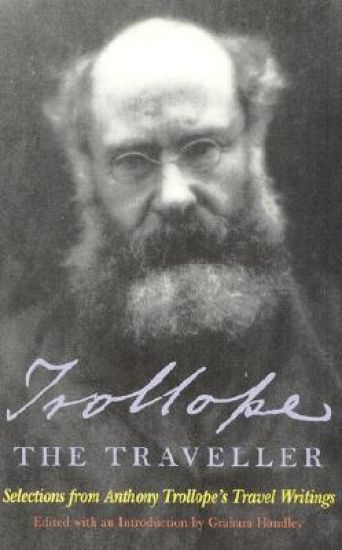
Reports from the West Indies, North America, Australia and New Zealand, and South Africa by the quintessential Victorian voyager, an adventurous and energetic sightseer with a fine sense of humor and irony.
It is in this book that we first meet Plantagenet Palliser, later to become Duke of Omnium, but the forces of attention concerns two women and their lovers: Lady Glencora and Alice Vavasour.
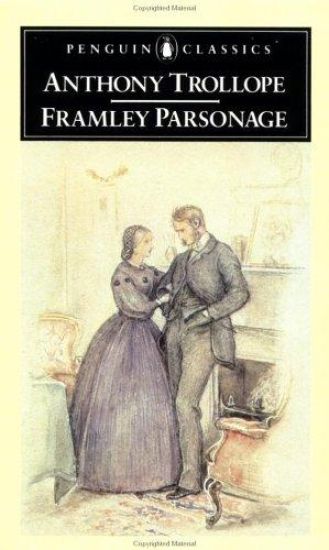
In the course of last century, Anthony Trollope's fictional county of Barset has become one of English literature's most 'real', most celebrated landscapes. Framley Parsonage--the fourth of his engrossing Barsetshire novels--concerns itself with the drastic misjudgements of an amiable but naive and overly ambitious young clergyman. Through its shrewd and excellent social comedy and subtle, sometimes wicked, grasp of political and ecclesiastical manoeuvering, Trollope brings a whole local universe to convincing and triumphant life. (Book Jacket Status: Not Jacketed)
The Way We Live Now is Anthony Trollope's radical exploration of the dangers associated with speculative capitalism, edited with an introduction and notes by Frank Kermode in Penguin Classics. Augustus Melmotte is a fraudulent foreign financier who preys on dissolute nobility - using charm to tempt the weak into making foolish investments in his dubious schemes. Persuaded to put money into a notional plot to run a railroad from San Francisco to Santa Cruz, the capricious gambler Felix Carbury soon becomes one of his victims. But as Melmotte climbs higher in society, his web of deceit - which also draws in characters as diverse as his own daughter Marie and Felix's mother, the pulp novelist Lady Carbury - begins to unravel. A radical exploration of the dangers associated with speculative capitalism, this is a fascinating satire about a society on the verge of moral bankruptcy. Frank Kermode's introduction explores the real-life inspiration for Trollope's masterly satire. This edition also includes detailed notes. Anthony Trollope (1815-82) had an unhappy childhood characterised by a stark contrast between his family's high social standing and their comparative poverty. He wrote his earliest novels while working as a Post Office inspector, but did not meet with success until the publication of the first of his 'Barsetshire novels', The Warden (1855). As well as writing over forty novels, including such popular works as Can You Forgive Her? (1865), Phineas Finn (1869), He Knew He Was Right (1869) and The Way We Live Now (1875) Trollope is credited with introducing the postbox to England. If you enjoyed The Way We Live Now, you might like William Makepeace Thackeray's Vanity Fair, also available in Penguin Classics.'Trollope's masterpiece ... its examination of how hopes of easy money can corrupt remains relevant today' Observer
FRAMLEY PARSONAGE continues the Barchester series of novels in which Trollope explores the social, political and domestic life revolving around a mid-nineteenth-century cathedral town. Popular since it was first published, the story combines romantic comedy with satirical commentary.
Plantaganet Palliser, Prime Minister of England - a man of power and prestige, with all the breeding and inherited wealth that goes with it - is appalled at the inexorable rise of Ferdinand Lopez. An exotic impostor, seemingly from nowhere, Lopez has society at his feet, while well-connected ladies vie with each other to exert influence on his behalf - even Palliser's own wife, Lady Glencora. But when the interloper makes a socially advantageous marriage, Palliser must decide whether to stand by his wife's support for Lopez in a by-election or leave him to face exposure as a fortune-hunting adventurer. A novel of social, sexual and domestic politics, The Prime Minister raises one of the most enduring questions in government - whether a morally scrupulous gentleman can make an effective leader.
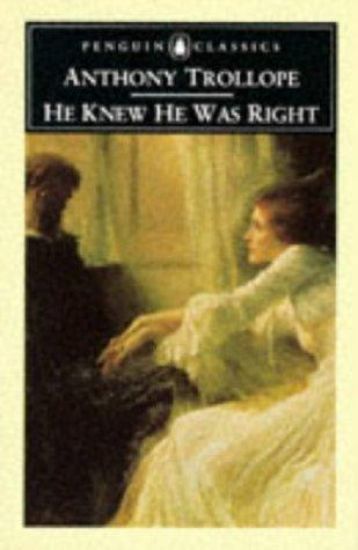
Anthony Trollope's story of one man's obsessive self-deception pitted against against the enduring power of his wife's love, He Knew He Was Right is edited with an introduction by Frank Kermode in Penguin Classics. On a visit to the Mandarin Islands, Louis Trevelyan falls in love with Emily, the daughter of the governor, and they are swiftly married and return to live in London. But when a friend of Emily's father - the meddlesome libertine Colonel Osborne - starts paying rather too much attention to the young woman, Louis is consumed by jealousy and refuses to listen to his wife's pleas of innocence. And as his suspicions become increasingly obsessive and the marriage collapses, Louis finds himself driven to desperate actions. In He Knew He Was Right, Trollope created a highly sympathetic portrait of a deeply troubled marriage, and a compelling psychological story of sexual obsession in his portrait of a nineteenth-century Othello. In his introduction, Frank Kermode discusses Victorian attitudes to courtship and marriage, compares the novel to Othello and places it in the context of Trollope's other works. This edition also includes a new chronology, a bibliography and notes. Anthony Trollope (1815-82) had an unhappy childhood characterised by a stark contrast between his family's high social standing and their comparative poverty. He wrote his earliest novels while working as a Post Office inspector, but did not meet with success until the publication of the first of his 'Barsetshire novels', The Warden (1855). As well as writing over forty novels, including such popular works as Can You Forgive Her? (1865), Phineas Finn (1869), He Knew He Was Right (1869) and The Way We Live Now (1875) Trollope is credited with introducing the postbox to England. If you enjoyed He Knew He Was Right, you might enjoy Trollope's The Way We Live Now, also available in Penguin Classics.

In the third novel of the Barsetshire series, Trollope continues his study of a small cathedral city and the surrounding rural community which he presents as a microcosm of nineteenth-century England. Through each of the Barsershire novels can be read on its own, the six together present an incomparable portrait of life and manners in the quiet but troubled heart of a great nation at the zenith of its prosperity. DOCTOR THORNE revolves round the characters of the doctor and his niece, Mary, but the complex social life of which they are a part, ranging in scope from great houses to poor cottages, is almost more important than individual characters. If God is in the details, these novels are indeed divine.
Lizzie Eustace can manipulate men and flatter powerful women, and she's determined to make her way in the world by whatever means she can. This comedy of a society adventuress and her necklace is one of the "Palliser" novels, describing the political and social life of mid-Victorian England.
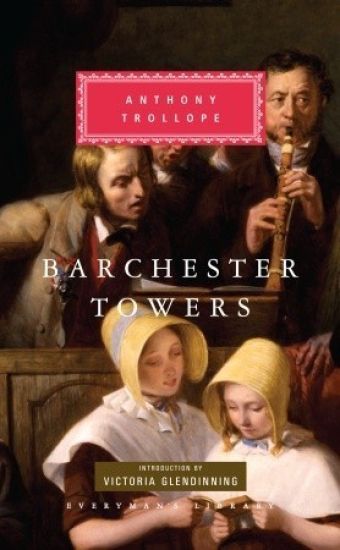
Anthony Trollope was well aware that the seemingly parochial power struggles that determine the action of Barchester Towers – struggles whose comic possibilities he exploits to hilarious effect – actually went to the heart of mid-Victorian English society, and had, in other times and other guises, led to civil war and constitutional upheaval. That awareness heightens the comedy and intensifies the drama in this magnificent novel and it transforms the story of a fight for ascendency among the clergy and dependants of a great English cathedral into something fundamental and universal. Barchester Towers is the second of Trollope's six Barchester Novels, all published by Everyman's Library.
Barchester Towers: Introduction by Victoria Glendinning
Anthony Trollope
Everyman's Library
1992
sidottu
The second novel of Anthony Trollope's brilliant Barsetshire series, presented here in a gorgeous hardcover edition. Anthony Trollope was well aware that the seemingly parochial power struggles that determine the action of Barchester Towers--struggles whose comic possibilities he exploits to hilarious effect--actually went to the heart of mid-Victorian English society, and had, in other times and other guises, led to civil war and constitutional upheaval. That awareness heightens the comedy and intensifies the drama in this magnificent novel, and it transforms the story of a fight for ascendency among the clergy and dependents of a great English cathedral into something fundamental and universal. Everyman's Library pursues the highest production standards, printing on acid-free cream-colored paper, with full-cloth cases with two-color foil stamping, decorative endpapers, silk ribbon markers, European-style half-round spines, and a full-color illustrated jacket. Everyman's Library Classics include an introduction, a select bibliography, and a chronology of the author's life and times.
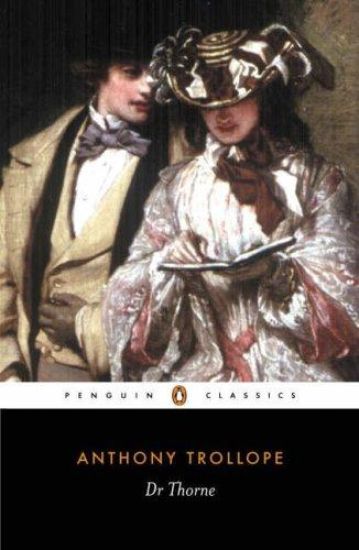
Son of a bankrupt landowner, Frank Gresham is intent on marrying his beloved Mary Thorne, despite her illegitimacy and apparent poverty. Frank's ambitious mother and haughty aunt are set against the match, however, and push him to save the family's mortgaged estate by making a good marriage to a wealthy heiress. Only Mary's loving uncle, Dr Thorne, knows the secret of her birth and the fortune she is to inherit that will make her socially acceptable in the eyes of Frank's family - but the high-principled doctor believes she should be accepted on her own terms. A telling examination of the relationship between society, money and morality, Dr Thorne (1858) is enduringly popular for Trollope's affectionate depiction of rural English life and his deceptively simple portrayal of human nature.
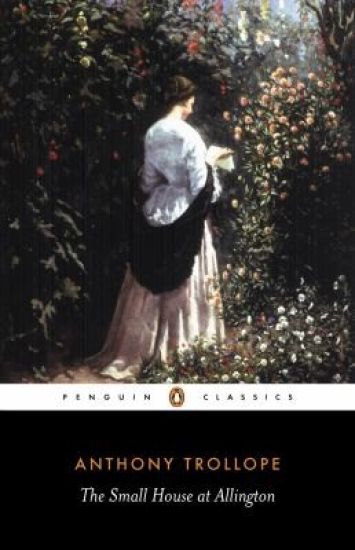
The Small House at Allington
Anthony Trollope
Penguin Classics
1991
pokkari
Halvin toimitettuna 17,00 €
Engaged to the ambitious and self-serving Adolphus Crosbie, Lily Dale is devastated when he jilts her for the aristocratic Lady Alexandrina. Although crushed by his faithlessness, Lily still believes she is bound to her unworthy former fiancé for life and therefore condemned to remain single after his betrayal. And when a more deserving suitor pays his addresses, she is unable to see past her feelings for Crosbie. Written when Trollope was at the height of his popularity, The Small House at Allington (1864) contains his most admired heroine in Lily Dale - a young woman of independent spirit who nonetheless longs to be loved - and is a moving dramatization of the ways in which personal dilemmas are affected by social pressures.
The complete text of this work is available for the first time, with corrections from the original manuscript
Mark Robarts is a clergyman with ambitions beyond his small country parish of Framley. In a naive attempt to mix in influential circles, he agrees to guarantee a bill for a large sum of money for the disreputable local Member of Parliament, while being helped in his career in the Church by the same hand. But the unscrupulous politician reneges on his financial obligations, and Mark must face the consequences this debt may bring to his family. One of Trollope's most enduringly popular novels since it appeared in 1860, Framley Parsonage is an evocative depiction of country life in nineteenth-century England, told with great compassion and acute insight into human nature.