Kirjojen hintavertailu – 12 859 828 kirjaa ja 27 kauppaa

Kirjailija

Antoine Yoshinaka

Kirjat ja teokset yhdessä paikassa: 3 kirjaa, julkaisuja vuosilta 2003–2015, suosituimpiin kuuluu Establishing the Rules of the Game. Vertaile teosten hintoja ja tarkista saatavuus suomalaisista kirjakaupoista.

3 kirjaa

Kirjojen julkaisuvuodet: 2003–2015.

Crossing the Aisle

Crossing the Aisle

Antoine Yoshinaka

Cambridge University Press
2015
sidottu
Switching parties is arguably the most important decision a politician will ever make. This book is the first-ever systematic study of the causes and consequences of legislative party switching in the United States. The author argues that re-election alone does not explain party switching. He proposes an ambition-based theory that accounts for multiple goals (including higher office aspirations and the desire for influence in the legislature) with a focus on the electoral costs and the institutional benefits of the decision. The book combines the statistical analysis of electoral data and legislative careers in the US Congress and state legislatures with elite interviews of party switchers, non-switchers, and a party leader. The case study of a party switcher's decision in 'real time' documents the complexity of the decision in a politician's own words prior to and following the switch. The book raises important questions regarding the meaning of a party label.
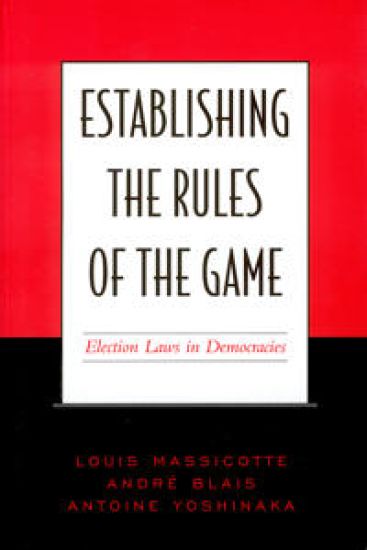
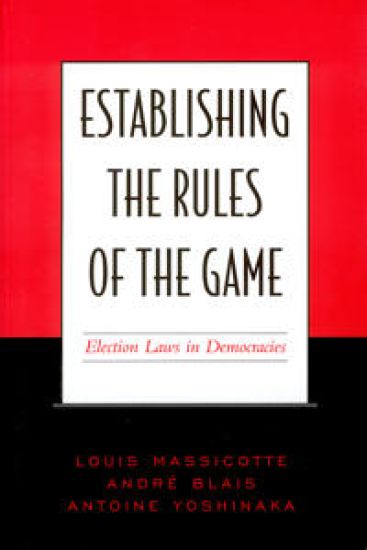
Establishing the Rules of the Game

Establishing the Rules of the Game

André Blais; Louis Massicotte; Antoine Yoshinaka

University of Toronto Press
2004
sidottu
There are an astonishing variety of election laws across contemporary democratic societies. In Establishing the Rules of the Game, Louis Massicotte, André Blais, and Antoine Yoshinaka provide the first thorough examination of these laws. The study incorporates original data collected from more than sixty democracies around the world, and touches on oft-ignored, yet extremely important, aspects of election laws. The countries covered by the study include Argentina, Brazil, Canada, France, Japan, the Netherlands, the Philippines, Romania, and the United Kingdom. The authors focus on six dimensions of election laws: the right to vote, the right to be a candidate, the electoral register, the agency in charge of the election, the procedure for casting votes, and the procedure to sort out the winners and losers. Massicotte, Blais, and Yoshinaka uncover underlying patterns, explaining why certain types of country tend to adopt a given sets of rules. In general, former colonies adopt the same laws as their former mother country. There is also a tendency for established democracies to be more inclusive than non-established ones. The authors point out sociological patterns and review normative and practical arguments for and against each set of rules, providing invaluable information for students of elections and democratic theory as well as election practicioners.
Establishing the Rules of the Game

Establishing the Rules of the Game

André Blais; Louis Massicotte; Antoine Yoshinaka

University of Toronto Press
2003
pokkari
There are an astonishing variety of election laws across contemporary democratic societies. In Establishing the Rules of the Game, Louis Massicotte, André Blais, and Antoine Yoshinaka provide the first thorough examination of these laws. The study incorporates original data collected from more than sixty democracies around the world, and touches on oft-ignored, yet extremely important, aspects of election laws. The countries covered by the study include Argentina, Brazil, Canada, France, Japan, the Netherlands, the Philippines, Romania, and the United Kingdom. The authors focus on six dimensions of election laws: the right to vote, the right to be a candidate, the electoral register, the agency in charge of the election, the procedure for casting votes, and the procedure to sort out the winners and losers. Massicotte, Blais, and Yoshinaka uncover underlying patterns, explaining why certain types of country tend to adopt a given sets of rules. In general, former colonies adopt the same laws as their former mother country. There is also a tendency for established democracies to be more inclusive than non-established ones. The authors point out sociological patterns and review normative and practical arguments for and against each set of rules, providing invaluable information for students of elections and democratic theory as well as election practicioners.