Kirjojen hintavertailu – 12 859 818 kirjaa ja 27 kauppaa

Kirjailija

Antoni Verger

Kirjat ja teokset yhdessä paikassa: 4 kirjaa, julkaisuja vuosilta 2009–2026, suosituimpiin kuuluu Data for Accountability in Education. Vertaile teosten hintoja ja tarkista saatavuus suomalaisista kirjakaupoista.

4 kirjaa

Kirjojen julkaisuvuodet: 2009–2026.

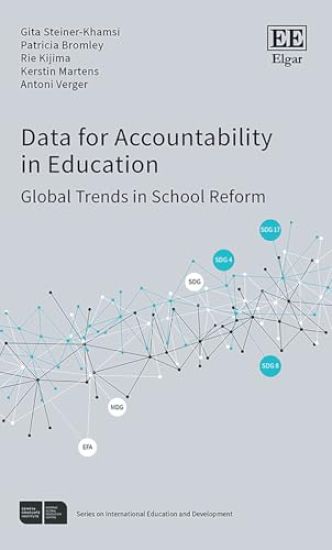
Data for Accountability in Education

Data for Accountability in Education

Gita Steiner-Khamsi; Patricia Bromley; Rie Kijima; Kerstin Martens; Antoni Verger

EDWARD ELGAR PUBLISHING LTD
2026
sidottu
This timely book investigates the emergence of data-for-accountability as a governing tool in education. Five leading scholars explore its evolution over time and across regions, highlighting how datafication in education benefits some and disadvantages others. The authors trace the origins of using data for accountability in education back to the 1990s, demonstrating how various actors have adapted and tailored this trend, thus diversifying its use as a governance tool. They examine the rise of student testing, performance-based evaluation and governance by numbers to reveal the political, economic and pedagogical uses and abuses of data. Drawing on a variety of methods, theories and disciplines, including a combination of macro-, meso-, and microlevel analyses, the authors illustrate how these instruments have taken root globally, why they persist and how their meanings and effects vary across policy contexts. Data for Accountability in Education is a crucial resource for scholars, students and practitioners in comparative education and international education policy, as well as those engaged with the sociology of education. Policymakers working with educational data will also find the book a valuable reference point for understanding accountability in education.

The Privatization of Education

The Privatization of Education

Antoni Verger; Clara Fontdevila; Adrián Zancajo

Teachers' College Press
2016
nidottu
Education privatization is a global phenomenon that crystallizes in countries with very different cultural, political, and economic backgrounds. In this book, the authors examine how privatization policies are being adopted and why so many countries are engaging in this type of education reform. The authors explore the contexts, key personnel, and policy initiatives that explain the worldwide advance of the private sector in education, and identify six different paths toward education privatization— as a drastic state sector reform (e.g., Chile, the U. K.), as an incremental reform (e.g., the U. S. A.), in social-democratic welfare states, historical public-private partnerships (e.g., Netherlands, Spain), de facto privatization in low-income countries, and privatization via disaster. Book Features: The first comprehensive, in-depth investigation of the political economy of education privatization at a global scale. An analysis of the different strategies, discourses, and agents that have contributed to advancing (and resisting) education privatization trends. An examination of the role of private corporations, policy entrepreneurs, philanthropic organizations, think-tanks, and teacher unions.
WTO/GATS and the Global Politics of Higher Education
Since the General Agreement on Trade in Services (GATS) was created in 1995, there has been international pressure towards the liberalization of education all over the world, as well as new challenges to the traditional internationalization rationale in the field of higher education. Nevertheless, education liberalization under the GATS is also a contested process. Public universities, teachers unions, development NGOs and other education stakeholders have opposed and campaigned against the GATS in different countries and at a range of levels from local to global. Based on intensive fieldwork in the WTO headquarters and on two case studies (Argentina and Chile), Antoni Verger opens the black-box of the GATS negotiations in the field of education. His well-documented work explores in-depth how domestic actors and interests are key to understanding the constitution of the global education liberalization process entailed by the GATS as well as the opposition to this process in certain places. This book is crucial reading to anyone with an interest in the future of higher education.