Kirjojen hintavertailu – 12 859 829 kirjaa ja 27 kauppaa

Kirjailija

Antonio Cassese

Kirjat ja teokset yhdessä paikassa: 7 kirjaa, julkaisuja vuosilta 1989–2013, suosituimpiin kuuluu The Human Dimension of International Law. Vertaile teosten hintoja ja tarkista saatavuus suomalaisista kirjakaupoista.

7 kirjaa

Kirjojen julkaisuvuodet: 1989–2013.

Cassese's International Criminal Law

Cassese's International Criminal Law

Antonio Cassese; Paola Gaeta

Oxford University Press
2013
nidottu
The third edition of Cassese's International Criminal Law provides a clear account of the main substantive and procedural aspects of international criminal law. Adopting a combination of the classic common law and more theoretical approaches to the subject, it discusses: · the historical evolution of international criminal law; · the legal definition of the so-called core crimes (war crimes, crimes against humanity, genocide) plus aggression, torture and terrorism; · the forms and modes of criminal responsibility; and · the main issues related to the prosecution and punishment of international crimes at the national and international level, including amnesties, statutes of limitations and immunities. Cassese guides the reader through a vast array of cases and materials from a number of jurisdictions, providing thought-provoking analysis that brings the political and human contexts to the fore. The International Criminal Court and all the other modern international criminal courts are fully covered, both as regards their structure, functioning and proceedings and as far as their case law is concerned. Online Resources Case materials: Key international documents and foreign legislation relating to chapters of the textbook Your questions answered: responses to questions from international law students Web links: Links to web sites relating to topics within the text
Five Masters of International Law

Five Masters of International Law

Antonio Cassese

Hart Publishing
2011
nidottu
This book consists of interviews with five distinguished international lawyers from the UK, USA, Uruguay and France, conducted by the editor, Antonio Cassese, between 1993 and 1995. Each interview is preceded by a brief 'intellectual portrait' of the interviewee. In his general introduction Cassese stresses that the interviews, all based on the same questionnaire, were intended to bring out not only the main ideas associated with each scholar in the fields of international law and international relations, but also his intellectual and philosophical background, his general outlook and his views of the prospects for the evolution of the international community. In his final essay, Cassese brings together the main threads of the interviews and points to the parallels and divergences appearing from them. This book offers a unique and important insight into the legal minds and outlook of a select group of prominent scholars of international law and legal institutions during the last years of the twentieth century.
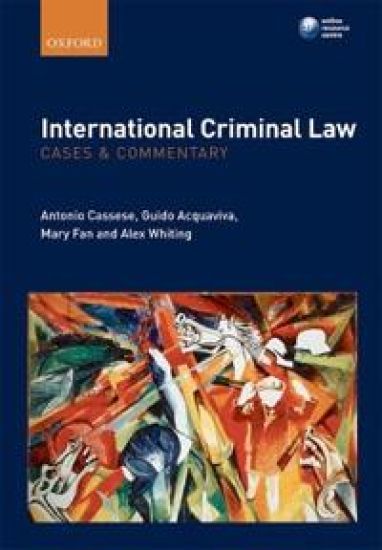
International Criminal Law: Cases and Commentary

International Criminal Law: Cases and Commentary

Antonio Cassese; Guido Acquaviva; Mary Fan; Alex Whiting

Oxford University Press
2011
nidottu
International Criminal Law: Cases and Commentary presents a concise and comprehensive explanation of the development of major areas in substantive international criminal law, through a selection of key illustrative cases from domestic and international jurisdictions. The focus is on the law related to individual criminal liability for war crimes, crimes against humanity, genocide and aggression, with specific attention paid to sources of international criminal law, fundamental principles of criminal responsibility and defences. Under the supervision of Antonio Cassese, the concisely-edited decisions presented in this casebook are accompanied by a short introduction setting out the circumstances of the case and a brief commentary on the importance of the decisions and principles illustrated, with cross-references to other relevant decisions on similar issues. At the end of each section, final remarks are added, together with thought-provoking questions and additional readings. International Criminal Law: Cases and Commentary focuses on the most relevant cases before international jurisdictions today and hard-to-find, domestic decisions that are highly relevant for the present and future development of international criminal justice. The volume is an important source for students and academics in the fields of public international law and international criminal law as well as a concise, interesting and instructive resource for practitioners, policy makers and staff of international organisations dealing with international justice.
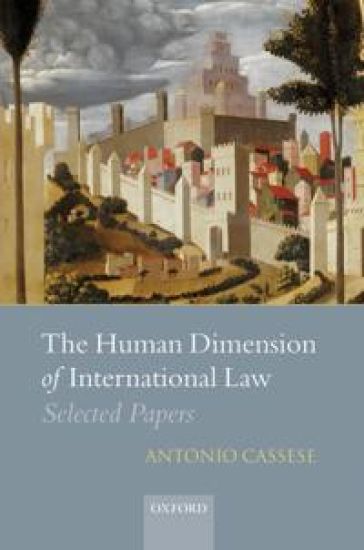
The Human Dimension of International Law

The Human Dimension of International Law

Antonio Cassese

Oxford University Press
2008
sidottu
This book collects together the most important papers of Antonio Cassese, the first President of the International Criminal Tribunal for the former Yugoslavia and chairman of the UN Commission of Inquiry into the crimes committed in Darfur. Written over a period of 25 years, from 1974 to 2001, the papers chart the development of Cassese's thought on the central issues that have shaped his life's work: the laws relating to armed conflict, respect of individual rights and the prosecution of individuals for international crimes. Emerging from the papers is Cassese's vision of the individual and human dignity as the lynchpin of the international legal system, and the need to balance the fact of statehood as an essential feature of modern international society with the protection of individual rights. In a new paper, written especially for the collection, Cassese looks back over the development of his understanding of international law and presents his current view of the issues discussed throughout the volume. The volume also features an exhaustive bibliography of Cassese's publications, and biographical notes from Cassese's colleagues. By gathering together the most important writings of one of the pre-eminent figures in contemporary international criminal justice, this collection provides not only the definitive statement of Cassese's thought, but a unique insight into some of the key developments in international law over the last quarter of the twentieth century.
Inhuman States

Inhuman States

Antonio Cassese

Polity Press
1996
nidottu
This is a first-hand account of the often appalling conditions in prisons, police stations, psychiatric institutions, detention centres and other places where individuals are deprived of their liberty. It is based on extensive inspections in many countries in Europe, including the UK, France, Spain, Greece and Turkey, by a group of inspectors who had hitherto unparalleled access to institutions of detention. Inhuman States is a gripping account of the seamy side of Europe, of those 'social dustbins' that most people tend to ignore and of the practices - including torture - which take place within them. But it is also a book about some general concepts - what is 'human'? What should 'inhuman' or 'degrading' mean? Should general standards be uniformly applied to countries with diverse traditions, legal systems and conditions of life? This book is also a forceful plea for a better and more civilized Europe. Cassese argues that Europe should be unified not only in the field of markets, banks, lawyers, and commerce: an effort should also be made to set out and implement at least some common European standards of justice with regard to those places of detention where each country relegates its misfits, deviants and all those who are thought to imperil the social fabric.
Terrorism, Politics and Law

Terrorism, Politics and Law

Antonio Cassese

Polity Press
1989
sidottu
This book is a highly original analysis of terrorism and its implications for international law and politics. Terrorism has introduced an explosive element into international politics. It can trigger crises which strain the relations between states – a strain which can reach breaking point if states allow their national interests to prevail. Cassese focuses on the Achille Lauro affair and uses this as an episode to illuminate the behaviour of modern states in response to terrorism. On 7 October 1985, four members of the Palestine Liberation Front hijacked an Italian transatlantic liner, the Achille Lauro, as it was sailing on a pleasure cruise off the coast of Egypt. In the days that followed, one dangerous and unforeseen event followed another, and the lives of the hostages hung by a thread. As states hastened to respond to unanticipated events they hovered on the brink of crisis and conflict. The United States was first swept by fury at the murder of one of its citizens, then by euphoria as its fighter planes intercepted an Egyptian airliner thought to be carrying the terrorists. Using a wealth of unpublished documents and material collected from the interviews with government officials and diplomats concerned in the affair, Cassese reconstructs this complex series of events and examines the actions of the states involved – the USA, Italy and Egypt among others. He shows how a range of pressures – military, diplomatic, psychological and legal – led various states to behave as they did, also explaining why some states, in particular the USA, allowed political considerations to override legal imperatives. This book, by one of the leading authorities in international law, will be praised as a major contribution to current debates on the nature of terrorism and its implications for the practices and policies of nation-states.