Kirjojen hintavertailu – 12 903 724 kirjaa ja 27 kauppaa

Kirjailija

Antonio Nicita

Kirjat ja teokset yhdessä paikassa: 10 kirjaa, julkaisuja vuosilta 2007–2026, suosituimpiin kuuluu Regulating Digital Markets. Vertaile teosten hintoja ja tarkista saatavuus suomalaisista kirjakaupoista.

10 kirjaa

Kirjojen julkaisuvuodet: 2007–2026.

Economic Perspectives on Institutions

Economic Perspectives on Institutions

Maurizio Franzini; Antonio Nicita

Routledge
2026
nidottu
Economic and social institutions are more and more important in modern economic systems. Efficiency, equity and also economic evolution depend on them. Indeed, since the pioneering analyses of Coase, North and Williamson huge progress has been made in the understanding of the influence of institutions on the working of economic systems. However, institutions are still a rather disregarded topic both in the analysis of economic phenomena and in the design of economic policies. This book offers a critical assessment of the results achieved so far by the various strands of Institutional Economics that paves the way for further improvements. Economic Perspectives on Institutions provides an introduction to the economic analysis of institutions, particularly with respect to the core issues of conflict, coordination and inequality, offering an essential synthesis of what we have learnt so far and highlighting the major gaps to be filled. Readers are introduced to some of the best ideas produced in the field of institutional economics and are provided with a critical assessment both of their ability to explain a number of crucial problems and to offer a guide to the choice of the best policies. This book will be essential reading to all those studying and researching in the field of institutional economics.

Economic Perspectives on Institutions

Economic Perspectives on Institutions

Maurizio Franzini; Antonio Nicita

Routledge
2026
sidottu
Economic and social institutions are more and more important in modern economic systems. Efficiency, equity and also economic evolution depend on them. Indeed, since the pioneering analyses of Coase, North and Williamson huge progress has been made in the understanding of the influence of institutions on the working of economic systems. However, institutions are still a rather disregarded topic both in the analysis of economic phenomena and in the design of economic policies. This book offers a critical assessment of the results achieved so far by the various strands of Institutional Economics that paves the way for further improvements. Economic Perspectives on Institutions provides an introduction to the economic analysis of institutions, particularly with respect to the core issues of conflict, coordination and inequality, offering an essential synthesis of what we have learnt so far and highlighting the major gaps to be filled. Readers are introduced to some of the best ideas produced in the field of institutional economics and are provided with a critical assessment both of their ability to explain a number of crucial problems and to offer a guide to the choice of the best policies. This book will be essential reading to all those studying and researching in the field of institutional economics.

Regulating Digital Markets

Regulating Digital Markets

Antonio Manganelli; Antonio Nicita

Springer Nature Switzerland AG
2022
sidottu
This book illustrates the challenges that regulators and policy makers have faced in the transition from the ‘old’ network industries to the new digital ecosystem. It succinctly describes the evolution of digital economy, its main actors, notably global digital platforms, as well as its interactions, interdependences, and trade-offs. Eventually, it proposes insights about why public rules are needed, what kind of rules could be more effective, fair, and efficient, and who should pose and enforce them. The book is opened by an introduction, dealing with Digital Transformation, Big Techs, and Public Policies, which provides a general conceptual and thematic framework to the following analysis but could be also read as a stand-alone paper. The following chapters are grouped in two parts: I. The Evolution of Digital Markets and Digital Rights, and II. Regulating Big Tech’s Impact on Market and Society. The secondary title - the European approach – has a twofold meaning. It highlights the fact that this work has a clear focus on EU law and policy - although the economic and institutional issues addressed are global phenomena, common to all world’s economies. In addition, it also underlines that European digital policy is not yet complete and effective. This book intends to provide a small contribution to the ongoing policy making process, as well as to the wider academic and policy debate.
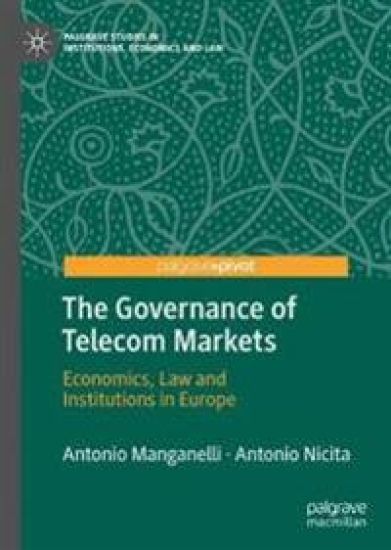
The Governance of Telecom Markets

The Governance of Telecom Markets

Antonio Manganelli; Antonio Nicita

Springer Nature Switzerland AG
2020
sidottu
This book provides a critical comprehensive summary of the coevolution of telecom markets, rules and public institutions over the last 25 years, focusing on the challenges that regulators and policy makers have been facing. Even if the perspective of the book is European (as the EU regulatory framework is examined), most of the economic and institutional issues addressed are common to all telecom markets in advanced economies. The book addresses some traditional fundamental topics in the telecom regulation literature, as well as some hot-button topics in the current policy debate, e.g., ultrafast broadband and 5G networks, the relationship between investments and competition, the sector digitalisation and the role of OTTs. All these are relevant to students, researchers, and policy makers interested to get a sound understanding of the sector, its many dimensions and coevolutionary patterns.
Economic Institutions and Environmental Policy
This title was first published in 2001. The essays in this volume examine the questions of evaluation processes and enforcement with regards to environmental externalities, stressing the role of institutional failures in dealing with the environment. The essays are divided into three sections: 1 - the complexity of evaluation processes; 2 - the complexity of institutional arrangements; and 3 - evaluation processes and political choice. Overall, the essays argue that the effectiveness of environmental policy depends on the role played by economic institutions in affording and implementing policy objectives. The studies investigates the role played by institutions in affecting and implementing environmental policy. Institutions, in the wider sense, are typically shaped by a complex set of economic and political interests, culture and values which require detailed interdisciplinary analysis.
Liberalizations in Network Industries

Liberalizations in Network Industries

Antonio Nicita; Filippo Belloc

Springer International Publishing AG
2018
nidottu
This book explores the wave of liberalization reforms experienced by OECD network industries. Focusing on the telecommunications sector, the authors analyze the latest data available on liberalization and privatization, and following a political economics approach, they integrate standard economic analysis with the most recent studies of the political determinants of market-oriented policies. The book presents new econometric evidence on several policy issues, including institutional complementarities dynamics, the problem of policy sequencing and the role of government political ideology. The detailed and comprehensive discussion offers insights into how so many countries adopting similar reforms actually differ in their policy “bundling”, intensity and implementation of liberalization and privatization.
Economic Institutions and Environmental Policy
This title was first published in 2001. This wide-ranging and comprehensive collection investigates the background to environmental economic development over the last thirty years, and the political implications of new directions resulting from technological and cultural changes in environmental issues. It examines the application of economic analysis to environmental problems in the past and solutions to the current issues of water, soil, air, energy, waste and urban ecology, discussing the implications of political decisions, cultural changes and technological constraints. It will prove a stimulating resource for students, academics, researchers and policy-makers alike.
Liberalizations in Network Industries

Liberalizations in Network Industries

Antonio Nicita; Filippo Belloc

Springer International Publishing AG
2016
sidottu
This book explores the wave of liberalization reforms experienced by OECD network industries. Focusing on the telecommunications sector, the authors analyze the latest data available on liberalization and privatization, and following a political economics approach, they integrate standard economic analysis with the most recent studies of the political determinants of market-oriented policies. The book presents new econometric evidence on several policy issues, including institutional complementarities dynamics, the problem of policy sequencing and the role of government political ideology. The detailed and comprehensive discussion offers insights into how so many countries adopting similar reforms actually differ in their policy “bundling”, intensity and implementation of liberalization and privatization.
Legal Orderings and Economic Institutions

Legal Orderings and Economic Institutions

Fabrizio Cafaggi; Antonio Nicita; Ugo Pagano

Routledge
2015
nidottu
This book addresses the lively interaction between the disciplines of law and economics. The traditional boundaries of these two disciplines have somehow inhibited a full understanding of the functioning of and the evolution of economic and legal systems. It has often been the case that these boundaries have had to be reshaped, and sometimes abolished, before either one of the two disciplines could successfully clarify the real life problems arising from the complex institutions of contemporary societies. The contributions to this volume encompass some of the core controversial issues in law and economics arising from interactions between legal orderings and economic institutions. They include:the nature of institutional and legislative change and the emergence of strong institutional complementarity in legal positionsthe relationship between private orderings and the role of the State in enforcing contracts and defining property rightsthe nature and dynamics of endogenous enforcement and the analysis of governance models and corporate ethics. Part of the renowned Siena Studies in Political Economy series, this book will be an essential read for postgraduates and researchers in the fields of law and economics, and the economics of institutions.
Legal Orderings and Economic Institutions

Legal Orderings and Economic Institutions

Fabrizio Cafaggi; Antonio Nicita; Ugo Pagano

Routledge
2007
sidottu
This book addresses the lively interaction between the disciplines of law and economics. The traditional boundaries of these two disciplines have somehow inhibited a full understanding of the functioning of and the evolution of economic and legal systems. It has often been the case that these boundaries have had to be reshaped, and sometimes abolished, before either one of the two disciplines could successfully clarify the real life problems arising from the complex institutions of contemporary societies. The contributions to this volume encompass some of the core controversial issues in law and economics arising from interactions between legal orderings and economic institutions. They include:the nature of institutional and legislative change and the emergence of strong institutional complementarity in legal positionsthe relationship between private orderings and the role of the State in enforcing contracts and defining property rightsthe nature and dynamics of endogenous enforcement and the analysis of governance models and corporate ethics. Part of the renowned Siena Studies in Political Economy series, this book will be an essential read for postgraduates and researchers in the fields of law and economics, and the economics of institutions.