Kirjojen hintavertailu – 12 903 724 kirjaa ja 27 kauppaa

Kirjailija

Antony Flew

Kirjat ja teokset yhdessä paikassa: 15 kirjaa, julkaisuja vuosilta 1997–2018, suosituimpiin kuuluu God & Philosophy. Vertaile teosten hintoja ja tarkista saatavuus suomalaisista kirjakaupoista.

15 kirjaa

Kirjojen julkaisuvuodet: 1997–2018.

Darwinian Evolution

Darwinian Evolution

Antony Flew

Routledge
2018
sidottu
In little more than a hundred years the evolutionary theory of Charles Darwin has conquered the thinking world. No other body of ideas has enjoyed such unrivaled success. But precisely because of its scientific status, Darwinism has sometimes been invoked to sustain other ideas and beliefs with a much less solid foundation. Darwinian Evolution is a study of the historical background of Darwin's ideas, of their logical structure, and of their alleged and actual implications. Flew explores the Scottish Enlightenment, an important and often neglected aspect of Darwin's intellectual background. He compares Darwin with such figures as Adam Smith, Thomas Malthus, and Karl Marx, emphasizing not the similarities, but the differences between the natural and social sciences. Flew argues that social science must do what natural science does not: take account of individual choice. He examines the creationist controversy in Britain and the United States and discusses the possibility of a human sociobiology. In his new introduction, Flew updates his book by discussing relevant works that have appeared since it was published thirteen years ago. He discusses two different tendencies among both social scientists and those who develop or promote social policies according to various findings in the social sciences: (1) to assume there is no such thing as human nature; and (2) to take no account of the possibility that differences between sets of individuals may be genetically determined. Flew maintains that both these tendencies violate Darwin's theory. Darwinian Evolution is an intriguing study that should be read by sociologists, biologists, philosophers, and all those interested in the impact of Darwin and his work.

Equality in Liberty and Justice

Equality in Liberty and Justice

Antony Flew

Routledge
2018
sidottu
Equality in Liberty and Justice is an integrated collection of essays in political philosophy, divided into two parts. The first examines (classically) liberal ideas-the ideas of the Founding Fathers of the American republic-and some of the applications and the rejections of such ideas in our contemporary world. Among other questions about liberty and responsibility it considers, in the context of the imprisonment and psychiatric treatment of dissidents in the psychiatric hospitals of the former Soviet Union, Plato's suggestion that all delinquency is an expression of mental disease. The second part examines the relations and the lack of relations between old fashioned, without prefix or suffix, justice and what is called by its promoters social justice. It therefore presses such questions as "Equal outcomes or equal justice?" and "Enemies of poverty or of inequality?" Equality in Liberty and Justice was originally published before the winning of the Cold War and the collapse of the Soviet Empire. This second edition updates the arguments of the previous editor and draws present day moral conclusions. This book will appeal to those for whom the classical liberal and conservative debates still have great meaning. Flew might well be the most significant sunthesizer of Tocqueville and Mill.
Crime, Punishment and Disease in a Relativistic Universe
In Crime, Punishment and Disease, Antony Flew makes clear both the meaning and the implications carried by the application of the expression "mental disease." He aims to discourage its use in conditions that provide the victims of such diseases with an excuse for failing to perform what would have been their imperative duties had they enjoyed good mental health. Flew attacks the gross over-extensions of the notion of mental disease on both sides of the Atlantic. He defends human dignity and responsibility against the suggestion that we are all, or most of us, "sick, sick, sick." In particular, he challenges the paternalist pretensions of people who claim a right to control and manipulate others because they are allegedly sick, and consequently not responsible for what they do. In a typical ordinary disease, Flew notes, it is the patient who complains of the disease rather than someone else who complains about the patient. But those who claim that some crime or all crime is symptomatic of mental disease and those who identify disorders such as attention/deficit/hyperactivity disorder (ADHD) as conditions requiring psychiatric attention are taking the disfavored behavior rather than the distress of their patients as the warrant for supposedly medical interventions. They should instead first consider how what they propose to call mental disease does, and does not, resemble syphilis, measles, and other communicable diseases. Flew sees his work as complementary to Thomas Szasz's. He applies a philosophical perspective to problems Szasz discusses as a psychiatrist. This work will be of particular interest to students of philosophy and politics, in that it relates modern discussion of mental illness to the Plato of The Republic. Flew also takes note in this context of Samuel Butler's Erewhon. This work will be of direct relevance to criminologists, as well as those interested in social welfare, philosophy of education, and new developments in psychiatry.
Hume's Philosophy of Belief (Routledge Revivals)
First published in 1961, this book considers Hume’s request to be judged solely by the acknowledged works of his maturity. It focuses on Hume’s first Inquiry in its own right as a separate book to the likes of his other works, such as the Treatise and the Dialogues, which are here only used as supplementary evidence when necessary. This approach brings out, as Hume himself quite explicitly wished to do, the important bearing of his more technical philosophy on matters of religion and of world-outlook generally: "Be a philosopher; but amidst all your philosophy, be still a man."
Hume's Philosophy of Belief (Routledge Revivals)
First published in 1961, this book considers Hume’s request to be judged solely by the acknowledged works of his maturity. It focuses on Hume’s first Inquiry in its own right as a separate book to the likes of his other works, such as the Treatise and the Dialogues, which are here only used as supplementary evidence when necessary. This approach brings out, as Hume himself quite explicitly wished to do, the important bearing of his more technical philosophy on matters of religion and of world-outlook generally: "Be a philosopher; but amidst all your philosophy, be still a man."
Did the Resurrection Happen?: A Conversation with Gary Habermas and Antony Flew
This book presents the full content of the third and final debate between philosopher Antony Flew--who was, until 2004, one of the world's most prominent atheists--and Christian philosopher Gary Habermas. Included as well are transcripts of the Q A session with the audience afterward, a 2004 conversation between Habermas and Flew shortly after Flew's much-publicized change of position to theism, as well as editor David Baggett's assessment and analysis of the full history of Habermas and Flew's interactions.
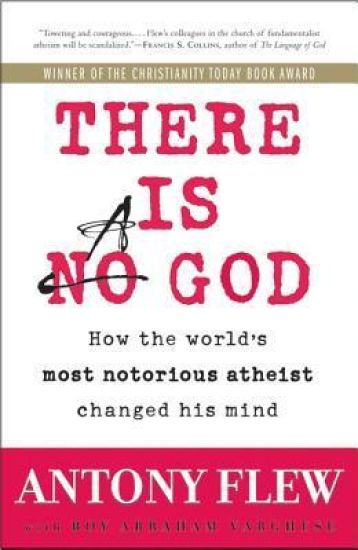
There Is a God

There Is a God

Antony Flew; Roy Abraham Varghese

HarperOne
2008
nidottu

Halvin toimitettuna 20,10 €

A wave of modern atheists have taken center stage and brought the long-standing debate about the existence of God back into the headlines. Spearheaded by Richard Dawkins, Sam Harris, and Christopher Hitchens, this 'new atheism' has found a powerful place in today's culture wars. Although this movement has been billed as 'new,' the foundation of its argument is indebted to philosopher Antony Flew and his groundbreaking paper "Theology and Falsification," the most widely reprinted philosophical publication of the last five decades. Flew built his highly acclaimed academic career publicly debunking the existence of God. But, now the renowned philosopher has arrived at the opposite conclusion and officially joined the other side. With refreshing openness to argument and an absence of the anger and hostility that have been hallmarks of the 'new atheism,' Flew shows how his commitment to following the argument wherever it leads resulted, to his own astonishment, in his conversion to belief in a creator God. Certain to be read and discussed for years to come, "There Is a God" will forever change the debate about the existence of God.
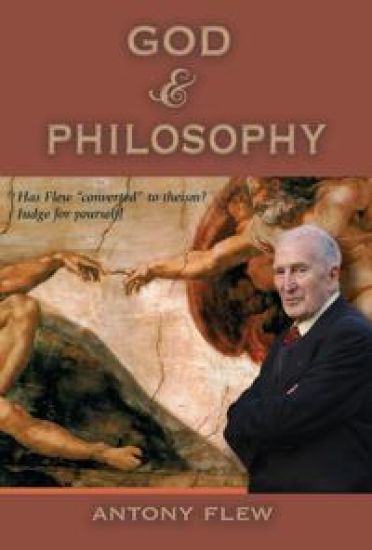
God & Philosophy

God & Philosophy

Antony Flew

Prometheus Books
2005
pokkari
In this classic primer to the philosophy of religion, Antony Flew subjects a wide range of philosophical arguments for the existence of the Christian God to intense critical scrutiny. However, the rumour in some circles is that Flew - long-time advocate of atheistic humanism - has become a theist. Judge for yourself.
Crime, Punishment and Disease in a Relativistic Universe
In Crime, Punishment and Disease, Antony Flew makes clear both the meaning and the implications carried by the application of the expression "mental disease." He aims to discourage its use in conditions that provide the victims of such diseases with an excuse for failing to perform what would have been their imperative duties had they enjoyed good mental health. Flew attacks the gross over-extensions of the notion of mental disease on both sides of the Atlantic. He defends human dignity and responsibility against the suggestion that we are all, or most of us, "sick, sick, sick." In particular, he challenges the paternalist pretensions of people who claim a right to control and manipulate others because they are allegedly sick, and consequently not responsible for what they do. In a typical ordinary disease, Flew notes, it is the patient who complains of the disease rather than someone else who complains about the patient. But those who claim that some crime or all crime is symptomatic of mental disease and those who identify disorders such as attention/deficit/hyperactivity disorder (ADHD) as conditions requiring psychiatric attention are taking the disfavored behavior rather than the distress of their patients as the warrant for supposedly medical interventions. They should instead first consider how what they propose to call mental disease does, and does not, resemble syphilis, measles, and other communicable diseases. Flew sees his work as complementary to Thomas Szasz's. He applies a philosophical perspective to problems Szasz discusses as a psychiatrist. This work will be of particular interest to students of philosophy and politics, in that it relates modern discussion of mental illness to the Plato of The Republic. Flew also takes note in this context of Samuel Butler's Erewhon. This work will be of direct relevance to criminologists, as well as those interested in social welfare, philosophy of education, and new developments in psychiatry.
Equality in Liberty and Justice

Equality in Liberty and Justice

Antony Flew

Transaction Publishers
2001
nidottu
Equality in Liberty and Justice is an integrated collection of essays in political philosophy, divided into two parts. The first examines (classically) liberal ideas-the ideas of the Founding Fathers of the American republic-and some of the applications and the rejections of such ideas in our contemporary world. Among other questions about liberty and responsibility it considers, in the context of the imprisonment and psychiatric treatment of dissidents in the psychiatric hospitals of the former Soviet Union, Plato's suggestion that all delinquency is an expression of mental disease. The second part examines the relations and the lack of relations between old fashioned, without prefix or suffix, justice and what is called by its promoters social justice. It therefore presses such questions as "Equal outcomes or equal justice?" and "Enemies of poverty or of inequality?" Equality in Liberty and Justice was originally published before the winning of the Cold War and the collapse of the Soviet Empire. This second edition updates the arguments of the previous editor and draws present day moral conclusions. This book will appeal to those for whom the classical liberal and conservative debates still have great meaning. Flew might well be the most significant sunthesizer of Tocqueville and Mill.
Merely Mortal?

Merely Mortal?

Antony Flew

Prometheus Books
2001
sidottu
Despite the perennial hope of life beyond the grave, Flew shows that there are insuperable difficulties in elucidating post-mortem survival on a rational basis. He analyses the three ways that philosophers of the past have attempted to get around these difficulties: the 'reconstitutionist way' (miraculous reassembly of our deceased bodies at some future time, such as the Last Judgement); the 'way of the astral body' (a sort of duplicate, undetectable 'body', which detaches itself from the material body after death); and, the 'Platonic-Cartesian way' (an incorporeal mind or soul containing a person's identity which lives on after death). The main problem, says Flew, is the impossibility of logically demonstrating how a person surviving death in any imagined altered state could identify him- or herself as the same person who had previously lived a flesh-and-blood life on the Earth. Flew reviews both the classic arguments of Plato, Aristotle, Aquinas, and Descartes, as well as the modern findings of parapsychology, elucidating this complex issue with logical rigor and engaging wit.
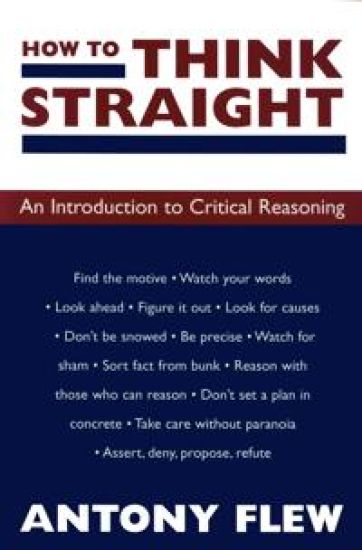
How to Think Straight

How to Think Straight

Antony Flew

Prometheus Books
1998
pokkari
Practical reasoning and clear thinking are essential for everyone if we are to make sense of the information we receive each day. Being able to quickly know the difference between valid and invalid arguments, the contradictory versus the contrary, vagueness and ambiguity, contradiction and self-contradiction, the truthful and the fallacious, separates clear thinkers from the crowd. How to Think Straight lays the foundation for critical reasoning by showing many ways in which our thinking goes awry. Celebrated philosopher Antony Flew entertainingly instructs on the many and varied faults that occur in argument, the power of reason, how to challenge assertions and find evidence, and how not to be persuaded by half-truths. Flew also examines poor reasoning, and why we should be concerned with finding the truth. Lucid, terse, and sensible, with study questions and exercises to help along the way, this enlightening second edition will help you develop the skills necessary to argue and reason effectively by following a few simple, easy-to-remember directions.
Philosophical Essays

Philosophical Essays

Antony Flew; John Shosky

Rowman Littlefield
1998
nidottu
Antony Flew is one of the most well-known and respected philosophers alive today. In Philosophical Essays, twelve of Flew's most significant works are gathered together for the first time, creating a unique and valuable collection. The book begins with a new autobiographical sketch of Flew's life and career. In addition to some of the distinguished scholar's most influential and famous articles, Philosophical Essays includes a number of rare works that have not been available to a wide audience until now. This important book will be an essential addition to the library of any philosopher.
Darwinian Evolution

Darwinian Evolution

Antony Flew

Transaction Publishers
1997
nidottu
In little more than a hundred years the evolutionary theory of Charles Darwin has conquered the thinking world. No other body of ideas has enjoyed such unrivaled success. But precisely because of its scientific status, Darwinism has sometimes been invoked to sustain other ideas and beliefs with a much less solid foundation. Darwinian Evolution is a study of the historical background of Darwin's ideas, of their logical structure, and of their alleged and actual implications. Flew explores the Scottish Enlightenment, an important and often neglected aspect of Darwin's intellectual background. He compares Darwin with such figures as Adam Smith, Thomas Malthus, and Karl Marx, emphasizing not the similarities, but the differences between the natural and social sciences. Flew argues that social science must do what natural science does not: take account of individual choice. He examines the creationist controversy in Britain and the United States and discusses the possibility of a human sociobiology. In his new introduction, Flew updates his book by discussing relevant works that have appeared since it was published thirteen years ago. He discusses two different tendencies among both social scientists and those who develop or promote social policies according to various findings in the social sciences: (1) to assume there is no such thing as human nature; and (2) to take no account of the possibility that differences between sets of individuals may be genetically determined. Flew maintains that both these tendencies violate Darwin's theory. Darwinian Evolution is an intriguing study that should be read by sociologists, biologists, philosophers, and all those interested in the impact of Darwin and his work.