Kirjojen hintavertailu – 12 903 735 kirjaa ja 27 kauppaa

Kirjailija

Archer Jones

Kirjat ja teokset yhdessä paikassa: 9 kirjaa, julkaisuja vuosilta 1988–2000, suosituimpiin kuuluu Why the South Lost the Civil War. Vertaile teosten hintoja ja tarkista saatavuus suomalaisista kirjakaupoista.

9 kirjaa

Kirjojen julkaisuvuodet: 1988–2000.

The Art of War in Western World

The Art of War in Western World

Archer Jones

University of Illinois Press
2000
nidottu

Halvin toimitettuna 35,80 €

The magnum opus of one of America's most respected military historians, The Art of War in the Western World has earned its place as the standard work on how the three major operational components of war--tactics, logistics, and strategy--have evolved and changed over time. This monumental work encompasses 2,500 years of military history, from infantry combat in ancient Greece through the dissolution of the Roman Empire to the Thirty Years' War and from the Napoleonic campaigns through World War II, which Jones sees as the culmination of modern warfare, to the Israeli-Egyptian War of 1973.
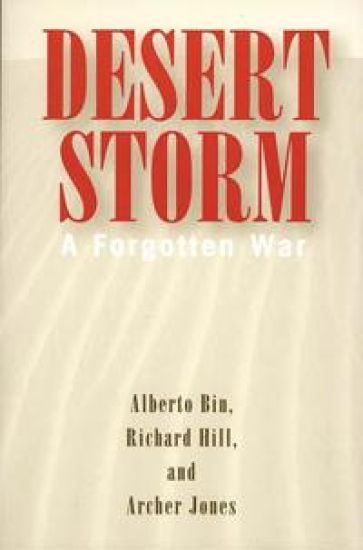
Desert Storm

Desert Storm

Alberto Bin; Richard Hill; Archer Jones

Praeger Publishers Inc
1998
nidottu
This account of the Gulf War reveals its importance from a military and political point of view, highlighting how modern military technology made possible, with relative ease, a victory that would have been nearly impossible by traditional means. It has become fashionable to trivialize the impressive military achievements of the Coatition victory over Iraq, but Bin, Hill, and Jones demonstrate that the Gulf War represents a defining moment in military and political history. The text includes numerous firsthand eyewitness accounts. Readers will discover why a multinational coalition deployed 800,000 soldiers to the Middle East to challenge to the Iraqi invasion of Kuwait. They will find out the truth behind political maneuvering by nations involved in the conflict, as well as those on the sidelines, and they will learn the details of the various weapons systems employed. The authors analyze the aftermath of the war and draw important lessons from it. This book provides an authoritative and provocative review of what will surely be remembered as one of the key events of the last half century.
Desert Storm

Desert Storm

Alberto Bin; Richard Hill; Archer Jones

Praeger Publishers Inc
1998
sidottu
This account of the Gulf War reveals its importance from a military and political point of view, highlighting how modern military technology made possible, with relative ease, a victory that would have been nearly impossible by traditional means. It has become fashionable to trivialize the impressive military achievements of the Coatition victory over Iraq, but Bin, Hill, and Jones demonstrate that the Gulf War represents a defining moment in military and political history. The text includes numerous firsthand eyewitness accounts. Readers will discover why a multinational coalition deployed 800,000 soldiers to the Middle East to challenge to the Iraqi invasion of Kuwait. They will find out the truth behind political maneuvering by nations involved in the conflict, as well as those on the sidelines, and they will learn the details of the various weapons systems employed. The authors analyze the aftermath of the war and draw important lessons from it. This book provides an authoritative and provocative review of what will surely be remembered as one of the key events of the last half century.
The Politics of Command

The Politics of Command

Thomas Lawrence Connelly; Archer Jones

Louisiana State University Press
1998
nidottu
The Politics of Command reevaluates the continual controversy over strategy that occurred between Jefferson Davis and his high command, and within the command itself. Thomas Lawrence Connelly and Archer Jones illustrate how Davis' decisions were affected by officers in the field, politicians, the considerable clout of the western bloc and its network of informal associations, the input of Robert E. Lee, the pressure brought to bear by P. G. T. Beauregard, and Davis' own changing concept of the departmental command system. Connelly and Jones were the first to realize that any significant assessment of Davis' strategy must examine those who influenced him, for his key decisions were products of the politics of command.
Elements of Military Strategy

Elements of Military Strategy

Archer Jones

Praeger Publishers Inc
1996
nidottu
This book uses history in two ways: as the source of ideas about strategy and as examples to illustrate the elements by showing their application to specific campaigns and their utility in understanding the role of strategy in military operations. The focus is on American military campaigns from the American Indian Wars to the War in the Gulf. Those case studies are used to illustrate the strategy behind land, sea, and air campaigns. Over a fifth of the book examines the U. S. war against Japan because it furnishes such fine examples of independent and interdependent operations on land, on the sea, and in the air. The cases studied are not only intended to illustrate strategic ideas but also to show the utility of the author's distinctive approach to organizing military strategy. The book will appeal to military professionals, students of military science, and enthusiasts.
Elements of Military Strategy

Elements of Military Strategy

Archer Jones

Praeger Publishers Inc
1996
sidottu
This book uses history in two ways: as the source of ideas about strategy and as examples to illustrate the elements by showing their application to specific campaigns and their utility in understanding the role of strategy in military operations. The focus is on American military campaigns from the American Indian Wars to the War in the Gulf. Those case studies are used to illustrate the strategy behind land, sea, and air campaigns. Over a fifth of the book examines the U. S. war against Japan because it furnishes such fine examples of independent and interdependent operations on land, on the sea, and in the air. The cases studied are not only intended to illustrate strategic ideas but also to show the utility of the author's distinctive approach to organizing military strategy. The book will appeal to military professionals, students of military science, and enthusiasts.
How the North Won

How the North Won

HERMAN HATTAWAY; Archer Jones

University of Illinois Press
1991
nidottu
From the introduction: “To those unacquainted with military history, [this book] provides an elementary, instructive, and readable military account of the American Civil War. The basic concepts of war, its conduct, management, and support, are thoroughly explained and explicitly applied throughout in order to make clear what many authors often incorrectly take for granted that readers already know. . . . We have tried to tell the military history of the war from the viewpoint of the higher commanders on both sides. We therefore emphasize strategy and logistics rather than tactics. . . . Strategy, management, and execution weigh more than superior numbers and resources in dictating the outcomes of wars, and the Civil War is no exception. The weaker side can win; the South almost did.”
The Elements of Confederate Defeat

The Elements of Confederate Defeat

Richard E. Beringer; Herman Hattaway; Archer Jones; William N. Still

University of Georgia Press
1988
pokkari
In Why the South Lost the Civil War, four historians considered the dominant explanations of southern defeat. At end, the authors found that states' rights disputes, the Union blockade, and inadequate southern forces did not fully account for the surrender. Rather, they concluded, the South lacked the will to win. Its strength sapped by a faltering Confederate nationalism and weakened by a peculiar brand of evangelical Protestantism, the South withdrew from a war not yet lost on the field of battle. Roughly one-half the size of its parent study, The Elements of Confederate Defeat retains all the essential arguments of the earlier edition, forming for the student a book that at once follows the events of the war and presents the major interpretations of its outcome in the South.