Kirjojen hintavertailu – 12 859 827 kirjaa ja 27 kauppaa

Kirjailija

Ariel Rubinstein

Kirjat ja teokset yhdessä paikassa: 19 kirjaa, julkaisuja vuosilta 1994–2024, suosituimpiin kuuluu No Prices No Games!: Four Economic Models. Vertaile teosten hintoja ja tarkista saatavuus suomalaisista kirjakaupoista.

19 kirjaa

Kirjojen julkaisuvuodet: 1994–2024.

No Prices No Games!: Four Economic Models

No Prices No Games!: Four Economic Models

Michael Richter; Ariel Rubinstein

Open Book Publishers
2024
sidottu
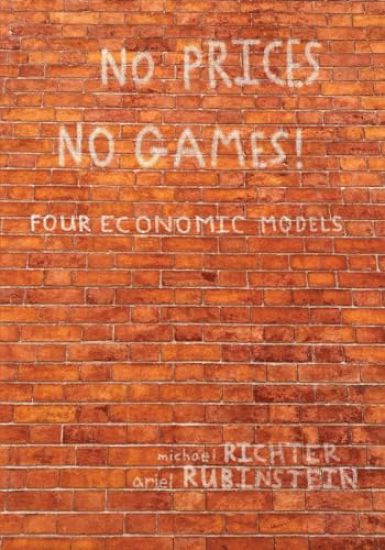
While current economic theory focuses on prices and games, this book models economic settings where harmony is established through one of the following societal conventions: - A power relation according to which stronger agents are able to force weaker ones to do things against their will.- A norm that categorizes actions as permissible or forbidden.- A status relation over alternatives which limits each agent's choices.- Systematic biases in agents' preferences. These four conventions are analysed using simple and mathematically straightforward models, without any pretensions regarding direct applied usefulness. While we do not advocate for the adoption of any of these conventions specifically - we do advocate that when modelling an economic situation, alternative equilibrium notions should be considered, rather than automatically reaching for the familiar approaches of prices or games.
No Prices No Games!: Four Economic Models

No Prices No Games!: Four Economic Models

Michael Richter; Ariel Rubinstein

Open Book Publishers
2024
nidottu
While current economic theory focuses on prices and games, this book models economic settings where harmony is established through one of the following societal conventions: - A power relation according to which stronger agents are able to force weaker ones to do things against their will.- A norm that categorizes actions as permissible or forbidden.- A status relation over alternatives which limits each agent's choices.- Systematic biases in agents' preferences. These four conventions are analysed using simple and mathematically straightforward models, without any pretensions regarding direct applied usefulness. While we do not advocate for the adoption of any of these conventions specifically - we do advocate that when modelling an economic situation, alternative equilibrium notions should be considered, rather than automatically reaching for the familiar approaches of prices or games.
No Prices No Games!: Four Economic Models

No Prices No Games!: Four Economic Models

Michael Richter; Ariel Rubinstein

Open Book Publishers
2024
nidottu
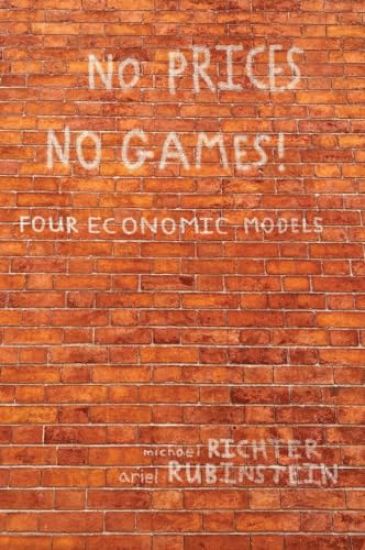
While current economic theory focuses on prices and games, this book models economic settings where harmony is established through one of the following societal conventions: -A power relation according to which stronger agents are able to force weaker ones to do things against their will.-A norm that categorizes actions as permissible or forbidden.-A status relation over alternatives which limits each agent's choices.-Systematic biases in agents' preferences. These four conventions are analysed using simple and mathematically straightforward models, without any pretensions regarding direct applied usefulness. While we do not advocate for the adoption of any of these conventions specifically - we do advocate that when modelling an economic situation, alternative equilibrium notions should be considered, rather than automatically reaching for the familiar approaches of prices or games.
No Prices No Games!: Four Economic Models

No Prices No Games!: Four Economic Models

Michael Richter; Ariel Rubinstein

Open Book Publishers
2024
sidottu
While current economic theory focuses on prices and games, this book models economic settings where harmony is established through one of the following societal conventions: -A power relation according to which stronger agents are able to force weaker ones to do things against their will.-A norm that categorizes actions as permissible or forbidden.-A status relation over alternatives which limits each agent's choices.-Systematic biases in agents' preferences. These four conventions are analysed using simple and mathematically straightforward models, without any pretensions regarding direct applied usefulness. While we do not advocate for the adoption of any of these conventions specifically - we do advocate that when modelling an economic situation, alternative equilibrium notions should be considered, rather than automatically reaching for the familiar approaches of prices or games.
Models in Microeconomic Theory

Models in Microeconomic Theory

Martin Osborne; Ariel Rubinstein

Open Book Publishers
2020
pokkari

Halvin toimitettuna 75,70 €

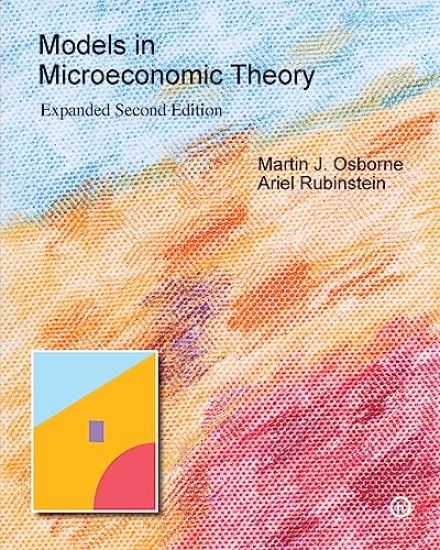
Models in Microeconomic Theory covers basic models in current microeconomic theory. Part I (Chapters 1-7) presents models of an economic agent, discussing abstract models of preferences, choice, and decision making under uncertainty, before turning to models of the consumer, the producer, and monopoly. Part II (Chapters 8-14) introduces the concept of equilibrium, beginning, unconventionally, with the models of the jungle and an economy with indivisible goods, and continuing with models of an exchange economy, equilibrium with rational expectations, and an economy with asymmetric information. Part III (Chapters 15-16) provides an introduction to game theory, covering strategic and extensive games and the concepts of Nash equilibrium and subgame perfect equilibrium. Part IV (Chapters 17-20) gives a taste of the topics of mechanism design, matching, the axiomatic analysis of economic systems, and social choice. The book focuses on the concepts of model and equilibrium. It states models and results precisely, and provides proofs for all results. It uses only elementary mathematics (with almost no calculus), although many of the proofs involve sustained logical arguments. It includes about 150 exercises. With its formal but accessible style, this textbook is designed for undergraduate students of microeconomics at intermediate and advanced levels. Throughout this book, the pronouns she/her are used.
Models in Microeconomic Theory

Models in Microeconomic Theory

Martin Osborne; Ariel Rubinstein

Open Book Publishers
2020
sidottu
Models in Microeconomic Theory covers basic models in current microeconomic theory. Part I (Chapters 1-7) presents models of an economic agent, discussing abstract models of preferences, choice, and decision making under uncertainty, before turning to models of the consumer, the producer, and monopoly. Part II (Chapters 8-14) introduces the concept of equilibrium, beginning, unconventionally, with the models of the jungle and an economy with indivisible goods, and continuing with models of an exchange economy, equilibrium with rational expectations, and an economy with asymmetric information. Part III (Chapters 15-16) provides an introduction to game theory, covering strategic and extensive games and the concepts of Nash equilibrium and subgame perfect equilibrium. Part IV (Chapters 17-20) gives a taste of the topics of mechanism design, matching, the axiomatic analysis of economic systems, and social choice. The book focuses on the concepts of model and equilibrium. It states models and results precisely, and provides proofs for all results. It uses only elementary mathematics (with almost no calculus), although many of the proofs involve sustained logical arguments. It includes about 150 exercises. With its formal but accessible style, this textbook is designed for undergraduate students of microeconomics at intermediate and advanced levels. Throughout this book, the pronouns he/his are used.
Models in Microeconomic Theory

Models in Microeconomic Theory

Martin Osborne; Ariel Rubinstein

Open Book Publishers
2020
pokkari

Halvin toimitettuna 57,80 €

Models in Microeconomic Theory covers basic models in current microeconomic theory. Part I (Chapters 1-7) presents models of an economic agent, discussing abstract models of preferences, choice, and decision making under uncertainty, before turning to models of the consumer, the producer, and monopoly. Part II (Chapters 8-14) introduces the concept of equilibrium, beginning, unconventionally, with the models of the jungle and an economy with indivisible goods, and continuing with models of an exchange economy, equilibrium with rational expectations, and an economy with asymmetric information. Part III (Chapters 15-16) provides an introduction to game theory, covering strategic and extensive games and the concepts of Nash equilibrium and subgame perfect equilibrium. Part IV (Chapters 17-20) gives a taste of the topics of mechanism design, matching, the axiomatic analysis of economic systems, and social choice. The book focuses on the concepts of model and equilibrium. It states models and results precisely, and provides proofs for all results. It uses only elementary mathematics (with almost no calculus), although many of the proofs involve sustained logical arguments. It includes about 150 exercises. With its formal but accessible style, this textbook is designed for undergraduate students of microeconomics at intermediate and advanced levels. Throughout this book, the pronouns he/his are used.
Models Of Bounded Rationality And Mechanism Design

Models Of Bounded Rationality And Mechanism Design

Ariel Rubinstein; Jacob Glazer

World Scientific Publishing Co Pte Ltd
2016
sidottu
This book brings together the authors' joint papers from over a period of more than twenty years. The collection includes seven papers, each of which presents a novel and rigorous model in Economic Theory. All of the models are within the domain of implementation and mechanism design theories. These theories attempt to explain how incentive schemes and organizations can be designed with the goal of inducing agents to behave according to the designer's (principal's) objectives. Most of the literature assumes that agents are fully rational. In contrast, the authors inject into each model an element which conflicts with the standard notion of full rationality, demonstrating how such elements can dramatically change the mechanism design problem. Although all of the models presented in this volume touch on mechanism design issues, it is the formal modeling of bounded rationality that the authors are most interested in. A model of bounded rationality signifies a model that contains a procedural element of reasoning that is not consistent with full rationality. Rather than looking for a canonical model of bounded rationality, the articles introduce a variety of modeling devices that will capture procedural elements not previously considered, and which alter the analysis of the model. The book is a journey into the modeling of bounded rationality. It is a collection of modeling ideas rather than a general alternative theory of implementation.
Lecture Notes in Microeconomic Theory

Lecture Notes in Microeconomic Theory

Ariel Rubinstein

Princeton University Press
2012
pokkari
This book presents Ariel Rubinstein's lecture notes for the first part of his well-known graduate course in microeconomics. Developed during the fifteen years that Rubinstein taught the course at Tel Aviv University, Princeton University, and New York University, these notes provide a critical assessment of models of rational economic agents, and are an invaluable supplement to any primary textbook in microeconomic theory. In this fully revised and expanded second edition, Rubinstein retains the striking originality and deep simplicity that characterize his famously engaging style of teaching. He presents these lecture notes with a precision that gets to the core of the material, and he places special emphasis on the interpretation of key concepts. Rubinstein brings this concise book thoroughly up to date, covering topics like modern choice theory and including dozens of original new problems. Written by one of the world's most respected and provocative economic theorists, this second edition of Lecture Notes in Microeconomic Theory is essential reading for students, teachers, and research economists. * Fully revised, expanded, and updated * Retains the engaging style and method of Rubinstein's well-known lectures * Covers topics like modern choice theory * Features numerous original new problems--including 21 new review problems * Solutions manual (available only to teachers) can be found at: http://gametheory.tau.ac.il/microTheory/.
Theory of Games and Economic Behavior

Theory of Games and Economic Behavior

John von Neumann; Oskar Morgenstern; Ariel Rubinstein

Princeton University Press
2007
pokkari
This is the classic work upon which modern-day game theory is based. What began more than sixty years ago as a modest proposal that a mathematician and an economist write a short paper together blossomed, in 1944, when Princeton University Press published Theory of Games and Economic Behavior. In it, John von Neumann and Oskar Morgenstern conceived a groundbreaking mathematical theory of economic and social organization, based on a theory of games of strategy. Not only would this revolutionize economics, but the entirely new field of scientific inquiry it yielded--game theory--has since been widely used to analyze a host of real-world phenomena from arms races to optimal policy choices of presidential candidates, from vaccination policy to major league baseball salary negotiations. And it is today established throughout both the social sciences and a wide range of other sciences. This sixtieth anniversary edition includes not only the original text but also an introduction by Harold Kuhn, an afterword by Ariel Rubinstein, and reviews and articles on the book that appeared at the time of its original publication in the New York Times, tthe American Economic Review, and a variety of other publications. Together, these writings provide readers a matchless opportunity to more fully appreciate a work whose influence will yet resound for generations to come.
Economics and Language

Economics and Language

Ariel Rubinstein

Cambridge University Press
2000
pokkari
Arising out of the author's lifetime fascination with the links between the formal language of mathematical models and natural language, this short book comprises five essays investigating both the economics of language and the language of economics. Ariel Rubinstein touches the structure imposed on binary relations in daily language, the evolutionary development of the meaning of words, game-theoretical considerations of pragmatics, the language of economic agents and the rhetoric of game theory. These short essays are full of challenging ideas for social scientists that should help to encourage a fundamental rethinking of many of the underlying assumptions in economic theory and game theory. As a postscript two economists, Tilman Borgers (University College London) and Bart Lipman (University of Wisconsin, Madison), and a logician, Johan van Benthem (University of Amsterdam, Institute for Logic, Language and Computation and Stanford University, Center for the Study of Language and Information) offer comments.
Economics and Language

Economics and Language

Ariel Rubinstein

Cambridge University Press
2000
sidottu
Arising out of the author’s lifetime fascination with the links between the formal language of mathematical models and natural language, this short book comprises five essays investigating both the economics of language and the language of economics. Ariel Rubinstein touches the structure imposed on binary relations in daily language, the evolutionary development of the meaning of words, game-theoretical considerations of pragmatics, the language of economic agents and the rhetoric of game theory. These short essays are full of challenging ideas for social scientists that should help to encourage a fundamental rethinking of many of the underlying assumptions in economic theory and game theory. As a postscript two economists, Tilman Borgers (University College London) and Bart Lipman (University of Wisconsin, Madison), and a logician, Johan van Benthem (University of Amsterdam, Institute for Logic, Language and Computation and Stanford University, Center for the Study of Language and Information) offer comments.
A Course in Game Theory

A Course in Game Theory

Martin J. Osborne; Ariel Rubinstein

MIT Press
1994
pokkari
A Course in Game Theory presents the main ideas of game theory at a level suitable for graduate students and advanced undergraduates, emphasizing the theory's foundations and interpretations of its basic concepts. The authors provide precise definitions and full proofs of results, sacrificing generalities and limiting the scope of the material in order to do so. The text is organized in four parts: strategic games, extensive games with perfect information, extensive games with imperfect information, and coalitional games. It includes over 100 exercises.