Kirjojen hintavertailu – 12 903 725 kirjaa ja 27 kauppaa
Kirjailija
Armand Borel
Kirjat ja teokset yhdessä paikassa: 15 kirjaa, julkaisuja vuosilta 1961–2019, suosituimpiin kuuluu Cohomologie des espaces localement compacts d'apres J. Leray. Vertaile teosten hintoja ja tarkista saatavuus suomalaisista kirjakaupoista.
Fifty years after it was first published, Armand Borel's Introduction aux groupes arithmetiques continues to be very important for the theory of arithmetic groups. In particular, Chapter III of the book remains the standard reference for fundamental results on reduction theory.
Armand Borel’s mathematical work centered on the theory of Lie groups. Because of the increasingly important place of this theory in the whole of mathematics, Borel’s work influenced some of the most important developments of contemporary mathematics. His first great achievement was to apply to Lie groups and homogenous spaces the powerful techniques of algebraic topology developed by Leray, Cartan and Steenrod. In 1992, Borel was awarded the International Balzan Prize for Mathematics "for his fundamental contributions to the theory of Lie groups, algebraic groups and arithmetic groups and for his indefatigable action in favor of high quality in mathematical research and of the propagation of new ideas." He wrote more than 145 articles before 1982, which were collected in three volumes published in 1983. A fourth volume of subsequent articles was published in 2001. Volume III collects the papers written from 1969 to 1982.
Armand Borel’s mathematical work centered on the theory of Lie groups. Because of the increasingly important place of this theory in the whole of mathematics, Borel’s work influenced some of the most important developments of contemporary mathematics. His first great achievement was to apply to Lie groups and homogenous spaces the powerful techniques of algebraic topology developed by Leray, Cartan and Steenrod. In 1992, Borel was awarded the International Balzan Prize for Mathematics "for his fundamental contributions to the theory of Lie groups, algebraic groups and arithmetic groups, and for his indefatigable action in favor of high quality in mathematical research and of the propagation of new ideas." He wrote more than 145 articles before 1982, which were collected in three volumes published in 1983. A fourth volume of subsequent articles was published in 2001. Volume II collects the papers written from 1959 to 1968.
This book collects the papers published by A. Borel from 1983 to 1999. About half of them are research papers, written on his own or in collaboration, on various topics pertaining mainly to algebraic or Lie groups, homogeneous spaces, arithmetic groups (L2-spectrum, automorphic forms, cohomology and covolumes), L2-cohomology of symmetric or locally symmetric spaces, and to the Oppenheim conjecture. Other publications include surveys and personal recollections (of D. Montgomery, Harish-Chandra, and A. Weil), considerations on mathematics in general and several articles of a historical nature: on the School of Mathematics at the Institute for Advanced Study, on N. Bourbaki and on selected aspects of the works of H. Weyl, C. Chevalley, E. Kolchin, J. Leray, and A. Weil. The book concludes with an essay on H. Poincaré and special relativity. Some comments on, and corrections to, a number of papers have also been added.
This book is a revised and enlarged edition of "Linear Algebraic Groups", published by W. A. Benjamin in 1969. The text of the first edition has been corrected and revised. Accordingly, this book presents foundational material on algebraic groups, Lie algebras, transformation spaces, and quotient spaces. After establishing these basic topics, the text then turns to solvable groups, general properties of linear algebraic groups and Chevally's structure theory of reductive groups over algebraically closed groundfields. The remainder of the book is devoted to rationality questions over non-algebraically closed fields. This second edition has been expanded to include material on central isogenies and the structure of the group of rational points of an isotropic reductive group. The main prerequisite is some familiarity with algebraic geometry. The main notions and results needed are summarized in a chapter with references and brief proofs.
This book provides an introduction to some aspects of the analytic theory of automorphic forms on G=SL2(R) or the upper-half plane X, with respect to a discrete subgroup G of G of finite covolume. The point of view is inspired by the theory of infinite dimensional unitary representations of G; this is introduced in the last sections, making this connection explicit. The topics treated include the construction of fundamental domains, the notion of automorphic form on G\G and its relationship with the classical automorphic forms on X, Poincare series, constant terms, cusp forms, finite dimensionality of the space of automorphic forms of a given type, compactness of certain convolution operators, Eisenstein series, unitary representations of G, and the spectral decomposition of L2 (G\G). The main prerequisites are some results in functional analysis (reviewed, with references) and some familiarity with the elementary theory of Lie groups and Lie algebras. Graduate students and researchers in analytic number theory will find much to interest them in this book.
This volume contains the Notes of a seminar on Intersection Ho- logy which met weekly during the Spring 1983 at the University of Bern, Switzerland. Its main purpose was to give an introduction to the pie- wise linear and sheaf theoretic aspects of the theory Goresky and R. MacPherson, Topology 19(1980) 135-162, Inv. Math. 72(1983) 17-130) and to some of its applications, for an audience assumed to have some familiarity with algebraic topology and sheaf theory. These Notes can be divided roughly into three parts. The first one to is chiefly devoted to the piecewise linear version of the theory: In A. Haefliger describes intersection homology in the piecewise linear context; II, by N. Habegger, prepares the transition to the sheaf theoretic point of view and III, by M. Goresky and R. Mac- Pherson, provides an example of computation of intersection homology. The spaces on which intersection homology is defined are assumed to admit topological stratifications with strong local triviality p- perties (cf I or V). Chapter IV, by N. A'Campo, gives some indications on how the existence of such stratifications is proved on complex analytic spaces. The primary goal of V is to describe intersection homology, or rather cohomology, in the framework of sheaf theory and to prove its main basic properties, following the second paper quoted above. Fa- liarity with standard sheaf theory, as in Godement's book, is assumed.
Noncompact symmetric and locally symmetric spaces naturally appear in many mathematical theories, including analysis (representation theory, nonabelian harmonic analysis), number theory (automorphic forms), algebraic geometry (modulae) and algebraic topology (cohomology of discrete groups). In most applications it is necessary to form an appropriate compactification of the space. The literature dealing with such compactifications is vast. The main purpose of this book is to introduce uniform constructions of most of the known compactifications with emphasis on their geometric and topological structures. The book is divided into three parts. Part I studies compactifications of Riemannian symmetric spaces and their arithmetic quotients. Part II is a study of compact smooth manifolds. Part III studies the compactification of locally symmetric spaces. Familiarity with the theory of semisimple Lie groups is assumed, as is familiarity with algebraic groups defined over the rational numbers in later parts of the book, although most of the pertinent material is recalled as presented. Otherwise, the book is a self-contained reference aimed at graduate students and research mathematicians interested in the applications of Lie theory and representation theory to diverse fields of mathematics.
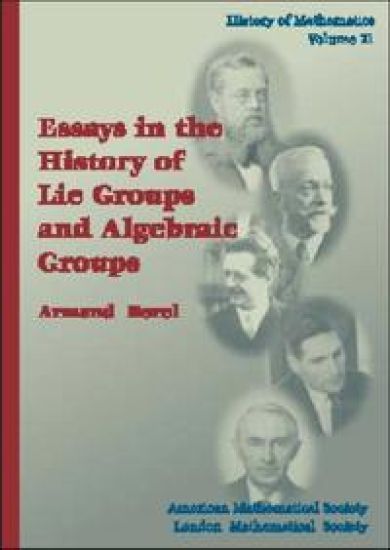
Algebraic groups and Lie groups are important in most major areas of mathematics, occuring in diverse roles such as the symmetries of differential equations and as central figures in the Langlands program for number theory. In this book, Professor Borel looks at the development of the theory of Lie groups and algebraic groups, highlighting the evolution from the almost purely local theory at the start to the global theory that we know today. As the starting point of this passage from local to global, the author takes Lie's theory of local analytic transformation groups and Lie algebras. He then follows the globalization of the process in its two most important frameworks: (transcendental) differential geometry and algebraic geometry. Chapters II to IV are devoted to the former, Chapters V to VIII, to the latter. The essays in the first part of the book survey various proofs of the full reducibility of linear representations of $SL 2M$, the contributions H. Weyl to representation and invariant theory for Lie groups, and conclude with a chapter on E. Cartan's theory of symmetric spaces and Lie groups in the large. The second part of the book starts with Chapter V describing the development of the theory of linear algebraic groups in the 19th century. Many of the main contributions here are due to E. Study, E. Cartan, and above all, to L. Maurer. After being abandoned for nearly 50 years, the theory was revived by Chevalley and Kolchin and then further developed by many others. This is the focus of Chapter VI. The book concludes with two chapters on various aspects of the works of Chevalley on Lie groups and algebraic groups and Kolchin on algebraic groups and the Galois theory of differential fields. The author brings a unique perspective to this study. As an important developer of some of the modern elements of both the differential geometric and the algebraic geometric sides of the theory, he has a particularly deep appreciation of the underlying mathematics. His lifelong involvement and his historical research in the subject give him a special appreciation of the story of its development.
This book provides an introduction to some aspects of the analytic theory of automorphic forms on G=SL2(R) or the upper-half plane X, with respect to a discrete subgroup G of G of finite covolume. The point of view is inspired by the theory of infinite dimensional unitary representations of G; this is introduced in the last sections, making this connection explicit. The topics treated include the construction of fundamental domains, the notion of automorphic form on G\G and its relationship with the classical automorphic forms on X, Poincare series, constant terms, cusp forms, finite dimensionality of the space of automorphic forms of a given type, compactness of certain convolution operators, Eisenstein series, unitary representations of G, and the spectral decomposition of L2 (G\G). The main prerequisites are some results in functional analysis (reviewed, with references) and some familiarity with the elementary theory of Lie groups and Lie algebras. Graduate students and researchers in analytic number theory will find much to interest them in this book.