Kirjojen hintavertailu – 12 903 733 kirjaa ja 27 kauppaa

Kirjailija

Armand Mattelart

Kirjat ja teokset yhdessä paikassa: 16 kirjaa, julkaisuja vuosilta 1977–2019, suosituimpiin kuuluu Multinacionales y Sistemas de Comunicacion. Los Aparatos Ideologicos del Imperialismo. Vertaile teosten hintoja ja tarkista saatavuus suomalaisista kirjakaupoista.

16 kirjaa

Kirjojen julkaisuvuodet: 1977–2019.

How to Read Donald Duck

How to Read Donald Duck

Ariel Dorfman; Armand Mattelart

Pluto Press
2019
pokkari

Halvin toimitettuna 23,30 €

First published in 1971, How to Read Donald Duck shocked readers by revealing how capitalist ideology operates in our most beloved cartoons. Having survived bonfires, impounding and being dumped into the ocean by the Chilean army, this controversial book is once again back on our shelves. Written and published during the blossoming of Salvador Allende's revolutionary socialism, the book examines how Disney comics not only reflect capitalist ideology, but are active agents working in this ideology's favour. Focusing on the hapless mice and ducks of Disney, curiously parentless, marginalised and always short of cash, Ariel Dorfman and Armand Mattelart expose how these characters established hegemonic ideas about capital, race, gender and the relationship between developed countries and the Third World. A devastating indictment of a media giant, a document of twentieth-century political upheaval, and a reminder of the dark undercurrent of pop culture, How to Read Donald Duck is once again available, together with a new introduction by Ariel Dorfman.

How to Read Donald Duck

How to Read Donald Duck

Ariel Dorfman; Armand Mattelart

Pluto Press
2019
sidottu
First published in 1971, How to Read Donald Duck shocked readers by revealing how capitalist ideology operates in our most beloved cartoons. Having survived bonfires, impounding and being dumped into the ocean by the Chilean army, this controversial book is once again back on our shelves. Written and published during the blossoming of Salvador Allende's revolutionary socialism, the book examines how Disney comics not only reflect capitalist ideology, but are active agents working in this ideology's favour. Focusing on the hapless mice and ducks of Disney, curiously parentless, marginalised and always short of cash, Ariel Dorfman and Armand Mattelart expose how these characters established hegemonic ideas about capital, race, gender and the relationship between developed countries and the Third World. A devastating indictment of a media giant, a document of twentieth-century political upheaval, and a reminder of the dark undercurrent of pop culture, How to Read Donald Duck is once again available, together with a new introduction by Ariel Dorfman.

Advertising International

Advertising International

Armand Mattelart

Routledge
2017
sidottu
A survey of the changes in the advertising industry in the last twenty years including coverage of the emergence of international conglomerates and the diversification of the agencies into public relations and media buying.
The Globalization of Surveillance

The Globalization of Surveillance

Armand Mattelart

Polity Press
2010
nidottu
Video surveillance, public records, fingerprints, hidden microphones, RFID chips: in contemporary societies the intrusive techniques of surveillance used in daily life have increased dramatically. The “war against terror” has only exacerbated this trend, creating a world that is closer than one might have imagined to that envisaged by George Orwell in 1984. How have we reached this situation? Why have democratic societies accepted that their rights and freedoms should be taken away, a little at a time, by increasingly sophisticated mechanisms of surveillance? From the anthropometry of the 19th Century to the Patriot Act, through an analysis of military theory and the Echelon Project, Armand Mattelart constructs a genealogy of this new power of control and examines its globalising dynamic. This book provides an essential wake-up call at a time when democratic societies are becoming less and less vigilant against the dangers of proliferating systems of surveillance.
The Globalization of Surveillance

The Globalization of Surveillance

Armand Mattelart

Polity Press
2010
sidottu
Video surveillance, public records, fingerprints, hidden microphones, RFID chips: in contemporary societies the intrusive techniques of surveillance used in daily life have increased dramatically. The “war against terror” has only exacerbated this trend, creating a world that is closer than one might have imagined to that envisaged by George Orwell in 1984. How have we reached this situation? Why have democratic societies accepted that their rights and freedoms should be taken away, a little at a time, by increasingly sophisticated mechanisms of surveillance? From the anthropometry of the 19th Century to the Patriot Act, through an analysis of military theory and the Echelon Project, Armand Mattelart constructs a genealogy of this new power of control and examines its globalising dynamic. This book provides an essential wake-up call at a time when democratic societies are becoming less and less vigilant against the dangers of proliferating systems of surveillance.
The Information Society

The Information Society

Armand Mattelart

SAGE Publications Inc
2003
nidottu
The impact of the `information society' are multiform and transdisciplinary. There are few areas of social, political and economic life that have not been affected or challenged by the new technologies of information and communication. In this short introduction, Armand Mattelart unpacks the notion of the information society, and examines why it has become the dominant paradigm for social change in the 21st Century. Critically, he also asks why the notion has come to dominant in the absence of any critical examination of the conditions under which it has been produced. Combining a long-term historical and geopolitical perspective, Mattelart questions the axioms used to legitimate the Information Society and critically assesses the ways in which it has been conceptualised as a theoretical concept as well as policy making tool. This introduction will be of interest to all students of media and communication, as well as social scientists in general.
The Information Society

The Information Society

Armand Mattelart

SAGE Publications Inc
2003
sidottu
The impact of the `information society' are multiform and transdisciplinary. There are few areas of social, political and economic life that have not been affected or challenged by the new technologies of information and communication. In this short introduction, Armand Mattelart unpacks the notion of the information society, and examines why it has become the dominant paradigm for social change in the 21st Century. Critically, he also asks why the notion has come to dominant in the absence of any critical examination of the conditions under which it has been produced. Combining a long-term historical and geopolitical perspective, Mattelart questions the axioms used to legitimate the Information Society and critically assesses the ways in which it has been conceptualised as a theoretical concept as well as policy making tool. This introduction will be of interest to all students of media and communication, as well as social scientists in general.
Networking the World, 1794-2000

Networking the World, 1794-2000

Armand Mattelart

University of Minnesota Press
2000
nidottu
In the age of satellites and the Internet, worldwide communication has become increasingly unified amid overblown claims about the redemptive possibilities of international networks. But this rhetoric is hardly new. As Armand Mattelart demonstrates in Networking the World, 1794-2000, globalization and its attendant hype have existed since road and rail were the fastest way to move information. Mattelart plates contemporary global communication networks into historical context and shows that the networking of the world began much earlier than many assume, in the late eighteenth century. He argues that the internationalization of communication was spawned by such Enlightenment ideals as universalism and liberalism, and examines how the development of global communications has been inextricably linked to the industrial revolution, modern warfare, and the emergence of nationalism. Throughout, Mattelart eloquently argues that discourses of better living through globalization often mask projects of political, economic, and cultural domination.
Theories of Communication

Theories of Communication

Armand Mattelart; Michele Mattelart

SAGE Publications Inc
1998
sidottu
This textbook provides students with a concise introduction to the development of communication theory. Written in an engaging style, it offers an account of the development of all the major theoretical approaches in communication and media studies. The book summarizes clearly and methodically the range of existing theories; explains how and why the diverse currents and schools of thought emerged; and contextualizes all the major approaches, including those of cultural studies and political economy, in their historical, social and intellectual setting. Theories of Communication is an essential text for all students of media, communication and cultural studies. It will also be welcomed by anyone seeking to understand the changes that have accompanied the rise of the so-called `information society'.
Theories of Communication

Theories of Communication

Armand Mattelart; Michele Mattelart

SAGE Publications Inc
1998
nidottu
This textbook provides students with a concise introduction to the development of communication theory. Written in an engaging style, it offers an account of the development of all the major theoretical approaches in communication and media studies. The book summarizes clearly and methodically the range of existing theories; explains how and why the diverse currents and schools of thought emerged; and contextualizes all the major approaches, including those of cultural studies and political economy, in their historical, social and intellectual setting. Theories of Communication is an essential text for all students of media, communication and cultural studies. It will also be welcomed by anyone seeking to understand the changes that have accompanied the rise of the so-called `information society'.
Invention Of Communication

Invention Of Communication

Armand Mattelart

University of Minnesota Press
1996
nidottu
A tour of the multiple usages and systems that each historic period puts forth in the name of communication. This genealogy maps the many means by which humans interact - from cataloguing others, to asserting power over them, to working together with them to build new forms of community. Included are topics such as the elaboration of warfare as a logistic; the rise of professional societies of propaganda and national propagation; the history of universal expositions and world fairs; the birth of documentary and film out of physiological investigations in the 19th century; the development of press and the popular novel; and the origins of American social science. The history runs from the circuits of exchange to the circulation of goods, people and messages, from the construction of railroads to the emergence of long-distance communication. The author brings a clarifying perspective to the ideologies and theories that accompany these transformations.
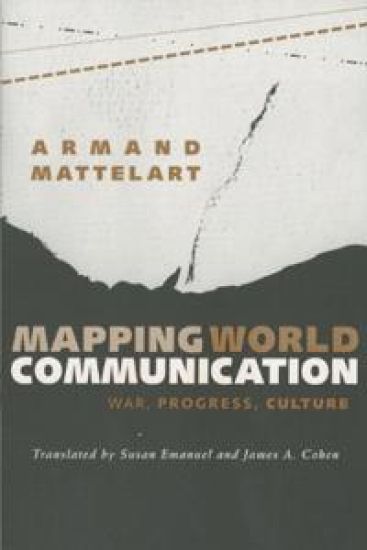
Mapping World Communication

Mapping World Communication

Armand Mattelart

University of Minnesota Press
1994
nidottu
Together, the media and the military have turned the 20th century into a spectacular but deadly show. How precisely this has happened, how it works and why, is the subject of this book. It offers a history of modern communications that exposes the connection between militarism and the evolution of the media industry. In this account, the history of modern media emerges clearly as a history of state control, wielded to discipline internal populations and combat external enemies. Mattelart demonstrates that in such a history, the use of media by the leisure and entertainment industry is only secondary, derivative of a media politics that is statist through and through. The book moves from the rise of the postal stamp to international telegraphy to the world press, and finds in each the traces of government intervention serving the specific needs of belligerency. Armand Mattelart is the author of, among other books, "Multinational Corporations and the Control of Culture", "Advertising International" and "Rethinking Media Theory".
Advertising International

Advertising International

Armand Mattelart

Routledge
1991
nidottu
A survey of the changes in the advertising industry in the last twenty years including coverage of the emergence of international conglomerates and the diversification of the agencies into public relations and media buying.
The Carnival of Images

The Carnival of Images

Michele Mattelart; Armand Mattelart

Praeger Publishers Inc
1990
sidottu
In creating and developing the new genre of the televised novela, a one-hour long dramatic serial, the Brazilian television industry grew, in less than 15 years, from an insignificant player in the international market to one of the largest, most influential in the world. In the first book in English to explore the phenomenon of the telenovela Michele and Armand Mattelart challenge accepted views of the world dominance of United States television and probe the socioeconomic impact of this new genre on a third world country. Using the telenovela and its impact on the medium world-wide, the authors document the important changes in the international circulation of television programs and in the way television is perceived theoretically as a subject of research. The book traces the development of the novela in a country that, in the early 1960s, did not have any nationwide media and later--from 1964 to the 1970s--was ruled by a military dictatorship. It further analyzes the formation of the genre and its mode of production, placing the novela's appearance and development in its cultural, institutional, and economic context. The authors look at the peculiar contradictory relation between the genre's creators and developers--generally left wing intellectuals--and the manipulations required to construct a television industry in a highly competitive marketplace. The book begins with a description of the economic, institutional, and cultural context which produced the genre. It explores the world of soap operas, the development of a national television industry, and the beginnings of an urban consumer society in Brazil. The authors include a valuable and detailed study of the mode of production of the telenovela, placing both the form and content of the genre in their specific economic and institutional context. The book goes on to examine the relationship between the genre and its wider social and cultural environment, explaining its immense popularity and the social function it fulfills. Finally, the authors link the study of Brazilian television to wider debates in media and cultural studies.