Kirjojen hintavertailu – 12 859 819 kirjaa ja 27 kauppaa

Kirjailija

Arne L. Kalleberg

Kirjat ja teokset yhdessä paikassa: 9 kirjaa, julkaisuja vuosilta 1987–2021, suosituimpiin kuuluu Good Jobs, Bad Jobs. Vertaile teosten hintoja ja tarkista saatavuus suomalaisista kirjakaupoista.

Nimi esiintyy myös muodoissa: Arne L Kalleberg

9 kirjaa

Kirjojen julkaisuvuodet: 1987–2021.

Precarious Asia

Precarious Asia

Arne L. Kalleberg; Kevin Hewison; Kwang-Yeong Shin

Stanford University Press
2021
sidottu
Precarious Asia assesses the role of global and domestic factors in shaping precarious work and its outcomes in Japan, South Korea, and Indonesia as they represent a range of Asian political democracies and capitalist economies: Japan and South Korea are now developed and mature economies, while Indonesia remains a lower-middle income country. With their established backgrounds in Asian studies, comparative political economy, social stratification and inequality, and the sociology of work, the authors yield compelling insights into the extent and consequences of precarious work, examining the dynamics underlying its rise. By linking macrostructural policies to both the mesostructure of labor relations and the microstructure of outcomes experienced by individual workers, they reveal the interplay of forces that generate precarious work, and in doing so, synthesize historical and institutional analyses with the political economy of capitalism and class relations. This book reveals how precarious work ultimately contributes to increasingly high levels of inequality and condemns segments of the population to chronic poverty and many more to livelihood and income vulnerability.

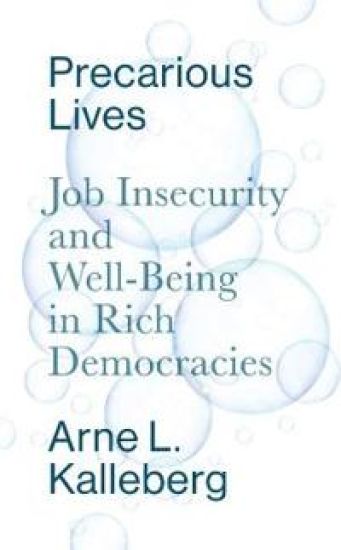
Precarious Lives

Precarious Lives

Arne L. Kalleberg

Polity Press
2018
sidottu
Employment relations in advanced, post-industrial democracies have become increasingly insecure and uncertain as the risks associated with work are being shifted from employers and governments to workers. Arne L. Kalleberg examines the impact of the liberalization of labor markets and welfare systems on the growth of precarious work and job insecurity for indicators of well-being such as economic insecurity, the transition to adulthood, family formation, and happiness, in six advanced capitalist democracies: the United States, the United Kingdom, Germany, Japan, Spain, and Denmark. This insightful cross-national analysis demonstrates how active labor market policies and generous social welfare systems can help to protect workers and give employers latitude as they seek to adapt to the rise of national and global competition and the rapidity of sweeping technological changes. Such policies thereby form elements of a new social contract that offers the potential for addressing many of the major challenges resulting from the rise of precarious work.
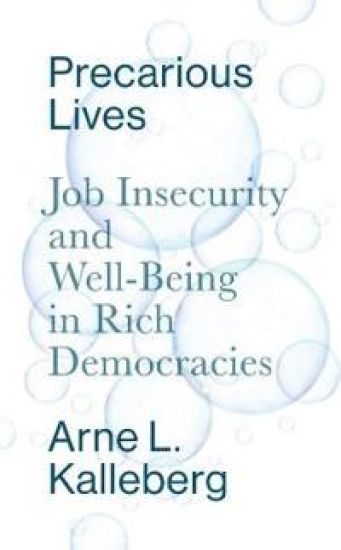
Precarious Lives

Precarious Lives

Arne L. Kalleberg

Polity Press
2018
nidottu

Halvin toimitettuna 32,30 €

Employment relations in advanced, post-industrial democracies have become increasingly insecure and uncertain as the risks associated with work are being shifted from employers and governments to workers. Arne L. Kalleberg examines the impact of the liberalization of labor markets and welfare systems on the growth of precarious work and job insecurity for indicators of well-being such as economic insecurity, the transition to adulthood, family formation, and happiness, in six advanced capitalist democracies: the United States, the United Kingdom, Germany, Japan, Spain, and Denmark. This insightful cross-national analysis demonstrates how active labor market policies and generous social welfare systems can help to protect workers and give employers latitude as they seek to adapt to the rise of national and global competition and the rapidity of sweeping technological changes. Such policies thereby form elements of a new social contract that offers the potential for addressing many of the major challenges resulting from the rise of precarious work.
Work and Industry

Work and Industry

Arne L. Kalleberg; Ivar Berg

Springer-Verlag New York Inc.
2013
nidottu
Work occupies a pivotal role in the daily activities and over the course of a lifetime of members of modern societies. In anticipation, work influ­ ences education and training; it has much to do with shaping current earned income and status in the community; and in retrospect, it influ­ ences retirement income and activities. It is a powerful force affecting personal associations. In our society work is deeply encased in moral and religious values: As Poor Richard says, A Life of Leisure and a Life of Laziness are two Things. Do you imagine that Sloth will afford you more Comfort than Labour? No, for as Poor Richard says: ... Industry gives Comfort, and Plenty and Respect. Study to show thyself approved unto God a workman that needeth not to be ashamed. But few words have as many different meanings and nuances as "work": to forge or to shape, to stir or to knead, to solve, to exploit, to practice trickery for some end, to excite or to provoke, to persuade or to influence, to toil, and the like. A need for precision in meaning is requisite with respect to work, not only in common discourse, but, even more so, in scholarly communication.
Good Jobs, Bad Jobs

Good Jobs, Bad Jobs

Arne L Kalleberg

Russell Sage Foundation
2013
pokkari
The economic boom of the 1990s veiled a grim reality: in addition to the growing gap between rich and poor, the gap between good and bad quality jobs was also expanding. The postwar prosperity of the mid-twentieth century had enabled millions of American workers to join the middle class, but as author Arne L. Kalleberg shows, by the 1970s this upward movement had slowed, in part due to the steady disappearance of secure, well-paying industrial jobs. Ever since, precarious employment has been on the rise--paying low wages, offering few benefits, and with virtually no long-term security. Today, the polarization between workers with higher skill levels and those with low skills and low wages is more entrenched than ever. Good Jobs, Bad Jobs traces this trend to large-scale transformations in the American labor market and the changing demographics of low-wage workers. Kalleberg draws on nearly four decades of survey data, as well as his own research, to evaluate trends in U. S. job quality and suggest ways to improve American labor market practices and social policies. Good Jobs, Bad Jobs provides an insightful analysis of how and why precarious employment is gaining ground in the labor market and the role these developments have played in the decline of the middle class. Kalleberg shows that by the 1970s, government deregulation, global competition, and the rise of the service sector gained traction, while institutional protections for workers--such as unions and minimum-wage legislation--weakened. Together, these forces marked the end of postwar security for American workers. The composition of the labor force also changed significantly; the number of dual-earner families increased, as did the share of the workforce comprised of women, non-white, and immigrant workers. Of these groups, blacks, Latinos, and immigrants remain concentrated in the most precarious and low-quality jobs, with educational attainment being the leading indicator of who will earn the highest wages and experience the most job security and highest levels of autonomy and control over their jobs and schedules. Kalleberg demonstrates, however, that building a better safety net--increasing government responsibility for worker health care and retirement, as well as strengthening unions--can go a long way toward redressing the effects of today's volatile labor market. There is every reason to expect that the growth of precarious jobs--which already make up a significant share of the American job market--will continue. Good Jobs, Bad Jobs deftly shows that the decline in U. S. job quality is not the result of fluctuations in the business cycle, but rather the result of economic restructuring and the disappearance of institutional protections for workers. Only government, employers and labor working together on long-term strategies--including an expanded safety net, strengthened legal protections, and better training opportunities--can help reverse this trend. A Volume in the American Sociological Association's Rose Series in Sociology.
Culture, Control and Commitment

Culture, Control and Commitment

James R. Lincoln; Arne L. Kalleberg

Eliot Werner Publications Inc
2003
nidottu
This book documents the conventional wisdom that Japanese workers displayed significantly more commitment to their organizations than did American workers. But as the authors point out in their new prologue, the world is very different from when this survey of U. S. and Japanese manufacturing firms first appeared; the latter are now moving closer to the American "market individualist" model. Originally published by Cambridge University Press in 1990.
Manufacturing Advantage

Manufacturing Advantage

Eileen Appelbaum; Thomas Bailey; Peter Berg; Arne L. Kalleberg

ILR Press
1999
pokkari
Much of the hoopla surrounding quality circles, teams, and high-performance work systems has been based on anecdotes and very thin evidence. It has not been established that those employee involvement strategies amount to anything more than another series of management fads or ruses designed to get more out of workers without giving them anything in return. This revelatory book, written by some of the skeptics, lays some of the suspicion to rest. Based on their visits to 44 plants and surveys of more than 4,000 employees, Eileen Appelbaum, Thomas Bailey, Peter Berg, and Arne L. Kalleberg concluded that companies are indeed more successful when managers share knowledge and power with workers and when workers assume increased responsibility and discretion. The study of steel, apparel, and medical electronics and imaging plants revealed much. In self-directed teams, workers were able to eliminate bottlenecks and coordinate the work process. In task forces created to improve quality, they communicated with individuals outside their own work groups and were able to solve problems. Expensive equipment in steel mills operated with fewer interruptions, turnaround and labor costs were cut in apparel factories, and costly inventories of components and medical equipment were reduced. And what did the employees think? The worker survey showed that jobs in participatory work systems often provide more challenging tasks and more opportunities for creativity. Employees in apparel had higher hourly earnings; those in steel had both higher hourly earnings and higher job satisfaction. Workers in more participatory settings were no more likely than others to report heavy workloads or excessive demands on their time. They were, however, less likely to report involuntary overtime or conflict with co-workers, and were more likely to be satisfied with their surroundings. Manufacturing Advantage provides the best assessment available of the effectiveness of high-performance work systems. Freestanding chapters near the end of the book provide full documentation of research data without interrupting the narrative flow.
Work and Industry

Work and Industry

Arne L. Kalleberg; Ivar Berg

Kluwer Academic/Plenum Publishers
1987
sidottu
Work occupies a pivotal role in the daily activities and over the course of a lifetime of members of modern societies. In anticipation, work influ­ ences education and training; it has much to do with shaping current earned income and status in the community; and in retrospect, it influ­ ences retirement income and activities. It is a powerful force affecting personal associations. In our society work is deeply encased in moral and religious values: As Poor Richard says, A Life of Leisure and a Life of Laziness are two Things. Do you imagine that Sloth will afford you more Comfort than Labour? No, for as Poor Richard says: ... Industry gives Comfort, and Plenty and Respect. Study to show thyself approved unto God a workman that needeth not to be ashamed. But few words have as many different meanings and nuances as "work": to forge or to shape, to stir or to knead, to solve, to exploit, to practice trickery for some end, to excite or to provoke, to persuade or to influence, to toil, and the like. A need for precision in meaning is requisite with respect to work, not only in common discourse, but, even more so, in scholarly communication.