

Kirjojen hintavertailu – 12 903 725 kirjaa ja 27 kauppaa

Kirjailija

Arnold M. Cooper

Kirjat ja teokset yhdessä paikassa: 3 kirjaa, julkaisuja vuosilta 1997–2004, suosituimpiin kuuluu The Quiet Revolution in American Psychoanalysis. Vertaile teosten hintoja ja tarkista saatavuus suomalaisista kirjakaupoista.

3 kirjaa

Kirjojen julkaisuvuodet: 1997–2004.

The Quiet Revolution in American Psychoanalysis

The Quiet Revolution in American Psychoanalysis

Arnold M. Cooper

Brunner-Routledge
2004
nidottu
This book brings together for the first time in one volume selected papers by one of the leading contemporary intellectual figures in the field of psychoanalysis, Arnold M. Cooper M. D. Cooper has addressed every aspect of American psychoanalytic life: theory, clinical work, education, research, the interface with neighboring disciplines, and the institutional life of the profession. In these papers, he both documents and critiques what he calls a 'Quiet Revolution' following the death of Freud, in the way psychoanalysis is conceived: as a science, as a theory of mental life, as a treatment, as a profession. Throughout his professional life, the process of change has fascinated Cooper. His own contributions to psychoanalytic clinical theory have changed our understanding of work with patients to include a greater appreciation of narcissistic and pre-oedipal themes in development and of the human encounter embedded in the psychoanalytic situation. His progressive leadership in our educational and professional organizations has done much to promote change toward greater self-examination and tolerance of new ideas, and indeed, to create the conditions that make change possible. Above all, Cooper's unique ability to observe and reflect upon the process of change, recorded here in papers selected from over 150 written in the years between 1947 and 2002, has helped make Cooper the guide to whom psychoanalysts repeatedly turn to understand not only where, but even what, psychoanalysis is.

The Quiet Revolution in American Psychoanalysis

The Quiet Revolution in American Psychoanalysis

Arnold M. Cooper

Brunner-Routledge
2004
sidottu
This book brings together for the first time in one volume selected papers by one of the leading contemporary intellectual figures in the field of psychoanalysis, Arnold M. Cooper M. D. Cooper has addressed every aspect of American psychoanalytic life: theory, clinical work, education, research, the interface with neighboring disciplines, and the institutional life of the profession. In these papers, he both documents and critiques what he calls a 'Quiet Revolution' following the death of Freud, in the way psychoanalysis is conceived: as a science, as a theory of mental life, as a treatment, as a profession. Throughout his professional life, the process of change has fascinated Cooper. His own contributions to psychoanalytic clinical theory have changed our understanding of work with patients to include a greater appreciation of narcissistic and pre-oedipal themes in development and of the human encounter embedded in the psychoanalytic situation. His progressive leadership in our educational and professional organizations has done much to promote change toward greater self-examination and tolerance of new ideas, and indeed, to create the conditions that make change possible. Above all, Cooper's unique ability to observe and reflect upon the process of change, recorded here in papers selected from over 150 written in the years between 1947 and 2002, has helped make Cooper the guide to whom psychoanalysts repeatedly turn to understand not only where, but even what, psychoanalysis is.
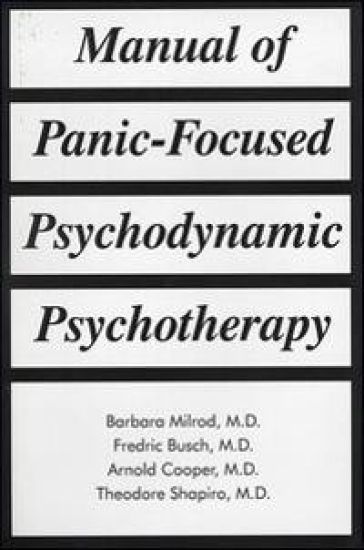
Manual of Panic-Focused Psychodynamic Psychotherapy

Manual of Panic-Focused Psychodynamic Psychotherapy

Barbara Milrod; Fredric N. Busch; Arnold M. Cooper; Theodore Shapiro

American Psychiatric Association Publishing
1997
sidottu
Despite the enormous progress in the pharmacological and cognitive-behavioual treatments of panic disorder over the last 30 years, many patients continue to suffer from persisent personality problems and panic vulnerability. Based on extensive clinical experience and written by experts in the field, this text suggests that psychodynamic approaches can aid both psycopharmacological and cognitive-behavioural treatments and often resolves panic symptoms in many patients when used alone. It catalogues psychological factors commonly present in panic disorder patients and describes how to address them within a psychodynamic psychotherapy. Clinical vignettes and a complete case example illustrate the psychodynamic approach of this disorder. Other treatment issues including defence mechanisms, transference and termination of treatment, common problems encountered in treating these patients, and the combination of this method with other approaches are also covered.