Kirjojen hintavertailu – 12 903 724 kirjaa ja 27 kauppaa

Kirjailija

Arthur C Sanderson

Kirjat ja teokset yhdessä paikassa: 8 kirjaa, julkaisuja vuosilta 1996–2012, suosituimpiin kuuluu Network-based Distributed Planning Using Coevolutionary Algorithms. Vertaile teosten hintoja ja tarkista saatavuus suomalaisista kirjakaupoista.

Nimi esiintyy myös muodoissa: Arthur C. Sanderson

8 kirjaa

Kirjojen julkaisuvuodet: 1996–2012.

Tetrobot

Tetrobot

Gregory J. Hamlin; Arthur C. Sanderson

Springer-Verlag New York Inc.
2012
nidottu
Robotic systems are characterized by the intersection of computer intelligence with the physical world. This blend of physical reasoning and computational intelligence is well illustrated by the Tetrobot study described in this book. Tetrobot: A Modular Approach to Reconfigurable Parallel Robotics describes a new approach to the design of robotic systems. The Tetrobot approach utilizes modular components which may be reconfigured into many different mechanisms which are suited to different applications. The Tetrobot system includes two unique contributions: a new mechanism (a multilink spherical joint design), and a new control architecture based on propagation of kinematic solutions through the structure. The resulting Tetrobot system consists of fundamental components which may be mechanically reassembled into any modular configuration, and the control architecture will provide position control of the resulting structure. A prototype Tetrobot system has been built and evaluated experimentally. Tetrobot arms, platforms, and walking machines have been built and controlled in a variety of motion and loading conditions. The Tetrobot system has applications in a variety of domains where reconfiguration, flexibility, load capacity, and failure recovery are important aspects of the task. A number of key research directions have been opened by the Tetrobot research activities. Continuing topics of interest include: development of a more distributed implementation of the computer control architecture, analysis of the dynamics of the Tetrobot system motion for improved control of high-speed motions, integration of sensor systems to control the motion and shape of the high-dimensionality systems, and exploration of self-reconfiguration of the system. Tetrobot: A Modular Approach to Reconfigurable Parallel Robotics will be of interest to research workers, specialists and professionals in the areas of robotics, mechanical systems and computer engineering.
Adaptive Differential Evolution

Adaptive Differential Evolution

Jingqiao Zhang; Arthur C. Sanderson

Springer-Verlag Berlin and Heidelberg GmbH Co. K
2012
nidottu
I ?rst met Jingqiao when he had just commenced his PhD research in evolutionary algorithms with Arthur Sanderson at Rensselaer. Jingqiao's goals then were the investigation and development of a novel class of se- adaptivedi?erentialevolutionalgorithms,later calledJADE. I had remarked to Jingqiao then that Arthur always appreciated strong theoretical foun- tions in his research, so Jingqiao's prior mathematically rigorous work in communications systems would be very useful experience. Later in 2007, whenJingqiaohadcompletedmostofthetheoreticalandinitialexperimental work on JADE, I invited him to spend a year at GE Global Research where he applied his developments to several interesting and important real-world problems. Most evolutionary algorithm conferences usually have their share of in- vative algorithm oriented papers which seek to best the state of the art - gorithms. The best algorithms of a time-frame create a foundation for a new generationof innovativealgorithms, and so on, fostering a meta-evolutionary search for superior evolutionary algorithms. In the past two decades, during whichinterest andresearchin evolutionaryalgorithmshavegrownworldwide by leaps and bounds, engaging the curiosity of researchers and practitioners frommanydiversescienceandtechnologycommunities,developingstand-out algorithms is getting progressively harder.
Adaptive Differential Evolution

Adaptive Differential Evolution

Jingqiao Zhang; Arthur C. Sanderson

Springer-Verlag Berlin and Heidelberg GmbH Co. K
2009
sidottu
I ?rst met Jingqiao when he had just commenced his PhD research in evolutionary algorithms with Arthur Sanderson at Rensselaer. Jingqiao's goals then were the investigation and development of a novel class of se- adaptivedi?erentialevolutionalgorithms,later calledJADE. I had remarked to Jingqiao then that Arthur always appreciated strong theoretical foun- tions in his research, so Jingqiao's prior mathematically rigorous work in communications systems would be very useful experience. Later in 2007, whenJingqiaohadcompletedmostofthetheoreticalandinitialexperimental work on JADE, I invited him to spend a year at GE Global Research where he applied his developments to several interesting and important real-world problems. Most evolutionary algorithm conferences usually have their share of in- vative algorithm oriented papers which seek to best the state of the art - gorithms. The best algorithms of a time-frame create a foundation for a new generationof innovativealgorithms, and so on, fostering a meta-evolutionary search for superior evolutionary algorithms. In the past two decades, during whichinterest andresearchin evolutionaryalgorithmshavegrownworldwide by leaps and bounds, engaging the curiosity of researchers and practitioners frommanydiversescienceandtechnologycommunities,developingstand-out algorithms is getting progressively harder.
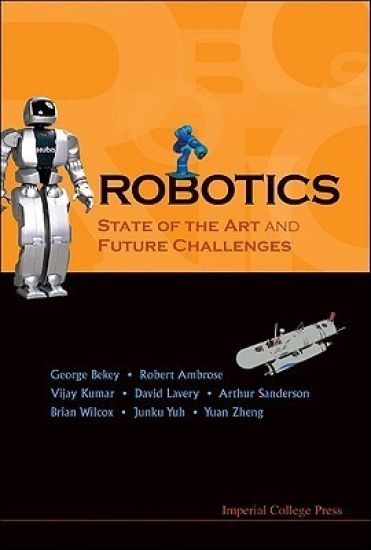
Robotics: State Of The Art And Future Challenges

Robotics: State Of The Art And Future Challenges

George A Bekey; Robert Ambrose; Vijay Kumar; Arthur C Sanderson; Brian Wilcox; Yuan F Zheng; Jun-ku Yuh; David Lavery

Imperial College Press
2008
sidottu
This book presents the results of an assessment of the state of robotics in Japan, South Korea, Western Europe and Australia and a comparison of robotics R&D programs in these countries with those in the United States. The comparisons include areas like robotic vehicles, space robotics, service robots, humanoid robots, networked robots, and robots for biological and medical applications, and based on criteria such as quality, scope, funding and commercialization. This important study identifies a number of areas where the traditional lead of the United States is being overtaken by developments in other countries.
Network-based Distributed Planning Using Coevolutionary Algorithms

Network-based Distributed Planning Using Coevolutionary Algorithms

Arthur C Sanderson; Raj Subbu

World Scientific Publishing Co Pte Ltd
2004
sidottu
In this book, efficient and scalable coevolutionary algorithms for distributed, network-based decision-making, which utilize objective functions are developed in a networked environment where internode communications are a primary factor in system performance. A theoretical foundation for this class of coevolutionary algorithms is introduced using techniques from stochastic process theory and mathematical analysis. A case study in distributed, network-based decision-making presents an implementation and detailed evaluation of the coevolutionary decision-making framework that incorporates distributed evolutionary agents and mobile agents. The methodology discussed in this book can have a fundamental impact on the principles and practice of engineering in the distributed, network-based environment that is emerging within and among corporate enterprise systems. In addition, the conceptual framework of the approach to distributed decision systems described may have much wider implications for network-based systems and applications.
Multisensor Fusion: A Minimal Representation Framework

Multisensor Fusion: A Minimal Representation Framework

Rajive Joshi; Arthur C Sanderson

World Scientific Publishing Co Pte Ltd
1999
sidottu
The fusion of information from sensors with different physical characteristics, such as sight, touch, sound, etc., enhances the understanding of our surroundings and provides the basis for planning, decision-making, and control of autonomous and intelligent machines. The minimal representation approach to multisensor fusion is based on the use of an information measure as a universal yardstick for fusion. Using models of sensor uncertainty, the representation size guides the integration of widely varying types of data and maximizes the information contributed to a consistent interpretation. In this book, the general theory of minimal representation multisensor fusion is developed and applied in a series of experimental studies of sensor-based robot manipulation. A novel application of differential evolutionary computation is introduced to achieve practical and effective solutions to this difficult computational problem.
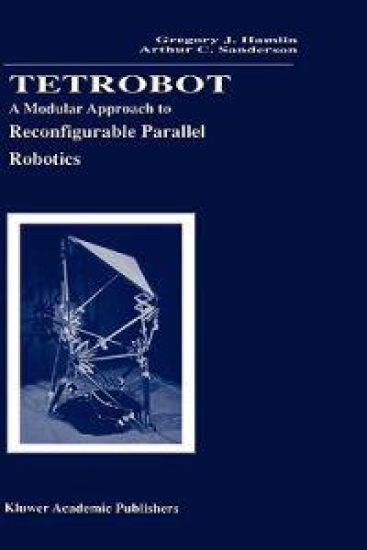
Tetrobot

Tetrobot

Gregory J. Hamlin; Arthur C. Sanderson

Springer
1997
sidottu
Robotic systems are characterized by the intersection of computer intelligence with the physical world. This blend of physical reasoning and computational intelligence is well illustrated by the Tetrobot study described in this book. Tetrobot: A Modular Approach to Reconfigurable Parallel Robotics describes a new approach to the design of robotic systems. The Tetrobot approach utilizes modular components which may be reconfigured into many different mechanisms which are suited to different applications. The Tetrobot system includes two unique contributions: a new mechanism (a multilink spherical joint design), and a new control architecture based on propagation of kinematic solutions through the structure. The resulting Tetrobot system consists of fundamental components which may be mechanically reassembled into any modular configuration, and the control architecture will provide position control of the resulting structure. A prototype Tetrobot system has been built and evaluated experimentally. Tetrobot arms, platforms, and walking machines have been built and controlled in a variety of motion and loading conditions. The Tetrobot system has applications in a variety of domains where reconfiguration, flexibility, load capacity, and failure recovery are important aspects of the task. A number of key research directions have been opened by the Tetrobot research activities. Continuing topics of interest include: development of a more distributed implementation of the computer control architecture, analysis of the dynamics of the Tetrobot system motion for improved control of high-speed motions, integration of sensor systems to control the motion and shape of the high-dimensionality systems, and exploration of self-reconfiguration of the system. Tetrobot: A Modular Approach to Reconfigurable Parallel Robotics will be of interest to research workers, specialists and professionals in the areas of robotics, mechanical systems and computer engineering.
Intelligent Task Planning Using Fuzzy Petri Nets

Intelligent Task Planning Using Fuzzy Petri Nets

Tom Tiehua Cao; Arthur C Sanderson

World Scientific Publishing Co Pte Ltd
1996
sidottu
This book describes an approach to intelligent task planning in a robotic system. Petri net and fuzzy logic are integrated and used to represent task sequence planning and error recovery. During the generation and execution of task plans, different kinds of uncertainties need to be handled to ensure the efficiency and reliability of the system. Following a systematic modeling procedure, a fuzzy Petri net is constructed based on geometric relations, fuzzy variables, and reasoning structures. The resulting net can be used to analyze and control the system. Many examples are discussed to illustrate the theory and the applications of fuzzy Petri nets.