

Kirjailija
Arthur E. Morgan
Kirjat ja teokset yhdessä paikassa: 13 kirjaa, julkaisuja vuosilta 1991–2026, suosituimpiin kuuluu My World. Vertaile teosten hintoja ja tarkista saatavuus suomalaisista kirjakaupoista.
Nimi esiintyy myös muodoissa: Arthur E Morgan
13 kirjaa
Kirjojen julkaisuvuodet: 1991–2026.

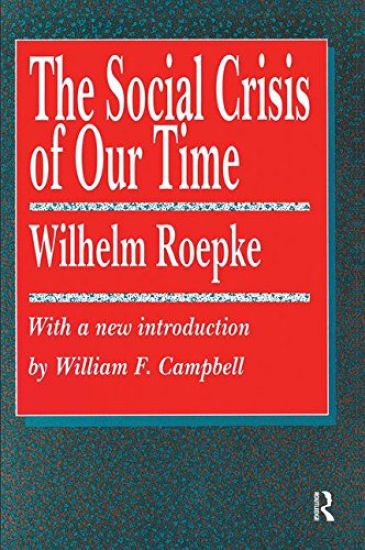
Roepke's The Social Crisis of Our Time is a series of blasts against the "malformations" of economics: the Nazi and Communist forms of collectivism both come in for severe criticism. Roepke shows the process by which the Western liberal tradition itself makes possible these rebellions against open economic systems. The drive toward social welfare, full employment policies, and the state management of fiscal fluctuations all lead away from free societies no less than market economies.

In this age of large cities, mass culture, and ever more massive events, people must struggle against an overwhelming crowd of their own creations to maintain human integrity. In this manual for human survival, Arthur E. Morgan offers a solution: peaceful existence in the small, primary community where, more easily than anywhere else, people can find a way to live well. Ultimately striving to show that the small community is "the lifeblood of civilization," this volume examines the political organization, membership, economics, health, and ethics characteristics of small communities. Like Rousseau before him, Morgan observes that we have less control over our affairs than in the past. In increasing our control of the natural environment, human beings have built a social environment so out of scale that it becomes nearly impossible for people to maintain balance. The struggle now is less with the natural order than with the social order, and preserving human integrity against the plethora of our own creations is the core problem. The need to rediscover elementary forms of human existence has been accelerated by the efficiencies of centralized control and mass persuasion. In the face of this, small communities or intimate groups become the primary pattern in which human beings must live if the good life is to be a realistic goal. The timely nature of this volume has grown as the electronic displaces the mechanical as a moral rival to human community.




The Philosophy of Edward Bellamy is a book written by Arthur E. Morgan that delves into the ideas and beliefs of Edward Bellamy, an American author and socialist who lived in the late 19th and early 20th centuries. The book explores Bellamy's philosophy and his vision for a utopian society, as outlined in his famous novel, Looking Backward. Morgan examines Bellamy's ideas on topics such as social justice, economic equality, and the role of government in creating a better world. He also considers Bellamy's influence on the socialist movement in America and his impact on the development of modern political thought. The Philosophy of Edward Bellamy is a comprehensive and insightful analysis of the ideas of one of America's most influential socialists, and it provides an important perspective on the history of political thought in the United States. This is a new release of the original 1945 edition. This scarce antiquarian book is a facsimile reprint of the old original and may contain some imperfections such as library marks and notations. Because we believe this work is culturally important, we have made it available as part of our commitment for protecting, preserving, and promoting the world's literature in affordable, high quality, modern editions, that are true to their original work.

In this age of large cities, mass culture, and ever more massive events, people must struggle against an overwhelming crowd of their own creations to maintain human integrity. In this manual for human survival, Arthur E. Morgan offers a solution: peaceful existence in the small, primary community where, more easily than anywhere else, people can find a way to live well. Ultimately striving to show that the small community is "the lifeblood of civilization," this volume examines the political organization, membership, economics, health, and ethics characteristics of small communities. Like Rousseau before him, Morgan observes that we have less control over our affairs than in the past. In increasing our control of the natural environment, human beings have built a social environment so out of scale that it becomes nearly impossible for people to maintain balance. The struggle now is less with the natural order than with the social order, and preserving human integrity against the plethora of our own creations is the core problem. The need to rediscover elementary forms of human existence has been accelerated by the efficiencies of centralized control and mass persuasion. In the face of this, small communities or intimate groups become the primary pattern in which human beings must live if the good life is to be a realistic goal. The timely nature of this volume has grown as the electronic displaces the mechanical as a moral rival to human community.

The Religion of Solidarity: The Philosophy of Edward Bellamy
Edward Bellamy; Arthur E. Morgan
Literary Licensing, LLC
2012
nidottu


Roepke's The Social Crisis of Our Time is a series of blasts against the "malformations" of economics: the Nazi and Communist forms of collectivism both come in for severe criticism. Roepke shows the process by which the Western liberal tradition itself makes possible these rebellions against open economic systems. The drive toward social welfare, full employment policies, and the state management of fiscal fluctuations all lead away from free societies no less than market economies.