Kirjojen hintavertailu – 12 859 819 kirjaa ja 27 kauppaa

Kirjailija

Arthur F. Marotti

Kirjat ja teokset yhdessä paikassa: 9 kirjaa, julkaisuja vuosilta 1995–2023, suosituimpiin kuuluu John Donne, Coterie Poet. Vertaile teosten hintoja ja tarkista saatavuus suomalaisista kirjakaupoista.

9 kirjaa

Kirjojen julkaisuvuodet: 1995–2023.

The Circulation of Poetry in Manuscript in Early Modern England
This study examines the transmission and compilation of poetic texts through manuscripts from the late-Elizabethan era through the mid-seventeenth century, paying attention to the distinctive material, social, and literary features of these documents. The study has two main focuses: the first, the particular social environments in which texts were compiled and, second, the presence within this system of a large body of (usually anonymous) rare or unique poems. Manuscripts from aristocratic, academic, and urban professional environments are examined in separate chapters that highlight particular collections. Two chapters consider the social networking within the university and London that facilitated the transmission within these environments and between them. Although the topic is addressed throughout the study, the place of rare or unique poems in manuscript collections is at the center of the final three chapters. The book as a whole argues that scholars need to pay more attention to the social life of texts in the period and to little-known or unknown rare or unique poems that represent a field of writing broader than that defined in a literary history based mainly on the products of print culture.

The Circulation of Poetry in Manuscript in Early Modern England
This study examines the transmission and compilation of poetic texts through manuscripts from the late-Elizabethan era through the mid-seventeenth century, paying attention to the distinctive material, social, and literary features of these documents. The study has two main focuses: the first, the particular social environments in which texts were compiled and, second, the presence within this system of a large body of (usually anonymous) rare or unique poems. Manuscripts from aristocratic, academic, and urban professional environments are examined in separate chapters that highlight particular collections. Two chapters consider the social networking within the university and London that facilitated the transmission within these environments and between them. Although the topic is addressed throughout the study, the place of rare or unique poems in manuscript collections is at the center of the final three chapters. The book as a whole argues that scholars need to pay more attention to the social life of texts in the period and to little-known or unknown rare or unique poems that represent a field of writing broader than that defined in a literary history based mainly on the products of print culture.

Ink, Stink Bait, Revenge, and Queen Elizabeth

Ink, Stink Bait, Revenge, and Queen Elizabeth

Steven W. May; Arthur F. Marotti

Cornell University Press
2014
sidottu
In Ink, Stink Bait, Revenge, and Queen Elizabeth, Steven W. May and Arthur F. Marotti present a recently discovered "household book" from sixteenth-century England. Its main scribe, John Hanson, was a yeoman who worked as a legal agent in rural Yorkshire. His book, a miscellaneous collection of documents that he found useful or interesting, is a rare example of a middle-class provincial anthology that contains, in addition to works from the country's cultural center, items of local interest seldom or never disseminated nationally. Among the literary highlights of the household book are unique copies of two ballads, whose original print versions have been lost, describing Queen Elizabeth's procession through London after the victory over the Spanish Armada; two poems attributed to Elizabeth herself; and other verse by courtly writers copied from manuscript and print sources. Of local interest is the earliest-known copy of a 126-stanza ballad about a mid-fourteenth-century West Yorkshire feud between the Eland and Beaumont families. The manuscript's utilitarian items include a verse calendar and poetic Decalogue, model legal documents, real estate records, recipes for inks and fish baits, and instructions for catching rabbits and birds. Hanson combined both professional and recreational interests in his manuscript, including material related to his legal work with wills and real estate transactions. As May and Marotti argue in their cultural and historical interpretation of the text, Hanson's household book is especially valuable not only for the unusual texts it preserves but also for the ways in which it demonstrates the intersection of the local and national and of popular and elite cultures in early modern England.
Ink, Stink Bait, Revenge, and Queen Elizabeth

Ink, Stink Bait, Revenge, and Queen Elizabeth

Steven W. May; Arthur F. Marotti

Cornell University Press
2014
pokkari
In Ink, Stink Bait, Revenge, and Queen Elizabeth, Steven W. May and Arthur F. Marotti present a recently discovered "household book" from sixteenth-century England. Its main scribe, John Hanson, was a yeoman who worked as a legal agent in rural Yorkshire. His book, a miscellaneous collection of documents that he found useful or interesting, is a rare example of a middle-class provincial anthology that contains, in addition to works from the country's cultural center, items of local interest seldom or never disseminated nationally. Among the literary highlights of the household book are unique copies of two ballads, whose original print versions have been lost, describing Queen Elizabeth's procession through London after the victory over the Spanish Armada; two poems attributed to Elizabeth herself; and other verse by courtly writers copied from manuscript and print sources. Of local interest is the earliest-known copy of a 126-stanza ballad about a mid-fourteenth-century West Yorkshire feud between the Eland and Beaumont families. The manuscript's utilitarian items include a verse calendar and poetic Decalogue, model legal documents, real estate records, recipes for inks and fish baits, and instructions for catching rabbits and birds. Hanson combined both professional and recreational interests in his manuscript, including material related to his legal work with wills and real estate transactions. As May and Marotti argue in their cultural and historical interpretation of the text, Hanson's household book is especially valuable not only for the unusual texts it preserves but also for the ways in which it demonstrates the intersection of the local and national and of popular and elite cultures in early modern England.
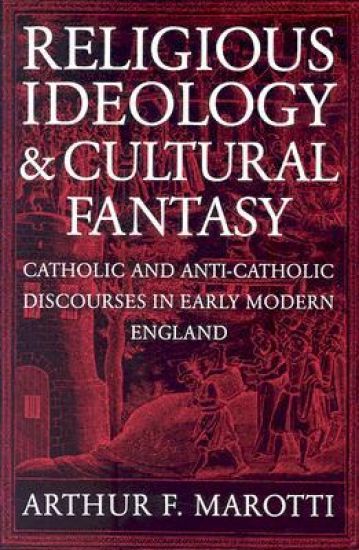
Religious Ideology and Cultural Fantasy

Religious Ideology and Cultural Fantasy

Arthur F. Marotti

University of Notre Dame Press
2005
nidottu
In this new book, Arthur F. Marotti analyzes some of the rhetorical and imaginative means by which the Catholic minority and the Protestant majority defined themselves and their religious and political antagonists in early modern England. He considers Catholic writings that have been relatively neglected, as well as the discourse of anti-Catholicism. Straddling the boundary of history and literature, this study offers an intriguing cultural history that focuses on the ideologized fantasies and language found on both sides of the early modern Christian religious divide. Marotti focuses on the period between the arrival of the first Jesuit missionaries in England in 1580 and the climax of ongoing religious conflict in the Restoration-era Popish Plot and the 1688 Glorious Revolution. In a series of thematically focused essays, he covers such issues as the relationship of print culture to the residual Catholic culture in Elizabethan England; recusant women, Jesuits and the cultural othering of Catholics, martyrdom accounts, the manuscript circulation of Catholic martyrdom accounts; polemically charged Catholic and Protestant narratives of conversion; and the depiction of Catholic plots or outrages and providential Protestant deliverances in the construction of Protestant English history and identity. This important and eagerly anticipated book makes a substantial contribution to our understanding of Catholicism and anti-Catholicism in the early modern period. It also points to a cultural dynamic in Anglo-American history that persisted far into the modern era.
Religious Ideology and Cultural Fantasy

Religious Ideology and Cultural Fantasy

Arthur F. Marotti

University of Notre Dame Press
2005
sidottu
In this new book, Arthur F. Marotti analyzes some of the rhetorical and imaginative means by which the Catholic minority and the Protestant majority defined themselves and their religious and political antagonists in early modern England. He considers Catholic writings that have been relatively neglected, as well as the discourse of anti-Catholicism. Straddling the boundary of history and literature, this study offers an intriguing cultural history that focuses on the ideologized fantasies and language found on both sides of the early modern Christian religious divide. Marotti focuses on the period between the arrival of the first Jesuit missionaries in England in 1580 and the climax of ongoing religious conflict in the Restoration-era Popish Plot and the 1688 Glorious Revolution. In a series of thematically focused essays, he covers such issues as the relationship of print culture to the residual Catholic culture in Elizabethan England; recusant women, Jesuits and the cultural othering of Catholics, martyrdom accounts, the manuscript circulation of Catholic martyrdom accounts; polemically charged Catholic and Protestant narratives of conversion; and the depiction of Catholic plots or outrages and providential Protestant deliverances in the construction of Protestant English history and identity. This important and eagerly anticipated book makes a substantial contribution to our understanding of Catholicism and anti-Catholicism in the early modern period. It also points to a cultural dynamic in Anglo-American history that persisted far into the modern era.
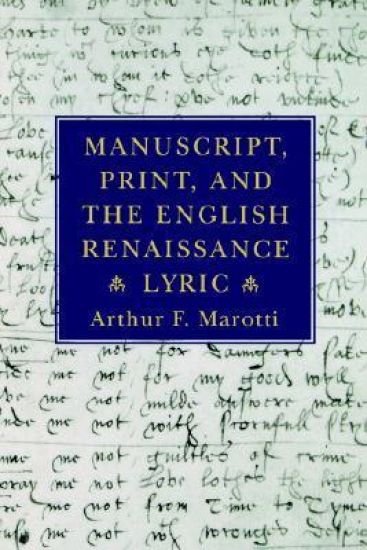
Manuscript, Print, and the English Renaissance Lyric

Manuscript, Print, and the English Renaissance Lyric

Arthur F. Marotti

Cornell University Press
1995
pokkari
The last of the literary genres to be incorporated into print culture, verse in the English Renaissance not only was published in anthologies, pamphlets, and folio editions, it was also circulated in manuscript. In this ground-breaking historical and cultural study of sixteenth- and early seventeenth-century lyric poetry, Marotti examines the interrelationship between the two systems of literary transmission and shows how in England manuscript and print publication together shaped the emerging institution of literature. Surveying a wide range of manuscript and print poetry of the period, Marotti outlines the different social and institutional contexts in which poems were collected and transmitted. He focuses on the two kinds of verse that were circulated more commonly in manuscript than in print—the obscene and the political—and he considers the contributions of scribes and compilers, particularly in composing "answer poetry" and other verse. Analyzing the process through which print gradually replaced manuscript as the standard medium for lyric verse, he identifies four crucial events in the history of publication in England: the appearances of Tottel's Miscellany ( (1557), Sir Philip Sidney's works in the 1590s, Ben Jonson's folio Workes (1616), and the posthumous editions of the poems of Donne and of Herbert (both 1633). Marotti also considers how certain material features of the book determined the reception of poetry, and he explores how poets attempted to establish their authority in print in relation to publishers, patrons, and readers.