Kirjojen hintavertailu – 12 859 829 kirjaa ja 27 kauppaa
Kirjailija
Arun Kumar
Kirjat ja teokset yhdessä paikassa: 154 kirjaa, julkaisuja vuosilta 2008–2026, suosituimpiin kuuluu Predprinimatel'skoe powedenie fermerow, zanimaüschihsq pchelowodstwom. Vertaile teosten hintoja ja tarkista saatavuus suomalaisista kirjakaupoista.
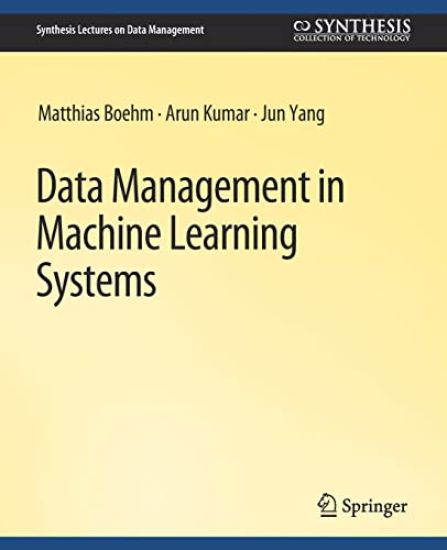
Large-scale data analytics using machine learning (ML) underpins many modern data-driven applications. ML systems provide means of specifying and executing these ML workloads in an efficient and scalable manner. Data management is at the heart of many ML systems due to data-driven application characteristics, data-centric workload characteristics, and system architectures inspired by classical data management techniques. In this book, we follow this data-centric view of ML systems and aim to provide a comprehensive overview of data management in ML systems for the end-to-end data science or ML lifecycle. We review multiple interconnected lines of work: (1) ML support in database (DB) systems, (2) DB-inspired ML systems, and (3) ML lifecycle systems. Covered topics include: in-database analytics via query generation and user-defined functions, factorized and statistical-relational learning; optimizing compilers for ML workloads; execution strategies and hardware accelerators;data access methods such as compression, partitioning and indexing; resource elasticity and cloud markets; as well as systems for data preparation for ML, model selection, model management, model debugging, and model serving. Given the rapidly evolving field, we strive for a balance between an up-to-date survey of ML systems, an overview of the underlying concepts and techniques, as well as pointers to open research questions. Hence, this book might serve as a starting point for both systems researchers and developers.
The Silent Rebellion tells a history of labour subjectivity formation at the site of education and the defiance of labouring subalterns who refused to see themselves solely as labouring bodies in the late nineteenth and twentieth centuries. It does so by focusing on the hitherto neglected social histories of nonelite education: industrial, technical, factory, and night schools. On the one hand, the book examines how elites-encompassing colonial officials, employers, and dominant castes-integrated caste labour into their modern projects of industrial and technical education, thereby reproducing labouring conditions, subjectivities, and the caste social order. On the other hand, the book reveals how labouring subalterns-artisans, factory workers, and service-industry workers-used education to rebel against their 'pre-destined' labouring fate. Focusing on their demands for literary education, experiences of reading, and becoming teachers, clerks, and poets, the book develops new analytical frameworks for writing nonwork histories of working lives.
Solar Powered Urbanization for a Sustainable Future presents a comprehensive and integrated approach to utilizing solar energy as a key solution for reducing grid dependency and pollution while fostering self-sufficient and cleaner urban centers. This book explores the strategic planning and application of solar power across essential urban sectors, including lighting, heating and cooling, water supply, wastewater recycling, transportation, and urban farming. By analyzing energy consumption patterns in residential, commercial, institutional, and industrial spaces, the book highlights sector-specific opportunities for sustainable transformation. With a strong emphasis on awareness, policy formulation, and technological advancements, it contributes valuable insights to the growing discourse on renewable energy integration in urban planning. It serves as an essential resource for researchers, policymakers, and urban planners striving for a solar-powered, sustainable future. Explores the role of solar power to reduce grid dependency and environmental impacts. Analyzes various energy consumption patterns and identifies tailored solar-powered strategies for sustainable urbanization. Highlights the importance of awareness, governance, and policy making in driving large-scale adoption of solar energy for self-sufficiency.
The United Nations predicts that by the year 2025, two-thirds of the world’s population will face water scarcity. Further, the planet would have well over eight billion people, the majority of whom would live in developing countries, where more than 80% of those are already experiencing water scarcity. Therefore, there is an urgent need for wastewater recycling to help solve issues of scarcity and to facilitate better management of generated wastewater. Water recycling includes reuse and treatment of municipal wastewater, which could be a sustainable approach for environmental sustainability and could also help to offset the increasing water demands for irrigation and industrial and other needs. Currently, water and wastewater treatment facilities consume large amounts of energy that are mainly generated through the use of fossil fuels. Solar Powered Wastewater Recycling examines how solar power can be implemented as an integrated approach whereby all the energy needs of the water and wastewater sector could be supplemented by renewable technologies, and in which a synergy can be developed between water and energy.