
Kirjojen hintavertailu – 12 875 542 kirjaa ja 26 kauppaa

Kirjailija

Arun R. Srinivasa

Kirjat ja teokset yhdessä paikassa: 3 kirjaa, julkaisuja vuosilta 2009–2025, suosituimpiin kuuluu Mechanics of Solids and Structures. Vertaile teosten hintoja ja tarkista saatavuus suomalaisista kirjakaupoista.

Nimi esiintyy myös muodoissa: Arun R Srinivasa

3 kirjaa

Kirjojen julkaisuvuodet: 2009–2025.

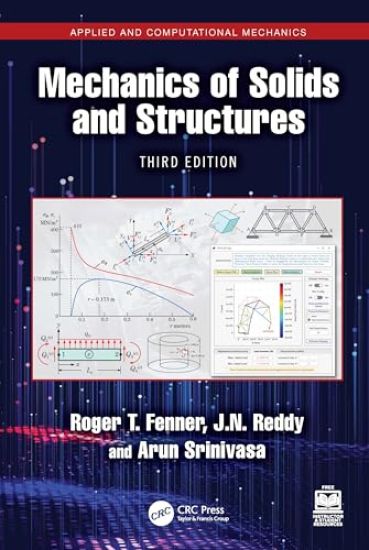
Mechanics of Solids and Structures

Mechanics of Solids and Structures

Roger T. Fenner; J.N. Reddy; Arun R. Srinivasa

TAYLOR FRANCIS LTD
2025
nidottu
The third edition of Mechanics of Solids and Structures makes use of computational methods such as the finite element method that has revolutionized the field to solve problems while retaining all the basic principles and foundational information needed for mastering advanced engineering mechanics principles and acquiring problem-solving skills. The authors have updated the text to include the integration of numerical approaches and MATLAB® computer programs into the body of the text for carrying out analysis of truss, beam, and frame structures. The third edition also offers an update to Chapters 1 through 4 as follows. All material related to determinate trusses and cables is moved to Chapter 1, as most students most likely were introduced to these topics in a course on statics. Thus, Chapter 1 of the current edition is a review of statics. The concepts of stress and strain and associated examples were moved from Chapter 1 to Chapter 2, with additional discussion of concepts and examples. Chapter 3 in the new edition deals with stress-strain relations with applications to determinate systems, including trusses and thin-walled pressure vessels. Indeterminate trusses and associated computer implementation have been moved from Chapter 4 of the second edition to Chapter 7 of the current edition. Other indeterminate systems from old Chapter 4 have been retained in new Chapter 4. The second major change is the updating of all the computational tools from FORTRAN to MATLAB and providing interactive tools (i.e., APPs) in Chapters 7, 10, and 12 of the new edition. All computational examples from Chapters 4 and 6 on trusses and beams of the second edition are consolidated into a new chapter, Chapter 7 with numerous examples and applications of newly included TRUSS2d, BEAM, and FRAME2d APPs. Chapter 7 also introduces finite element analysis of plane frames (a new topic). The authors have also added new examples and exercise problems throughout the book that allow students to practice and apply the concepts and formulas to solve problems.
Mechanics of Solids and Structures

Mechanics of Solids and Structures

Roger T. Fenner; J.N. Reddy; Arun R. Srinivasa

TAYLOR FRANCIS LTD
2025
sidottu
The third edition of Mechanics of Solids and Structures makes use of computational methods such as the finite element method that has revolutionized the field to solve problems while retaining all the basic principles and foundational information needed for mastering advanced engineering mechanics principles and acquiring problem-solving skills. The authors have updated the text to include the integration of numerical approaches and MATLAB computer programs into the body of the text for carrying out analysis of truss, beam, and frame structures. The third edition also offers an update to chapter one, which includes a more detailed explanation of the idealization of real-world objects, the conversion into two-dimensional approximation, and the student’s ability to create line drawings and other schematics to practice drawing and create free-body diagrams. The authors have also added new examples and exercise problems throughout the book that allow students to practice and apply the concepts and formulas to solve problems. Following the legacy of the previous editions, the third edition serves as a course text for the senior/graduate (third, fourth, or fifth year) courses/modules in the mechanics of solid/advanced strength of materials, offered in aerospace, civil, engineering science, and mechanical engineering departments.
Inelasticity Of Materials: An Engineering Approach And A Practical Guide

Inelasticity Of Materials: An Engineering Approach And A Practical Guide

Arun R Srinivasa; Sivakumar M Srinivasa

World Scientific Publishing Co Pte Ltd
2009
sidottu
With the advent of a host of new materials ranging from shape memory alloys to biomaterials to multiphase alloys, acquiring the capacity to model inelastic behavior and to choose the right model in a commercial analysis software has become a pressing need for practicing engineers. Even with the traditional materials, there is a continued emphasis on optimizing and extending their full range of capability in the applications. This textbook builds upon the existing knowledge of elasticity and thermodynamics, and allows the reader to gain confidence in extending one's skills in understanding and analyzing problems in inelasticity. By reading this textbook and working through the assigned exercises, the reader will gain a level of comfort and competence in developing and using inelasticity models. Thus, the book serves as a valuable book for practicing engineers and senior-level undergraduate/graduate-level students in the mechanical, civil, aeronautical, metallurgical and other disciplines. The book is written in three parts. Part 1 is primarily focused on lumped parameter models and simple structural elements such as trusses and beams. This is suitable for an advanced undergraduate class with just a strength of materials background. Part II is focused on small deformation multi-dimensional inelasticity and is suitable for a beginning graduate class. Sufficient material is included on how to numerically implement an inelastic model and solve either using a simple stress function type of approach or using commercial software. Case studies are included as examples. There is also an extensive discussion of thermodynamics in the context of small deformations. Part III focuses on more advanced situations such as finite deformation inelasticity, thermodynamical ideas and crystal plasticity. More advanced case studies are included in this part.• This textbook takes a new, task- or scenario-based approach to teaching and learning inelasticity. The book is written in an active learning style that appeals to engineers and students who wish to design or analyze structures and components that are subject to inelasticity.• The book incorporates thermodynamical considerations into the modeling right from an early stage. Extensive discussions are provided throughout the book on the thermodynamical underpinnings of the models.• This textbook is the first to make extensive use of MATLAB to implement many inelasticity models. It includes the use of concepts such as Airy stress functions to solve plane problems for inelastic materials. The MATLAB codes are listed in the appendix for one to modify with their own models and requirements.• Step-by-step procedures for formulations and calculations are provided for the reader to readily adapt to the inelastic problems that he or she attempts to solve.• A large number of problems, exercises and projects for one to teach or learn from are included. These can be assigned as homework, in-class exercises or projects.• The book is written in a modular fashion, which provides adequate flexibility for adaptation in classes that cater to different audiences such as senior-level students, graduate students, research scholars, and practicing engineers.