Kirjojen hintavertailu – 12 859 824 kirjaa ja 27 kauppaa

Kirjailija

Asimina Michailidou

Kirjat ja teokset yhdessä paikassa: 5 kirjaa, julkaisuja vuosilta 2008–2023, suosituimpiin kuuluu The European Union Online. Vertaile teosten hintoja ja tarkista saatavuus suomalaisista kirjakaupoista.

5 kirjaa

Kirjojen julkaisuvuodet: 2008–2023.

The Internet and European Integration

The Internet and European Integration

Pieter de Wilde; Asimina Michailidou; Hans Jörg Trenz

Verlag Barbara Budrich
2023
nidottu
This book offers a wealth of original empirical data on how online media shape EU politics. The authors highlight myths and facts about the nature of audience-driven online media content and show how public demands for legitimacy are at the heart of the politicization of European integration. What EU citizens most intensely debate online are fundamental questions of what European institutions stand for and how they can be held accountable. Drawing on innovative and rigorous analysis of online media ownership, journalistic content, and readers’ input, the authors piece together the convergence toward Euroskepticism across EU member states.

The Internet and European Integration

The Internet and European Integration

Asimina Michailidou; Pieter de Wilde; Hans Jörg Trenz

Verlag Barbara Budrich
2014
sidottu
This book offers a wealth of original empirical data on how online media shape EU contestation. Taking a public sphere perspective, the authors highlight the myths and truths about the nature of audience-driven online media content and show how public demands for legitimacy are at the heart of the much-analyzed politicization of European integration. What EU citizens most intensely debate online are the fundamental questions of what the European institutions stand for and how they can be held accountable. Drawing on innovative and rigorous analysis of online media ownership, journalistic content and online readers’ inputs, the authors piece together the components of the dynamic nature of EU contestation and the degree of convergence towards Euroscepticism across EU member states in the first years of the Eurocrisis. There is no doubt that EU citizens have strong opinions about the EU and interactive online media allow these opinions to come to the fore, to be challenged and amplified both within and beyond national public spheres. Yet, for all its potential to unite European publics, online EU contestation remains firmly anchored in offline news media frames, while citizens and journalists alike struggle to put forward a clear vision of the future EU polity.
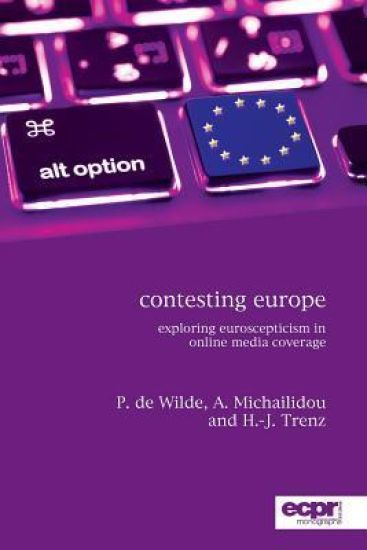
Contesting Europe

Contesting Europe

Pieter De Wilde; Asimina Michailidou; Hans J Trenz

ECPR Press
2013
nidottu
Investigates the way politicians and citizens evaluated the European Union and the process of European integration in public debates during the 2009 European Parliament elections. The authors present detailed, rigorous analysis of citizens' online response to news stories, and reveal new evidence about the dynamic nature of online contestation of Europe and the degree of convergence towards Euroscepticism. Such convergence provides new challenges for democratic representation in the EU, and insight into the public basis for a legitimate European Union.
The European Union online

The European Union online

Asimina Michailidou

AV Akademikerverlag
2012
pokkari
Revision with unchanged content. The issues of European Union (EU) citizenship, democratic legitimacy, social dialogue and trans-European communication of socio-economic actors have been ever present in the academic and political debates regarding the role of the EU institutions and the future of the Union. These issues have also defined the conceptual frame of the EU's information and communication strategy and feature at the core of the debates on the EU Constitutional Treaty (2002-2005) and the Reform Treaty (2007). This book is an innovative and timely interdisciplinary piece of research within the European political communication field: It assesses the potential democratising impact of the Internet on European Union (EU) institutions and its contribution to the emerging European public sphere, focusing on the 'top-down' process of direct online communication initiated at the supranational level by the European Commission to address the general public. The findings highlight significant disparities between the Commission's public communication strategy, its online implementation and the institution's operating culture.