Kirjojen hintavertailu – 12 859 819 kirjaa ja 27 kauppaa

Kirjailija

Aslak Tveito

Kirjat ja teokset yhdessä paikassa: 11 kirjaa, julkaisuja vuosilta 2002–2023, suosituimpiin kuuluu Computing the Electrical Activity in the Heart. Vertaile teosten hintoja ja tarkista saatavuus suomalaisista kirjakaupoista.

11 kirjaa

Kirjojen julkaisuvuodet: 2002–2023.

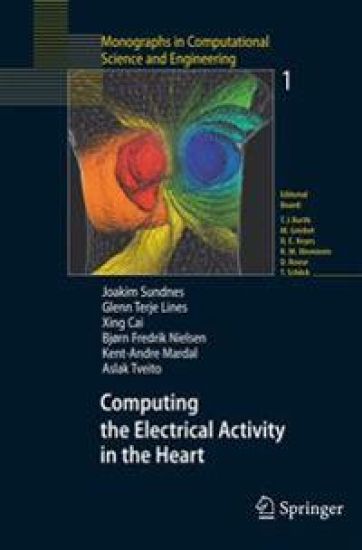
Computing the Electrical Activity in the Heart

Computing the Electrical Activity in the Heart

Joakim Sundnes; Glenn Terje Lines; Xing Cai; Bjørn Frederik Nielsen; Kent-Andre Mardal; Aslak Tveito

Springer-Verlag Berlin and Heidelberg GmbH Co. K
2010
nidottu
The heart is a fantastic machine; during a normal lifetime it beats about 2.5 billion times and pumps 200.000 tons of blood through an enormous system of vessels extending 160.000 kilometres throughout the body. For centuries, man has tried to understand how the heart works, but there remain many unsolved problems, problems that have captured the attention of thousands of researchers worldwide. There is, for example, a huge amount of research being devoted to the analysis of single heart cells. Other areas of research include trying to understand how it works as a complete muscle, and how blood ows through the heart. The entire process is extremely complex. The history of bioelectricity can be traced back to the late eighteenth century and the experiments of Luigi Galvani. A century later, in 1887, Augustus Wallers managed to measure the electrical signal generated by the heart at the surface of the body [142]. His dog Jimmy earned a place in history by being the rst to have his heart measured in this way; see Figure 1.1. In 1903 Willem Einthoven [34] - veloped the rst commercial device for recording electrocardiograms (ECGs); see Figure 1.2.
Differential Equations for Studies in Computational Electrophysiology

Differential Equations for Studies in Computational Electrophysiology

Karoline Horgmo Jæger; Aslak Tveito

Springer International Publishing AG
2023
nidottu
This open access text aims at giving you the simplest possible introduction to differential equations that are used in models of electrophysiology. It covers models at several spatial and temporal scales with associated numerical methods. The text demonstrates that a very limited number of fundamental techniques can be used to define numerical methods for equations ranging from ridiculously simple to extremely complex systems of partial differential equations. Every method is implemented in Matlab and the codes are freely available online. By using these codes, the reader becomes familiar with classical models of electrophysiology, like the cable equation, the monodomain model, and the bidomain model. But modern models that have just started to gain attention in the field of computational electrophysiology are also presented. If you just want to read one book, it should probably not be this one, but if you want a simple introduction to a complex field, it is worth considering the present text.
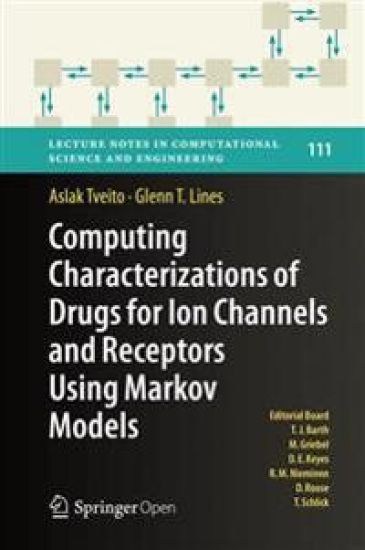
Computing Characterizations of Drugs for Ion Channels and Receptors Using Markov Models

Computing Characterizations of Drugs for Ion Channels and Receptors Using Markov Models

Aslak Tveito; Glenn T. Lines

Springer International Publishing AG
2018
nidottu
Flow of ions through voltage gated channels can be represented theoretically using stochastic differential equations where the gating mechanism is represented by a Markov model. The flow through a channel can be manipulated using various drugs, and the effect of a given drug can be reflected by changing the Markov model. These lecture notes provide an accessible introduction to the mathematical methods needed to deal with these models. They emphasize the use of numerical methods and provide sufficient details for the reader to implement the models and thereby study the effect of various drugs. Examples in the text include stochastic calcium release from internal storage systems in cells, as well as stochastic models of the transmembrane potential. Well known Markov models are studied and a systematic approach to including the effect of mutations is presented. Lastly, the book shows how to derive the optimal properties of a theoretical model of a drug for a given mutation defined in terms of a Markov model.
Computing Characterizations of Drugs for Ion Channels and Receptors Using Markov Models

Computing Characterizations of Drugs for Ion Channels and Receptors Using Markov Models

Aslak Tveito; Glenn T. Lines

Springer International Publishing AG
2016
sidottu
Flow of ions through voltage gated channels can be represented theoretically using stochastic differential equations where the gating mechanism is represented by a Markov model. The flow through a channel can be manipulated using various drugs, and the effect of a given drug can be reflected by changing the Markov model. These lecture notes provide an accessible introduction to the mathematical methods needed to deal with these models. They emphasize the use of numerical methods and provide sufficient details for the reader to implement the models and thereby study the effect of various drugs. Examples in the text include stochastic calcium release from internal storage systems in cells, as well as stochastic models of the transmembrane potential. Well known Markov models are studied and a systematic approach to including the effect of mutations is presented. Lastly, the book shows how to derive the optimal properties of a theoretical model of a drug for a given mutation defined in terms of a Markov model.
Introduction to Partial Differential Equations

Introduction to Partial Differential Equations

Aslak Tveito; Ragnar Winther

Springer-Verlag New York Inc.
2013
nidottu
“It is impossible to exaggerate the extent to which modern applied mathematics has been shaped and fueled by the g- eral availability of fast computers with large memories. Their impact on mathematics, both applied and pure, is comparable to the role of the telescopes in astronomy and microscopes in biology.” — Peter Lax, Siam Rev. Vol. 31 No. 4 Congratulations! You have chosen to study partial di?erential equations. That decision is a wise one; the laws of nature are written in the language of partial di?erential equations. Therefore, these equations arise as models in virtually all branches of science and technology. Our goal in this book is to help you to understand what this vast subject is about. The book is an introduction to the ?eld. We assume only that you are familiar with - sic calculus and elementary linear algebra. Some experience with ordinary di?erential equations would also be an advantage. Introductory courses in partial di?erential equations are given all over the world in various forms. The traditional approach to the subject is to introduce a number of analytical techniques, enabling the student to - rive exact solutions of some simpli?ed problems. Students who learn about viii Preface computational techniques on other courses subsequently realize the scope of partial di?erential equations beyond paper and pencil.
Elements of Scientific Computing

Elements of Scientific Computing

Aslak Tveito; Hans Petter Langtangen; Bjørn Frederik Nielsen; Xing Cai

Springer-Verlag Berlin and Heidelberg GmbH Co. K
2012
nidottu
Science used to be experiments and theory, now it is experiments, theory and computations. The computational approach to understanding nature and technology is currently flowering in many fields such as physics, geophysics, astrophysics, chemistry, biology, and most engineering disciplines. This book is a gentle introduction to such computational methods where the techniques are explained through examples. It is our goal to teach principles and ideas that carry over from field to field. You will learn basic methods and how to implement them. In order to gain the most from this text, you will need prior knowledge of calculus, basic linear algebra and elementary programming.
Elements of Scientific Computing

Elements of Scientific Computing

Aslak Tveito; Hans Petter Langtangen; Bjørn Frederik Nielsen; Xing Cai

Springer-Verlag Berlin and Heidelberg GmbH Co. K
2010
sidottu
Science used to be experiments and theory, now it is experiments, theory and computations. The computational approach to understanding nature and technology is currently flowering in many fields such as physics, geophysics, astrophysics, chemistry, biology, and most engineering disciplines. This book is a gentle introduction to such computational methods where the techniques are explained through examples. It is our goal to teach principles and ideas that carry over from field to field. You will learn basic methods and how to implement them. In order to gain the most from this text, you will need prior knowledge of calculus, basic linear algebra and elementary programming.
Introduction to Partial Differential Equations

Introduction to Partial Differential Equations

Aslak Tveito; Ragnar Winther

Springer-Verlag Berlin and Heidelberg GmbH Co. K
2008
nidottu
Mathematics is playing an ever more important role in the physical and biological sciences, provoking a blurring of boundaries between scientific disciplines and a resurgence of interest in the modern as well as the cl- sical techniques of applied mathematics. This renewal of interest, both in research and teaching, has led to the establishment of the series: Texts in Applied Mathematics (TAM). The development of new courses is a natural consequence of a high level of excitement on the research frontier as newer techniques, such as numerical and symbolic computer systems, dynamical systems, and chaos mix with and reinforce the traditional methods of applied mathematics. Thus, the purpose of this textbook series is to meet the current and future needs of these advances and encourage the teaching of new courses. TAM will publish textbooks suitable for use in advanced undergraduate and beginning graduate courses, and will complement the Applied Ma- ematical Sciences (AMS) series, which will focus on advanced textbooks and research-level monographs. Preface "It is impossible to exaggerate the extent to which modern applied mathematics has been shaped and fueled by the g- eral availability of fast computers with large memories. Their impact on mathematics, both applied and pure, is comparable to the role of the telescopes in astronomy and microscopes in biology." — Peter Lax, Siam Rev. Vol. 31 No. 4 Congratulations! You have chosen to study partial differential equations.
Computing the Electrical Activity in the Heart

Computing the Electrical Activity in the Heart

Joakim Sundnes; Glenn Terje Lines; Xing Cai; Bjørn Frederik Nielsen; Kent-Andre Mardal; Aslak Tveito

Springer-Verlag Berlin and Heidelberg GmbH Co. K
2006
sidottu
The heart is a fantastic machine; during a normal lifetime it beats about 2.5 billion times and pumps 200.000 tons of blood through an enormous system of vessels extending 160.000 kilometres throughout the body. For centuries, man has tried to understand how the heart works, but there remain many unsolved problems, problems that have captured the attention of thousands of researchers worldwide. There is, for example, a huge amount of research being devoted to the analysis of single heart cells. Other areas of research include trying to understand how it works as a complete muscle, and how blood ows through the heart. The entire process is extremely complex. The history of bioelectricity can be traced back to the late eighteenth century and the experiments of Luigi Galvani. A century later, in 1887, Augustus Wallers managed to measure the electrical signal generated by the heart at the surface of the body [142]. His dog Jimmy earned a place in history by being the rst to have his heart measured in this way; see Figure 1.1. In 1903 Willem Einthoven [34] - veloped the rst commercial device for recording electrocardiograms (ECGs); see Figure 1.2.
Introduction to Partial Differential Equations

Introduction to Partial Differential Equations

Aslak Tveito; Ragnar Winther

Springer-Verlag Berlin and Heidelberg GmbH Co. K
2004
sidottu
Mathematics is playing an ever more important role in the physical and biological sciences, provoking a blurring of boundaries between scientific disciplines and a resurgence of interest in the modern as well as the cl- sical techniques of applied mathematics. This renewal of interest, both in research and teaching, has led to the establishment of the series: Texts in Applied Mathematics (TAM). The development of new courses is a natural consequence of a high level of excitement on the research frontier as newer techniques, such as numerical and symbolic computer systems, dynamical systems, and chaos mix with and reinforce the traditional methods of applied mathematics. Thus, the purpose of this textbook series is to meet the current and future needs of these advances and encourage the teaching of new courses. TAM will publish textbooks suitable for use in advanced undergraduate and beginning graduate courses, and will complement the Applied Ma- ematical Sciences (AMS) series, which will focus on advanced textbooks and research-level monographs. Preface "It is impossible to exaggerate the extent to which modern applied mathematics has been shaped and fueled by the g- eral availability of fast computers with large memories. Their impact on mathematics, both applied and pure, is comparable to the role of the telescopes in astronomy and microscopes in biology." — Peter Lax, Siam Rev. Vol. 31 No. 4 Congratulations! You have chosen to study partial differential equations.
Einführung in partielle Differentialgleichungen

Einführung in partielle Differentialgleichungen

Aslak Tveito; Ragnar Winther

Springer-Verlag Berlin and Heidelberg GmbH Co. K
2002
nidottu
In diesem Buch werden die Grundlagen partieller Differentialgleichungen sowie mit der Untersuchung numerischer Methoden für diese partiellen Differentialgleichungen in Zusammenhang stehende wichtige Überlegungen vorgestellt. Standardthemen wie Trennung der Variablen, Fourier Analysis, Maximumprinzipien und Energieabschätzungen werden behandelt. Numerische Verfahren werden parallel zur klassischen Theorie vorgestellt. Die Eigenschaften von Differentialgleichungen werden anhand numerischer Experimente veranschaulicht, und die Theorie der finiten Differentialapproximationen wird entwickelt. Numerische Verfahren werden eingeführt, um die Bedeutung des Rechnens bei partiellen Differentialgleichungen zu zeigen und die starke Interaktion zwischen mathematischer Theorie und der Entwicklung numerischer Verfahren zu illustrieren. Besonderer Wert wurde im gesamten Buch auf eine möglichst gleichgewichtige Darstellung der analytischen und der numerischen Verfahren gelegt.