Kirjojen hintavertailu – 12 903 725 kirjaa ja 27 kauppaa

Kirjailija

Auguste Comte

Kirjat ja teokset yhdessä paikassa: 183 kirjaa, julkaisuja vuosilta 1970–2026, suosituimpiin kuuluu Lettres Ã? M. Valat. Vertaile teosten hintoja ja tarkista saatavuus suomalaisista kirjakaupoista.

183 kirjaa

Kirjojen julkaisuvuodet: 1970–2026.

The Positive Philosophy of Auguste Comte 2 Volume Paperback Set
The Positive Philosophy of Auguste Comte is a condensed English version of the French philosopher's controversial work, freely translated by Harriet Martineau and published in two volumes in 1853. Martineau's abridged and more easily digestible version of Comte's work was intended to be readily accessible to a wide general readership, particularly those she felt to be morally and intellectually adrift, and Comte's philosophy indeed attracted a significant following in Britain in the later nineteenth century. Comte's 'doctrine' promoted personal and public ethics and social cohesion based no longer on metaphysics but on strict scientific method, and anticipated twentieth-century logical positivism and secular humanism. Volume 1 covers mathematics and science, while Volume 2 presents Comte's new science of 'social physics' and outlines his theories about society and human progress.
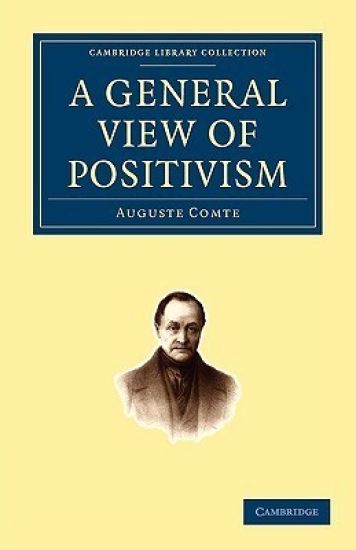
A General View of Positivism

A General View of Positivism

Auguste Comte

Cambridge University Press
2009
pokkari
In A General View of Positivism French philosopher Auguste Comte (1798–1857) gives an overview of his social philosophy known as Positivism. Comte, credited with coining the term 'sociology' and one of the first to argue for it as a science, is concerned with reform, progress and the problem of social order in society. In this English edition of the work, published in 1865, he addresses the practical problems of implementing his philosophy or doctrine, as he also refers to Positivism, into society. He believes that society evolves through a series of stages that are ruled by social laws and culminate in a superior form of social life. During this reorganisation of society, which will find its greatest supporters among women and the working class, a 'new moral power' will emerge. Under the motto 'love, order and progress' Comte wishes humanism to replace organised religion as the object of spiritual worship.
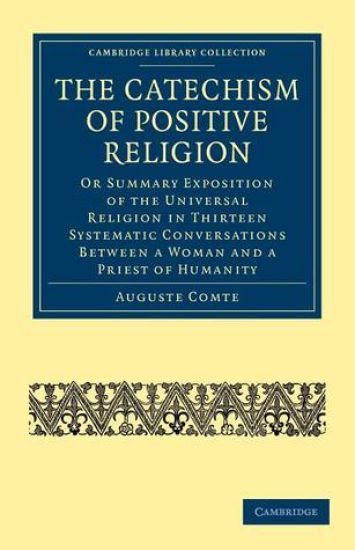
The Catechism of Positive Religion

The Catechism of Positive Religion

Auguste Comte

Cambridge University Press
2009
pokkari
This English edition of The Catechism of Positive Religion was published in 1891, thirty-four years after the death of Comte, the French philosopher of science and politics and founder of positivism, whose work was widely read in the later nineteenth century. Comte's self-published French original of 1852, translated here, outlines his progressive ideal of 'sociocracy', which would provide a systematic basis, free of metaphysics, for intellectual and moral transactions among humans. Congreve's edition, in common with others, divides the book into five parts. The introduction contains two dialogues, entitled General Theory of Religion and Theory of Humanity. Parts 1–3 respectively consider the Positivist's private and public 'worship'; 'doctrine', including the external world and human society and ethics; and 'regime' or way of life, private and public. The final two dialogues cover polytheism, monotheism and theocracy. This book remains of interest as an early precursor of secular humanist ethics.

Comte: Early Political Writings

Comte: Early Political Writings

Auguste Comte

Cambridge University Press
1998
pokkari
This edition of the French philosopher Auguste Comte’s (1798–1857) early essays shows Comte at the heart of the political and intellectual debates of Restoration France. The young Comte forged the central features of his philosophical system in response to the central challenge of the 1820s - how to find a new foundation for political legitimacy and thus to ‘close’ the revolutionary era. Stuart Jones’s introduction to this new edition shows how Comte grappled with problems that confronted liberals and counter-revolutionaries alike, and identifies the novelty of his solution. The essays presented in this edition reveal the systematizing character of Comte’s intellect, which lay at the root of his enormous appeal to nineteenth-century readers. In addition to the substantial introduction, this volume contains a chronology, biographical information on key figures, and a bibliographical note making this an accessible volume highly suitable for undergraduate use.
Comte: Early Political Writings

Comte: Early Political Writings

Auguste Comte

Cambridge University Press
1998
sidottu
This edition of the French philosopher Auguste Comte's (1798–1857) early essays shows Comte at the heart of the political and intellectual debates of Restoration France. The young Comte forged the central features of his philosophical system in response to the central challenge of the 1820s - how to find a new foundation for political legitimacy and thus to 'close' the revolutionary era. Stuart Jones's introduction to this new edition shows how Comte grappled with problems that confronted liberals and counter-revolutionaries alike, and identifies the novelty of his solution. The essays presented in this edition reveal the systematizing character of Comte's intellect, which lay at the root of his enormous appeal to nineteenth-century readers. In addition to the substantial introduction, this volume contains a chronology, biographical information on key figures, and a bibliographical note making this an accessible volume highly suitable for undergraduate use.
Rede über den Geist des Positivismus

Rede über den Geist des Positivismus

Auguste Comte

Felix Meiner
1994
sidottu
Im Discours sur l'esprit positif (1844) begündet Auguste Comte (1798-1857) seinen utopischen Entwurf einer von wissenschaftlichen Prinzipien geleiteten und auf positive Erkenntnisse (wahrgenommene Tatsachen) gestützten zivilisatorischen Erneuerung der bürgerlichen Gesellschaft. Comte untermauert und bestärkt hier den Fortschrittsglauben des frühen 19. Jahrhunderts. Somit gilt der Text als Programm- und Hauptschrift des >klassischen Positivismus