
Kirjailija
Aurel Kolnai
Kirjat ja teokset yhdessä paikassa: 12 kirjaa, julkaisuja vuosilta 1999–2026, suosituimpiin kuuluu Sexualethik. Vertaile teosten hintoja ja tarkista saatavuus suomalaisista kirjakaupoista.
12 kirjaa
Kirjojen julkaisuvuodet: 1999–2026.

The essays in this collection, spanning 1925 to 1970, confirm Aurel Kolnai's place as one of the great conservative theorists of the twentieth century. Kolnai carefully analyzes the leading intellectual positions and thinkers of his day, the dominant social movements, and the prevailing moral influences―psychoanalysis, fascism, and National Socialism. He documents how they run counter to the architecture of civilization. Kolnai is relatively unknown outside philosophical circles, but Politics, Values, and National Socialism provides an overview of his moral philosophy. In most moral philosophy books one finds pages devoted to the major theories of ethics. This volume is different. It seeks to address the larger moral question of what kind of thought works against morality, and by implication, how one can defend morality. Eager to protect "the surviving islands of Liberal Civilization," Kolnai's concern is really one of theory. He shows that much of what passes for moral theory is subversive of moral order. All who think that totalitarianism is a permanent threat, and who suspect that ideas can quickly be dangerously distorted in times of social unrest, will find plenty of clarifying ideas in this volume.
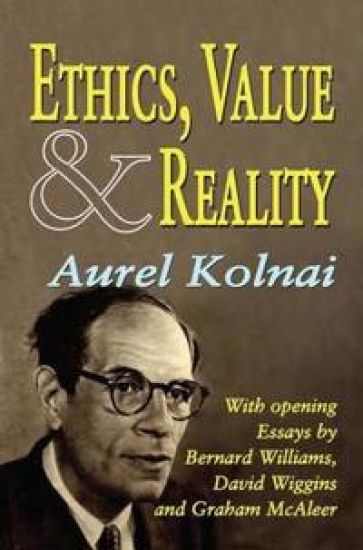
Ethics, Value, and Reality is a collection of essays written after Kolnai settled in England in 1955. These essays from Kolnai's mature years sit atop a remarkable gestation of moral and political thinking. At the heart of his thought is the special role of privilege in a good social order. Kolnai relies heavily on the work of late nineteenth- and early twentieth-century value theorists such as Alexius Meinong, Nicolai Hartmann, and Max Scheler. He blends this continental tradition of ethics with British intuitionism and Scottish Enlightenment articulations. For Kolnai, ethical life cannot be adequately understood except by reference to moral emphasis, and thus, Kolnai can be thought of as a liberal conservative. He acknowledges myriad values, moral and non-moral, and accepts that all can have some claim upon us. Low values as much as high values have a legitimate claim. His is a tolerant conservatism though not for a moment does he forgo the necessity of judgment: a readily graspable hierarchy keeps the respective demands of values in proportion. Kolnai welcomes the call to seriousness, which is the hallmark of existentialism. The ground of Kolnai's thought is the idea of emotion as cognitive. He saw the typical analytical philosopher's fascination with simplicity of explanation not only thoroughly refuted by the gains in understanding wrought by phenomenological method, with its deference to the richness of phenomena, but sensed in the monistic inclination he dreaded a harbinger of totalitarianism. Never denying his emotionalism, he nonetheless made his points well enough by adopting an analytical approach to philosophy and ethics. This is a major work crossing moral and political philosophy.

English summary: This edition of Aurel Kolnai's War against the West (1938) brings one of the first English-language critiques of Nazi ideology to a German-speaking audience interested in contemporary approaches to critically examining Nazism. Kolnai's main goal was to warn the Western world that Nazism threatened its core and its way of life. He accomplished this in his discussion of the basic elements of Nazi ideology, such as anti-Semitism, racial nationalism, and the anti-liberal concept of a people's community (Volksgemeinschaft), which, in his view, amounted to replacing Christianity with the political religion of race. German description: Diese historisch-kritische deutsche Ausgabe des 1938 auf Englisch erschienenen Buches von Aurel Kolnai The War against the West schliesst eine Lucke in der Dokumentation der zeitgenossischen Auseinandersetzungen mit den Ideen des Nationalsozialismus. Kolnai stellte die Unvereinbarkeit des Nationalsozialismus mit dem christlich-humanistischen Wertesystem heraus und hob dessen fundamentalen Gegensatz zur westlichen Demokratie, ihren christlichen Grundlagen und sozialistischen Elementen hervor. Sein Buch verstand Kolnai als Appell an den Westen, auf die existenzielle Bedrohung des burgerlichen Gesellschafts- und Wertesystems durch den Nationalsozialismus politisch angemessen zu reagieren. Der Nationalsozialismus musse ernst genommen werden, anstatt ihn vulgarmarxistisch als wenig originelle Variante eines aggressiv auf seine Existenzkrise reagierenden Kapitalismus zu unterschatzen oder als rein destruktiven Nihilismus zu verkennen. Mit traditionellen politischen Begriffen wie reaktionar und konservativ jedenfalls sei das radikal Neue des Nazismus, das Kolnai an der rassenbiologischen Umgestaltung der deutschen Gesellschaft festmachte, nicht zu fassen. Als Ausdruck deutschen Geistes sei der Nationalsozialismus tief in deutscher Geschichte verwurzelt, auch wenn er keineswegs, wie von ihm beansprucht, Inkarnation des Deutschen sei.
The essays in this collection, spanning 1925 to 1970, confirm Aurel Kolnai's place as one of the great conservative theorists of the twentieth century. Kolnai carefully analyzes the leading intellectual positions and thinkers of his day, the dominant social movements, and the prevailing moral influences—psychoanalysis, fascism, and National Socialism. He documents how they run counter to the architecture of civilization. Kolnai is relatively unknown outside philosophical circles, but Politics, Values, and National Socialism provides an overview of his moral philosophy. In most moral philosophy books one finds pages devoted to the major theories of ethics. This volume is different. It seeks to address the larger moral question of what kind of thought works against morality, and by implication, how one can defend morality. Eager to protect "the surviving islands of Liberal Civilization," Kolnai's concern is really one of theory. He shows that much of what passes for moral theory is subversive of moral order. All who think that totalitarianism is a permanent threat, and who suspect that ideas can quickly be dangerously distorted in times of social unrest, will find plenty of clarifying ideas in this volume.

Psychoanalysis and Sociology
Aurel Kolnai; Eden (TRN) Paul; Cedar (TRN) Paul
Kessinger Pub
2009
pokkari
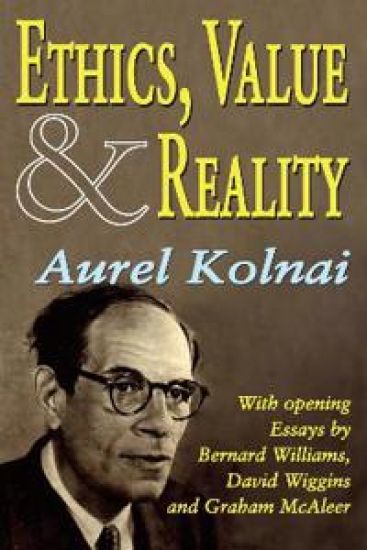
Ethics, Value, and Reality is a collection of essays written after Kolnai settled in England in 1955. These essays from Kolnai's mature years sit atop a remarkable gestation of moral and political thinking. At the heart of his thought is the special role of privilege in a good social order. Kolnai relies heavily on the work of late nineteenth- and early twentieth-century value theorists such as Alexius Meinong, Nicolai Hartmann, and Max Scheler. He blends this continental tradition of ethics with British intuitionism and Scottish Enlightenment articulations. For Kolnai, ethical life cannot be adequately understood except by reference to moral emphasis, and thus, Kolnai can be thought of as a liberal conservative. He acknowledges myriad values, moral and non-moral, and accepts that all can have some claim upon us. Low values as much as high values have a legitimate claim. His is a tolerant conservatism though not for a moment does he forgo the necessity of judgment: a readily graspable hierarchy keeps the respective demands of values in proportion. Kolnai welcomes the call to seriousness, which is the hallmark of existentialism. The ground of Kolnai's thought is the idea of emotion as cognitive. He saw the typical analytical philosopher's fascination with simplicity of explanation not only thoroughly refuted by the gains in understanding wrought by phenomenological method, with its deference to the richness of phenomena, but sensed in the monistic inclination he dreaded a harbinger of totalitarianism. Never denying his emotionalism, he nonetheless made his points well enough by adopting an analytical approach to philosophy and ethics. This is a major work crossing moral and political philosophy.

Aurel Kolnai (1900-1973), ein deutschsprachiger Philosoph jüdischer Herkunft, der in der Tradition der Phänomenologie Husserls und Schelers groß wurde und nach seinem Exil in Nordamerika an der Universität Oxford lehrte, ist mit seinen Studien zu Gefühlen der Aversion zu spätem Ruhm in der analytischen Philosophie Englands gelangt. Die hier versammelten Beiträge über den Ekel, den Haß und den Hochmut zeigen einen Autor, der die herkömmliche Kluft zwischen kontinentaler und analytischer Tradition spielerisch überwindet, indem er in phänomenologischer Einstellung die Struktur und den Gehalt feindlicher Gefühle skrupulös erkundet.

Kolnai made a breakthrough in the phenomenology of aversion when he showed the "double intentionality" of emotions like fear, focusing on both the object of fear and the subjects' concern for his own well-being, this being one of the ways in which fear differs from disgust. In a surprising yet persuasive move, Kolnai argues that disgust is never related to inorganic or non-biological matter, and that its arousal by moral objects has an underlying similarity with its arousal by organic material: a particular combination of life and death. Kolnai gives an analytic list of various kinds of disgusting objects (which should not be read just before lunch) and shows how disgust relates to the five senses.
Ranked by many scholars as one of the most important moral philosophers of the twentieth century, Aurel Kolnai has been inexplicably neglected in this country until quite recently. He is best known for his works of political philosophy, recently published under the title The Utopian Mind: A Critical Study in Moral and Political Philosophy. Here, for the first time ever in English, is Kolnai's magnum opus, his Political Memoirs, superbly annotated and edited by Francesca Murphy of the University of Aberdeen, Scotland. The memoirs recount the author's life, from his childhood in the turn-of-the-century Austro-Hungarian Empire to his education in Germany and his early professional life in prewar Vienna. It was in these formative years that he converted from Judaism to Roman Catholicism and began his career as a writer and philosopher. The narrative continues through his years in exile in the United States and Canada, where he lived before ultimately settling in Great Britain and being granted citizenship in 1955.
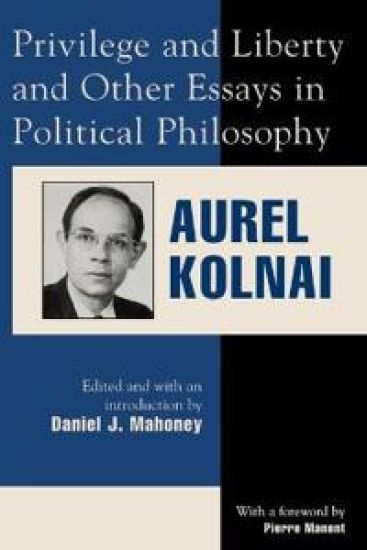
Privilege and Liberty and Other Essays in Political Philosophy
Aurel Kolnai; Pierre Manent
Lexington Books
1999
nidottu
We are currently witnessing an increasingly influential counterrevolution in political theory, evident in the dialectical return to classical political science pioneered most prominently by Leo Strauss and Eric Voegelin. In this context, the work of the relatively unknown Aurel Kolnai is of great importance. Kolnai was one of the greatest thinkers of the twentieth century to place the restoration of common-sense evaluation and philosophical realism at the center of his philosophical and political itinerary. In this volume, Daniel J. Mahoney presents Kolnai's major writings in political philosophy, writings that explore - in ways that are diverse but complementary - Kolnai's critique of progressive or egalitarian democracy. The title essay contains Kolnai's fullest account of the limits of liberty understood as emancipation from traditional, natural, or divine restraints. 'The Utopian Mind,' a pr,cis of Kolnai's critique of utopianism in a posthumous book of the same title, appears here for the first time. 'Conservative and Revolutionary Ethos,' Kolnai's remarkable 1972 essay comparing conservative and revolutionary approaches to political life, appears for the first time in English translation. The volume also includes a critically sympathetic evaluation of Michael Oakeshott's Rationalism in Politics and an incisive criticism of Jacques Maritain's efforts to synthesize Christian orthodoxy and progressive politics. Privilege and Liberty and Other Essays in Political Philosophy is a searching critique of political utopianism, as well as a pathbreaking articulation of conservative constitutionalism as the true support for human liberty properly understood. It is a major contribution to Christian and conservative political reflection in our time.