Kirjojen hintavertailu – 12 903 725 kirjaa ja 27 kauppaa

Kirjailija

Aviad E. Raz

Kirjat ja teokset yhdessä paikassa: 5 kirjaa, julkaisuja vuosilta 1999–2016, suosituimpiin kuuluu Community Genetics and Genetic Alliances. Vertaile teosten hintoja ja tarkista saatavuus suomalaisista kirjakaupoista.

5 kirjaa

Kirjojen julkaisuvuodet: 1999–2016.

Comparative Empirical Bioethics: Dilemmas of Genetic Testing and Euthanasia in Israel and Germany

Comparative Empirical Bioethics: Dilemmas of Genetic Testing and Euthanasia in Israel and Germany

Aviad E. Raz; Silke Schicktanz

Springer International Publishing AG
2016
nidottu
This book is a comprehensive, empirically-grounded exploration of the relationship between bioethics, culture, and the perspective of being affected. It provides a new outlook on how complex “bioethical” issues become questions of everyday life. The authors focus on two contexts, genetic testing and end-of-life care, to locate and demonstrate emerging themes of responsibility, such as self-responsibility, responsibility for kin, and the responsibility of society. Within these themes, the duty to know versus the right not to know one's genetic fate (in the context of genetic testing), or the sanctity of life versus self-determination (in the context of end of life care) are identified as culturally embedded dilemmas that are very much relevant for lay persons. Furthermore, cultural factors such as religion, history, utopian and dystopian views of biomedical technologies, outlooks on the body and on health/illness, and citizenship are examined. Health issues are increasingly becoming a question of assessing risk and responsibility: How can we better prepare ourselves for the future? We all make such assessments in a way that combines personal inclinations, professional recommendations, and cultural framings. There is still much to be learned about the interplay between these three dimensions.

Community Genetics and Genetic Alliances
Carrier testing of adults provides information about the risk of passing a genetic mutation to your children, leading to reproductive (and some say, eugenic) decisions. Excessive carrier screening may have adverse effects, but it can also prevent suffering and open up new reproductive options. Raz's study focuses on the interplay of community genetics (the medical organisation of carrier screening) and genetic alliances (networks of individuals at risk), exploring how 'genetic communities' are emerging both within existing ethnic groups and around patients' organizations. While the interplay between carrier testing, reproduction and eugenics has sparked many discussions, this study provides a novel and much-needed perspective on its actual implementation and interpretation by community members. Conflating a cross-cultural spectrum of genetic communities, the benefits and perils of supporting (or restricting) carrier screening are located within broader social issues such as religion, ethnicity, multi-culturalism, abortion, stigmatization, suffering and care-giving. While carrier screening emerges as ultimately a morally justified pronatalist endeavour for the reduction of suffering, thus being different in principle from the 'old' eugenics, it can also carry unintended adverse consequences if left unattended to consumers, communities, or health professionals.
Community Genetics and Genetic Alliances
Carrier testing of adults provides information about the risk of passing a genetic mutation to your children, leading to reproductive (and some say, eugenic) decisions. Excessive carrier screening may have adverse effects, but it can also prevent suffering and open up new reproductive options. Raz's study focuses on the interplay of community genetics (the medical organisation of carrier screening) and genetic alliances (networks of individuals at risk), exploring how 'genetic communities' are emerging both within existing ethnic groups and around patients' organizations. While the interplay between carrier testing, reproduction and eugenics has sparked many discussions, this study provides a novel and much-needed perspective on its actual implementation and interpretation by community members. Conflating a cross-cultural spectrum of genetic communities, the benefits and perils of supporting (or restricting) carrier screening are located within broader social issues such as religion, ethnicity, multi-culturalism, abortion, stigmatization, suffering and care-giving. While carrier screening emerges as ultimately a morally justified pronatalist endeavour for the reduction of suffering, thus being different in principle from the 'old' eugenics, it can also carry unintended adverse consequences if left unattended to consumers, communities, or health professionals.
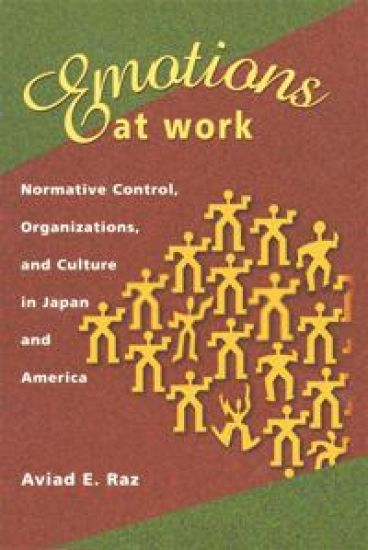
Emotions at Work

Emotions at Work

Aviad E. Raz

Harvard University Press
2002
sidottu
Our work life is filled with emotions. How we feel on the job, what we say we feel, and what feelings we display—all these are important aspects of organizational behavior and workplace culture. Rather than focusing on the psychology of personal emotions at work, however, this study concentrates on emotions as role requirements, on workplace emotions that combine the private with the public, the personal with the social, and the authentic with the masked. In this cross-cultural study of "emotion management," the author argues that even though the goals of normative control in factories, offices, and shops may be similar across cultures, organizational structure and the surrounding culture affect how that control is discussed and conceived.
Riding the Black Ship

Riding the Black Ship

Aviad E. Raz

Harvard University Press
1999
nidottu
In 1997, over 17 million people visited Tokyo Disneyland, making it the most popular of the many theme parks in Japan. Since it opened in 1983, Tokyo Disneyland has been analyzed mainly as an example of the globalization of the American leisure industry and its organizational culture, particularly the “company manual.” By looking at how Tokyo Disneyland is experienced by employees, management, and visitors, Aviad Raz produces not only a cultural reading of the onstage show but also an ethnographic analysis of its production by those who work there and its reception by its customers. Previous studies have seen Disneyland as a “black ship”—an exported, hegemonic model of American leisure and pop culture—that “conquered” Japan. By concentrating on the Japanese point of view, Raz shows that it is much more an example of successful domestication and that it has succeeded precisely because it has become Japanese even while marketing itself as foreign. Rather than being an agent of Americanization, Tokyo Disneyland is a simulated “America” showcased by and for the Japanese.