Kirjojen hintavertailu – 12 903 725 kirjaa ja 27 kauppaa

Kirjailija

Avik Ghosh

Kirjat ja teokset yhdessä paikassa: 5 kirjaa, julkaisuja vuosilta 2016–2025, suosituimpiin kuuluu Fundamentals Of Electronic Materials And Devices: A Gentle Introduction To The Quantum-classical World. Vertaile teosten hintoja ja tarkista saatavuus suomalaisista kirjakaupoista.

5 kirjaa

Kirjojen julkaisuvuodet: 2016–2025.

Modeling of Electrical Machines

Modeling of Electrical Machines

Arabinda Das; Avik Ghosh; Arunava Kabiraj Thakur

Lap Lambert Academic Publishing
2025
pokkari
Synchronous generators generate electricity at 50 Hz (60 Hz in the U. S.). When driven by steam turbines at high speeds, they are called turbogenerators, while those powered by water at lower speeds are hydrogenerators. Large motors for load management are usually induction motors with squirrel cage construction. Initially, isolated prime-mover generator sets were used, with later advancements introducing synchronization and parallel operation of alternators. Over time, power stations were linked to form power pools, which eventually connected into large, complex grid systems. Engineers have continually developed models for turbogenerators and hydrogenerators for reliable parallel operation. Key control systems include boiler-firing control, turbine-governor control, and exciter-AVR controls for turbogenerators, while hydrogenerators require the latter two and modeling for static and transient droop. Early models followed guidelines by Blondel, Nickle, and Doherty, later expanded by R. H. Park for transient analysis. Computer methods for stability analysis have advanced through ongoing research. This book presents seven chapters on modeling synchronous motors.

Fundamentals Of Electronic Materials And Devices: A Gentle Introduction To The Quantum-classical World
The Romans built enduring bridges well before Newton came along, armed simply with a working knowledge of mechanics and materials. In contrast, today's bridge building is an elaborate enterprise involving CAD tools, composite materials and acoustic imaging. When technology is pushed to its limits, a working knowledge proves inadequate, and an in-depth understanding of core physical principles, both macroscopic and microscopic, top-down vs bottom-up, becomes essential. We find ourselves today at a similar crossroad in semiconductor device technology, where a working knowledge of solid state electronics is no longer enough. Faced with the prohibitive cost of computing and the slowdown of chip manufacturing, device scaling and the global supply chain, the semiconductor industry is forced to explore alternate platforms such as 2-D materials, spintronics, analog processing and quantum engineering. This book combines top-down classical device physics with bottom-up quantum transport in a single venue to provide the basis for such a scientific exploration. It is essential, easy reading for beginning undergraduate and practicing graduate students, physicists unfamiliar with device engineering and engineers untrained in quantum physics. With just a modest pre-requisite of freshman maths, the book works quickly through key concepts in quantum physics, Matlab exercises and original homeworks, to cover a wide range of topics from chemical bonding to Hofstader butterflies, domain walls to Chern insulators, solar cells to photodiodes, FinFETs to Majorana fermions. For the practicing device engineer, it provides new concepts such as the quantum of resistance, while for the practicing quantum physicist, it provides new contexts such as the tunnel transistor.
Fundamentals Of Electronic Materials And Devices: A Gentle Introduction To The Quantum-classical World
The Romans built enduring bridges well before Newton came along, armed simply with a working knowledge of mechanics and materials. In contrast, today's bridge building is an elaborate enterprise involving CAD tools, composite materials and acoustic imaging. When technology is pushed to its limits, a working knowledge proves inadequate, and an in-depth understanding of core physical principles, both macroscopic and microscopic, top-down vs bottom-up, becomes essential. We find ourselves today at a similar crossroad in semiconductor device technology, where a working knowledge of solid state electronics is no longer enough. Faced with the prohibitive cost of computing and the slowdown of chip manufacturing, device scaling and the global supply chain, the semiconductor industry is forced to explore alternate platforms such as 2-D materials, spintronics, analog processing and quantum engineering. This book combines top-down classical device physics with bottom-up quantum transport in a single venue to provide the basis for such a scientific exploration. It is essential, easy reading for beginning undergraduate and practicing graduate students, physicists unfamiliar with device engineering and engineers untrained in quantum physics. With just a modest pre-requisite of freshman maths, the book works quickly through key concepts in quantum physics, Matlab exercises and original homeworks, to cover a wide range of topics from chemical bonding to Hofstader butterflies, domain walls to Chern insulators, solar cells to photodiodes, FinFETs to Majorana fermions. For the practicing device engineer, it provides new concepts such as the quantum of resistance, while for the practicing quantum physicist, it provides new contexts such as the tunnel transistor.
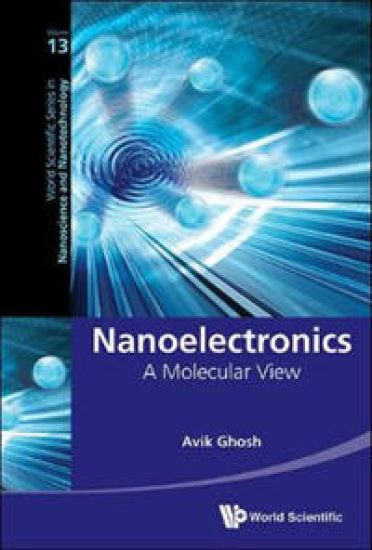
Nanoelectronics: A Molecular View

Nanoelectronics: A Molecular View

Avik Ghosh

World Scientific Publishing Co Pte Ltd
2016
sidottu
'This is one of the best available graduate-level textbooks on electronic transport at the nanoscale. Its unique feature is providing a thorough and completely self-contained treatment of several theoretical formalisms for treating the transport problem. As such, the book is useful not only for the graduate students working in the field of nanoscale electrical transport, but also for the researchers who wish to expand their knowledge of various fundamental issues associated with this rapidly developing field. Of particular note are deep physical insights accompanying the rigorous mathematical derivations in each of the chapters, as well as the clear statement of all the approximations involved in a particular theoretical formalism. This winning combination makes the book very accessible to a reader with basic knowledge of quantum mechanics, solid state theory and thermodynamics/statistical mechanics. I give this book the highest recommendation.' [Read Full Review]Serfei A EgorovUniveristy of Virginia, USAThis book is aimed at senior undergraduates, graduate students and researchers interested in quantitative understanding and modeling of nanomaterial and device physics. With the rapid slow-down of semiconductor scaling that drove information technology for decades, there is a pressing need to understand and model electron flow at its fundamental molecular limits. The purpose of this book is to enable such a deconstruction needed to design the next generation memory, logic, sensor and communication elements. Through numerous case studies and topical examples relating to emerging technology, this book connects 'top down' classical device physics taught in electrical engineering classes with 'bottom up' quantum and many-body transport physics taught in physics and chemistry. The book assumes no more than a nodding acquaintance with quantum mechanics, in addition to knowledge of freshman level mathematics. Segments of this book are useful as a textbook for a course in nano-electronics.
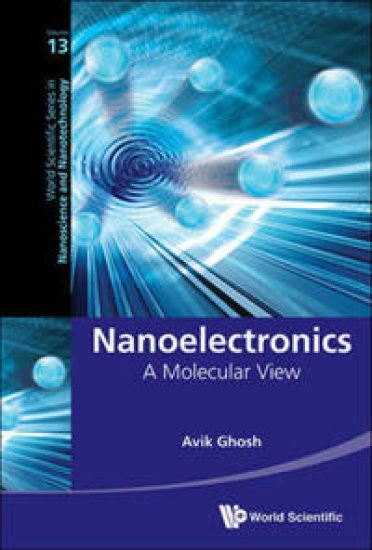
Nanoelectronics: A Molecular View

Nanoelectronics: A Molecular View

Avik Ghosh

World Scientific Publishing Co Pte Ltd
2016
nidottu
'This is one of the best available graduate-level textbooks on electronic transport at the nanoscale. Its unique feature is providing a thorough and completely self-contained treatment of several theoretical formalisms for treating the transport problem. As such, the book is useful not only for the graduate students working in the field of nanoscale electrical transport, but also for the researchers who wish to expand their knowledge of various fundamental issues associated with this rapidly developing field. Of particular note are deep physical insights accompanying the rigorous mathematical derivations in each of the chapters, as well as the clear statement of all the approximations involved in a particular theoretical formalism. This winning combination makes the book very accessible to a reader with basic knowledge of quantum mechanics, solid state theory and thermodynamics/statistical mechanics. I give this book the highest recommendation.' [Read Full Review]Serfei A EgorovUniveristy of Virginia, USAThis book is aimed at senior undergraduates, graduate students and researchers interested in quantitative understanding and modeling of nanomaterial and device physics. With the rapid slow-down of semiconductor scaling that drove information technology for decades, there is a pressing need to understand and model electron flow at its fundamental molecular limits. The purpose of this book is to enable such a deconstruction needed to design the next generation memory, logic, sensor and communication elements. Through numerous case studies and topical examples relating to emerging technology, this book connects 'top down' classical device physics taught in electrical engineering classes with 'bottom up' quantum and many-body transport physics taught in physics and chemistry. The book assumes no more than a nodding acquaintance with quantum mechanics, in addition to knowledge of freshman level mathematics. Segments of this book are useful as a textbook for a course in nano-electronics.