Kirjojen hintavertailu – 12 868 504 kirjaa ja 27 kauppaa

Kirjailija

Avinash K. Dixit

Kirjat ja teokset yhdessä paikassa: 9 kirjaa, julkaisuja vuosilta 1990–2025, suosituimpiin kuuluu Spieltheorie für Einsteiger. Vertaile teosten hintoja ja tarkista saatavuus suomalaisista kirjakaupoista.

9 kirjaa

Kirjojen julkaisuvuodet: 1990–2025.

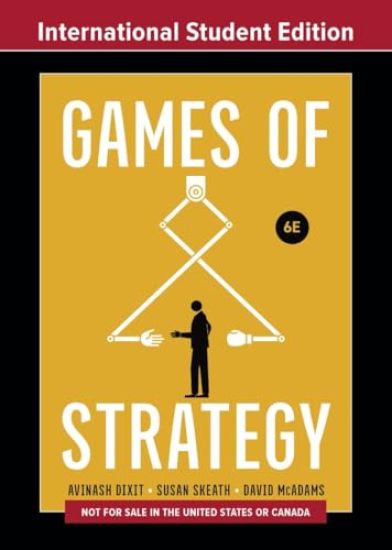
Games of Strategy

Games of Strategy

Avinash K. Dixit; Susan Skeath; David McAdams

WW NORTON CO
2025
nidottu

Halvin toimitettuna 82,80 €

From the minds of renowned economists Avinash Dixit, Susan Skeath, and David McAdams comes the Sixth Edition of the most approachable game theory text, rooted in rigorous research and engaging examples. Assuming no prior knowledge of game theory—only a principles level of economic education—and exposure to only high-school level algebra, this book’s examples appeal to students of all different interests and experiences while maintaining an empirical approach. The new edition applies game theory to topics like digital currency and the politics of the war in Ukraine, and includes more thorough coverage of behavioral economics as well as new material on auction design.
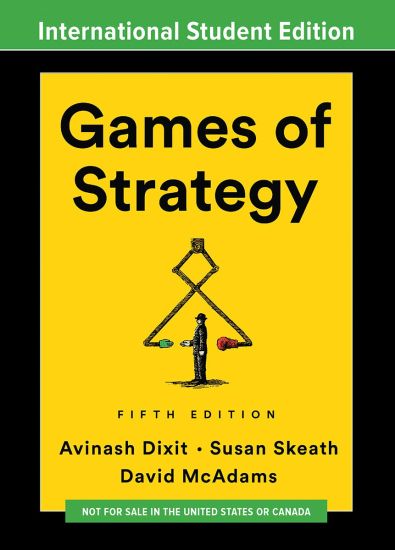
Games of Strategy

Games of Strategy

Avinash K. Dixit; Susan Skeath; David McAdams

WW Norton Co
2020
nidottu
Games of Strategy is beloved by students and instructors alike for its flexible organisation, focus on problem-solving and engaging and accessible examples from diverse fields, like political science, biology and business. The completely revised Fifth Edition adds the work of David McAdams, especially in the areas of market design and auction theory, and provides new insights into diverse applications, such as billion-dollar buy-outs, job offer negotiation, the Cuban Missile Crisis and collusion in the school milk market.
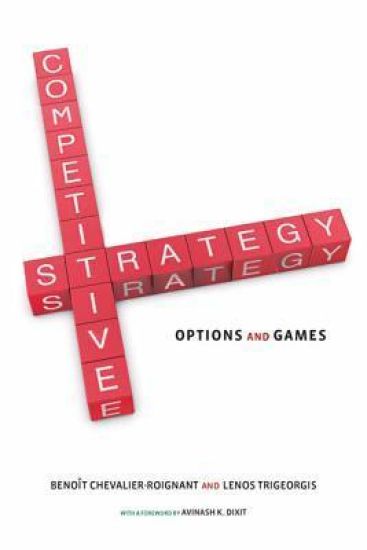
Competitive Strategy

Competitive Strategy

Benoit Chevalier-Roignant; Lenos Trigeorgis; Avinash K. Dixit

MIT Press
2014
pokkari
A new paradigm for balancing flexibility and commitment in management strategy through the amalgamation of real options and game theory. Corporate managers who face both strategic uncertainty and market uncertainty confront a classic trade-off between commitment and flexibility. They can stake a claim by making a large capital investment today, influencing their rivals' behavior, or they can take a "wait and see" approach to avoid adverse market consequences tomorrow. In Competitive Strategy, Benoit Chevalier-Roignant and Lenos Trigeorgis describe an emerging paradigm that can quantify and balance commitment and flexibility, "option games," by which the decision-making approaches of real options and game theory can be combined. The authors first discuss prerequisite concepts and tools from basic game theory, industrial organization, and real options analysis, and then present the new approach in discrete time and later in continuous time. Their presentation of continuous-time option games is the first systematic coverage of the topic and fills a significant gap in the existing literature. Competitive Strategy provides a rigorous yet pragmatic and intuitive approach to strategy formulation. It synthesizes research in the areas of strategy, economics, and finance in a way that is accessible to readers not necessarily expert in the various fields involved.
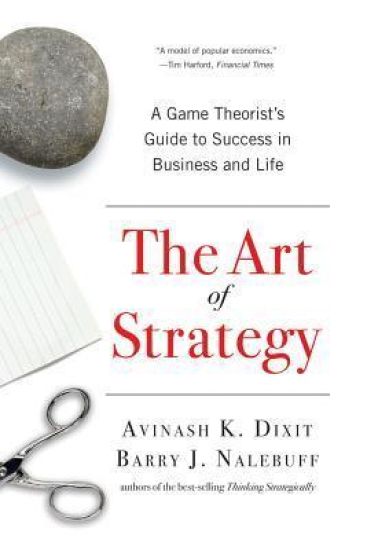
The Art of Strategy

The Art of Strategy

Avinash K. Dixit; Barry J. Nalebuff

WW Norton Co
2010
nidottu

Halvin toimitettuna 22,00 €

Game theory means rigorous strategic thinking. It’s the art of anticipating your opponent’s next moves, knowing full well that your rival is trying to do the same thing to you. Though parts of game theory involve simple common sense, much is counterintuitive, and it can only be mastered by developing a new way of seeing the world. Using a diverse array of rich case studies—from pop culture, TV, movies, sports, politics, and history—the authors show how nearly every business and personal interaction has a game-theory component to it. Mastering game theory will make you more successful in business and life, and this lively book is the key to that mastery.
Lawlessness and Economics

Lawlessness and Economics

Avinash K. Dixit

Princeton University Press
2007
pokkari
How can property rights be protected and contracts be enforced in countries where the rule of law is ineffective or absent? How can firms from advanced market economies do business in such circumstances? In Lawlessness and Economics, Avinash Dixit examines the theory of private institutions that transcend or supplement weak economic governance from the state. In much of the world and through much of history, private mechanisms--such as long-term relationships, arbitration, social networks to disseminate information and norms to impose sanctions, and for-profit enforcement services--have grown up in place of formal, state-governed institutions. Even in countries with strong legal systems, many of these mechanisms continue under the shadow of the law. Numerous case studies and empirical investigations have demonstrated the variety, importance, and merits, and drawbacks of such institutions. This book builds on these studies and constructs a toolkit of theoretical models to analyze them. The models shed new conceptual light on the different modes of governance, and deepen our understanding of the interaction of the alternative institutions with each other and with the government's law. For example, one model explains the limit on the size of social networks and illuminates problems in the transition to more formal legal systems as economies grow beyond this limit. Other models explain why for-profit enforcement is inefficient. The models also help us understand why state law dovetails with some non-state institutions and collides with others. This can help less-developed countries and transition economies devise better processes for the introduction or reform of their formal legal systems.
The Making of Economic Policy

The Making of Economic Policy

Avinash K. Dixit

MIT Press
1998
pokkari
The Making of Economic Policy begins by observing that most countries' trade policies are so blatantly contrary to all the prescriptions of the economist that there is no way to understand this discrepancy except by delving into the politics. The same is true for many other dimensions of economic policy. Avinash Dixit looks for an improved understanding of the politics of economic policy-making from a transaction cost perspective. Such costs of planning, implementing, and monitoring an exchange have proved critical to explaining many phenomena in industrial organization. Dixit discusses the variety of similar transaction costs encountered in the political process of making economic policy and how these costs affect the operation of different institutions and policies. Dixit organizes a burgeoning body of research in political economy in this framework. He uses U. S. fiscal policy and the General Agreement on Tariffs and Trade (GATT) as two examples that illustrate the framework, and show how policy often deviates from the economist's ideal of efficiency. The approach reveals, however, that some seemingly inefficient practices are quite creditable attempts to cope with transaction costs such as opportunism and asymmetric information. Copublished with the Center for Economic Studies and the Ifo Institute
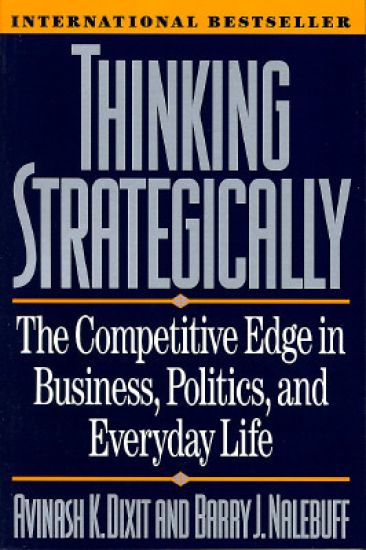
Thinking Strategically

Thinking Strategically

Avinash K. Dixit; Barry J. Nalebuff

WW Norton Co
1993
nidottu

Halvin toimitettuna 26,60 €

A major bestseller in Japan, Financial Times Top Ten book of the year, Book-of-the-Month Club bestseller, and required reading at the best business schools, Thinking Strategically is a crash course in outmaneuvering any rival. This entertaining guide builds on scores of case studies taken from business, sports, the movies, politics, and gambling. It outlines the basics of good strategy making and then shows how you can apply them in any area of your life.
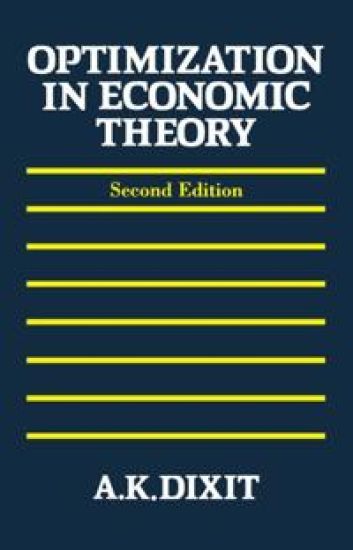
Optimization in Economic Theory

Optimization in Economic Theory

Avinash K. Dixit

Oxford University Press
1990
nidottu
* This is the new edition of a popular student textbook. The first edition was well-received. The author has made revisions and additions to enhance the book's usefulness without destroying its distinctive character as a lucid, thorough, and readable text. It gives a broad treatment of optimization methods, building on simple economic theory and elementary linear algebra and calculus, and reinforcing each new mathematical idea by relating it to its economics application.