Kirjojen hintavertailu – 12 903 724 kirjaa ja 27 kauppaa

Kirjailija

B. Baert

Kirjat ja teokset yhdessä paikassa: 10 kirjaa, julkaisuja vuosilta 2006–2021, suosituimpiin kuuluu Kairos or Occasion as Paradigm in the Visual Medium. Vertaile teosten hintoja ja tarkista saatavuus suomalaisista kirjakaupoista.

10 kirjaa

Kirjojen julkaisuvuodet: 2006–2021.

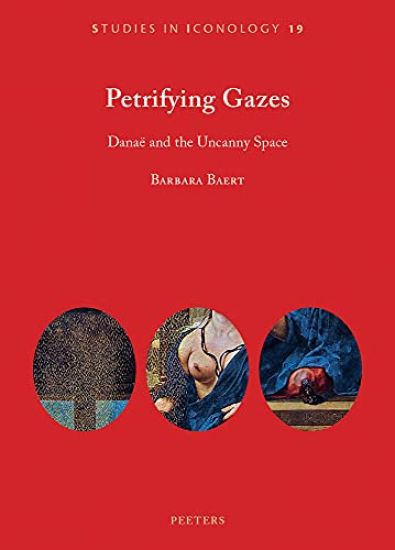
Petrifying Gazes

Petrifying Gazes

B. Baert

PEETERS PUBLISHERS
2021
nidottu
Of all the ancient myths where rain plays an important role, the impregnation of Danaë by Zeus through a golden rain is perhaps the one most often depicted in art. This essay is dedicated to the artistic afterlife of the myth, with special focus on the painting of Danaë (1527) by Jan Gossaert van Mabuse (1478-1532). Gossaert’s Danaë is a sophisticated articulation of outer and inner discourse: the hard, dry, background, with its eclectic architecture, in contrast with the sweltering, moist, foreground with the figure’s naked body. This essay develops Gossaert’s complex phantasmata surrounding architecture, decoration, and the female body in three spaces: the intimate space of impregnation, the psychosomatic space, and, third, the petrifying space of Medusa. Barbara Baert writes: “Danaë is the living emanation of painting as the uttermost exhibitionistic medium. Her unveiled skin fragile exposed in the midst of an overwhelming symphonic outburst of details, facades, windows. Danaë: martyr of glossy materials - marble and flesh - unable to disappear in her own skin; held hostage within a medium of walls. Her only desire is to disappear in the ultimate thin membrane, to vaporize beyond the harsh brocks and, then, at the very end, leave the medium of textile too. There were threads become drippings, lines become tears.”
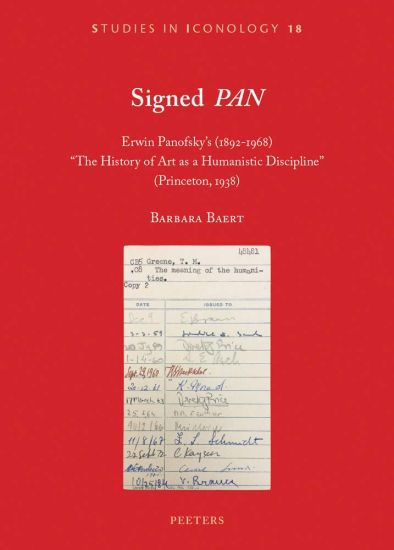
Signed 'PAN'

Signed 'PAN'

B. Baert

PEETERS PUBLISHERS
2020
nidottu
In 1935 Erwin Panofsky (1892-1968) was appointed the first ‘permanent member’ of the School of Humanistic Studies (now the School of Historical Studies) at the Institute for Advanced Study in Princeton. The famous institute was founded by the American educator Abraham Flexner (1866-1959). This essay contributes to the content and context of Panofsky’s important lecture “The History of Art as a Humanistic Discipline” from1938. The publication of that lecture functioned as a manifesto written by an intellectual émigré in a new American context. It is thanks to Panofsky that the locus classicus of iconography, as Irving Lavin (1927-2019) described the Institute for Advanced Study, received the compelling arguments for an “art history that deserves to be counted among the humanities.” A close reading of the text and an analysis of its impact can still teach us something about the origins and development of the Art Historical field and Iconological Studies today.
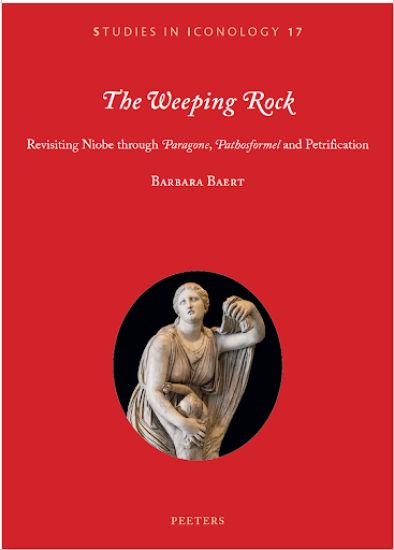
The Weeping Rock

The Weeping Rock

B. Baert

PEETERS PUBLISHERS
2020
nidottu
Publius Ovid (43 BC-17/18 AD) describes in his Metamorphoses Niobe’s transformation into a weeping rock. Niobe’s transformation incorporates the form and matter of the medium of sculpture. According to the humanist paragone debate, painting and sculpture struggle to be the medium with the highest qualities of virtuosity. Aby Warburg (1866-1929) refers to the Niobe motif’s Nachleben in his Tafel 5: Beraubte Mutter. (Niobe, Flucht und Schrecken). This displays the images of both the bereaved mother (Niobe) and the murderous mother (Medea). The montage also introduces the theme of the descent to the underworld. It becomes clear how the cluster of motifs around the figure of Niobe - hybris, lamentatio and the chthonic substrate - functions as a direct entry to a bipolar hermeneutics of the visual medium: the ‘historical psychology of human expression’ that navigates between Apollo and Dionysus. The 'weeping rock' that according to legend still stands on Mount Sipylus in Turkey, draws upon deeper anthropological patterns. Petrification indicates inertia, frigidity and a Medusan psychosis of fear. In nature, stones and rocks have a 'slumbering insistence' that can be captivating. Stones are after all visible but impenetrable, they index an irrevocable absence in their presence, and ‘have abode’ in an otherworldly region of utter blindness and silence. From a psychoanalytical perspective, Niobe’s petrifaction symbolises the straitening of her life and the loss of anima within a culture divorced from authentic feeling, nature, and instinct. Here Niobe meets Echo.
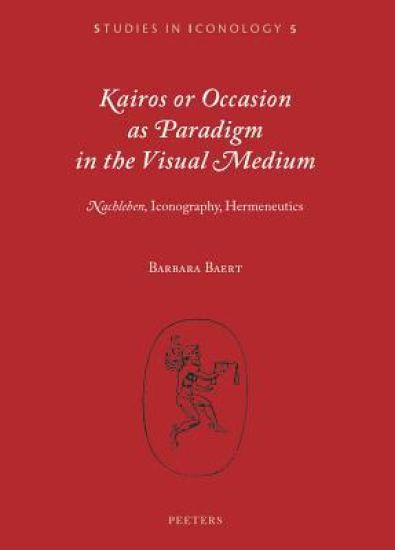
Kairos or Occasion as Paradigm in the Visual Medium
The meaning of tearing and splitting as a life-, love- and wisdom-generating event (for example, the tearing of the temple curtain) is profoundly rooted in the visual and literary 'bodies' of ancient and Christian thought. The primordial cosmogonic split is always sudden, is always sharp (like a knife), appears as a flash (sudden and all encompassing) and is experienced through the whole bodily sensorium (in shivering, bliss, sigh, wind, breath). The split is the epiphany of radical change, revolution and the transition beyond. The Greek deity Kairos embodies this mystery. The reach of Kairos can be detected in the theory of rhetoric (Sophists vs. Aristotle (385-322 BC)), in humanistic politics, in postmodern theology and in contemporary time-management. Iconographical studies have treated Kairos's Nachleben in Byzantine and Latin visual traditions where the god is conflated with Fortuna and Occasio. This essay addresses the impact of Kairos and its iconographic Nachleben from a literary and historical perspective, and further considers Kairos as a new art historical paradigm. Indeed, Kairos can offer us alternative hermeneutics to reconceive the image as chronotopos, as epiphany and as intercession.
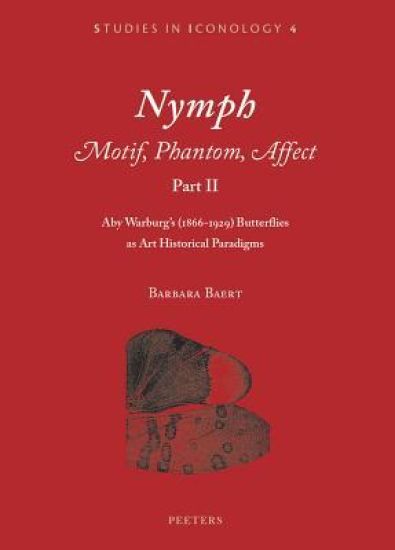
Nymph. Motif, Phantom, Affect. Part II

Nymph. Motif, Phantom, Affect. Part II

B. Baert

PEETERS PUBLISHERS
2016
nidottu
This essay, a meditation on the butterfly and its resonance in art history, is organized in three parts. I begin with Aby Warburg's fascination with moths and butterflies as documented by (1) his letters to André Jolles (e.g. the letter from 1900 known as 'But such high-flown movements are not for me'), (2) the Kreuzlingen pathological report and archives by Ludwig Binswanger (1881-1966) preserved in Tübingen, and (3) the Ninfa fiorentina file in the Warburg Institute. As Seelentierchen - soul animals, psychè - butterflies are archetypically connected to deep cultural affects regarding the soul, resurrection and immortality. Part 2 of the paper considers the butterfly as paradigm for the visual medium and the oculocentric paradigms in art history. Indeed, the butterfly has a specific visual (and sensory) impact on humankind with its flashy, quick, vibrant and hypnotic wings, its medusian eyes and its capability to camouflage itself (cf. 'Sciences diagonales' by Roger Caillois (1913-1978)). Hypnosis, Medusa and camouflage are three important paradigms with which to consider the essence of the image as a dis/appearing, enchanting, and deceiving medium. In Part 3, the three paradigms become the basis for new reflections about art history (and the history of art history) as a study of the butterfly, in short, as 'lepidopterology'.
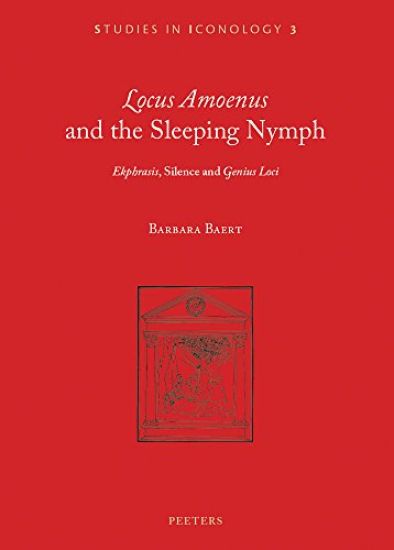
'locus Amoenus' and the Sleeping Nymph: 'ekphrasis', Silence, and 'genius Loci'
In his late 15th century chronicle (ca 1477-1484), Michael Fabricius Ferrarinus (died between 1488-1493), prior of the Carmelite cloister in Reggio Emilia, introduced the rumour that an ancient fountain had been found super ripam Danuvii (on the banks of the Danube) with the sculpted figure of a sleeping nymph. According to Ferrarinus, the fountain bore a peculiar epigram: HVIVS NYMPHA LOCI, SACRI CVSTODIA FONTIS, DORMIO, DVM BLANDAE SENTIO MVRMVR AQVAE. PARCE MEVM, QVISQVIS TANGIS CAVA MARMORA, SOMNVM RVMPERE. SIVE BIBAS SIVE LAVERE TACE. Many scholars have discussed the impact of the rumour as creating a prototype for Renaissance sculptures of the sleeping nymph in Rome and for the development of the well-known genre of the sleeping Venus in painting. Building upon the previous studies, this essay contextualizes the phenomenon of the sleeping nymph and its textual and artistic Nachleben from the point of view of the locus amoenus as silence. This study combines iconological, aesthetical-philosophical and anthropological approaches, and contributes to a better understanding of sleep, voyeurism, water and silence within the context of the nymph's particular genius loci.
Pneuma and the Visual Medium in the Middle Ages and Early Modernity
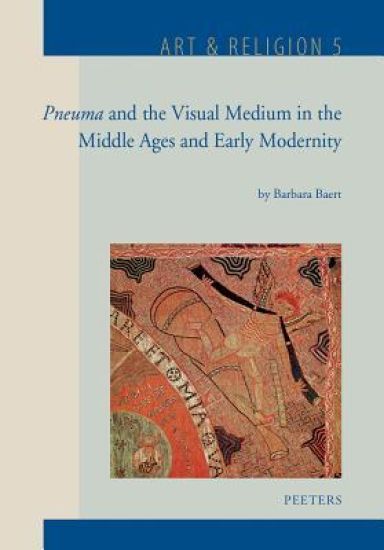
The focus of these essays is the impact of wind, pneuma, and movement in medieval and early modern iconography on art historical hermeneutics. What can wind, pneuma, and movement tell us about the visual medium as such? Wind joins, flows, links, changes direction – in short, the wind is capricious. In its capriciousness wind embodies a particular hermeneutics of association, of freedom and the unexpected. Is an iconography of this caprice possible? How does one capture in pictorial form a natural phenomenon that envelops and penetrates us, even escapes from our own bodies? The dynamics of wind are after all only indirectly visible: swaying trees, waving grass, fluttering textile. How has wind impregnated the theory of the image? Is it a question of visual pneuma? And is wind in the arts a question of content, or rather a matter of formal affect?
Late Medieval Enclosed Gardens of the Low Countries
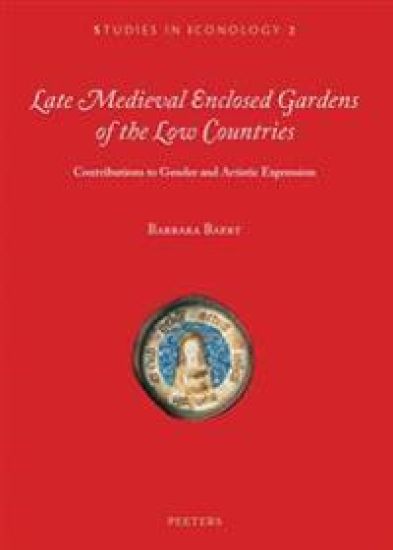
During the Late Middle Ages a unique type of 'mixed media' recycled and remnant art arose in houses of religious women in the Low Countries: Enclosed Gardens. These are retables, sometimes with painted side panels, the central section filled not only with narrative sculpture, but also with all sorts of trinkets and hand-worked textiles. Adornments include relics, wax medallions, gemstones set in silver, pilgrimage souvenirs, parchment banderoles, flowers made from textiles with silk thread, semi-precious stones, pearls and quilling (a decorative technique using rolled paper). The ensemble is an impressive and one-of-a-kind display and presents as an intoxicating garden. In this essay the exceptional heritage of such Enclosed Gardens is interpreted from a range of approaches. The Enclosed Garden is studied as a symbol of paradise and mystical union, as the sanctuary of interiority, as the sublimation of the sensorium (in particular the sense of smell), as a typical gendered product, and as a centre of psycho-energetic creative processes.
Nymph. Motif, Phantom, Affect

Nymph. Motif, Phantom, Affect

B. Baert

PEETERS PUBLISHERS
2014
nidottu
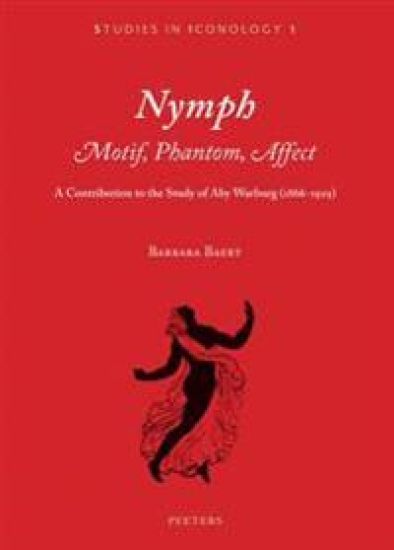
Behind them, close to the open door, there runs - no, that is not the word, there flies, or rather there hovers - the object of my dreams, which slowly assumes the proportion of a harming nightmare. A fantastic figure - should I call her a servant girl, or rather a classical nymph? (...) This lively, light-footed and rapid gait, this striding step, which contrasts with the aloof distance of all other figures, what is the meaning of it all? (...) My condition varied between a bad dream and a fairy tale (...). I lost my reason. It was always she who brought life and movement into an otherwise calm scene. Indeed, she appeared to be the embodiment of movement (...) but is it very unpleasant to be her lover? (...) Who is she? Where does she come from? Have I encountered her before? I mean one and a half millennia earlier? Does she come from a noble Greek lineage, and did her great-grandmother have an affair with people from Asia Minor, Egypt or Mesopotamia? pAby Warburg (1866-1929)
«Noli me tangere». Maria Magdalena in veelvoud

«Noli me tangere». Maria Magdalena in veelvoud

B. Baert; R. Bieringer; K. Demasure; S. Van Den Eynde

PEETERS PUBLISHERS
2006
nidottu
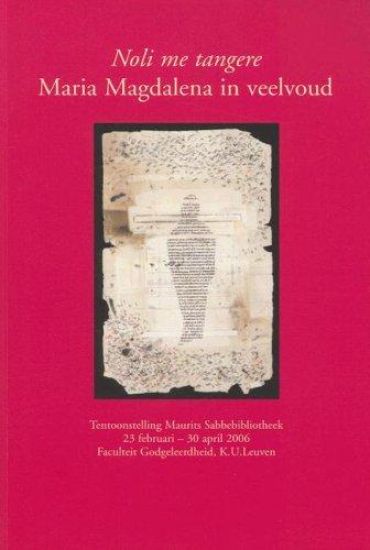
Noli me tangere', zegt de verrezen Christus tegen Maria Magdalena volgens de Latijnse bijbelvertaling van Johannes 20,17. Weinig bijbelse uitspraken hebben zoveel interesse gewekt van zowel kunstenaars als theologen als deze drie intrigerende woorden. Het «Noli me tangere»-motief ligt aan de basis van het door het Fonds voor Wetenschappelijk Onderzoek - Vlaanderen gefinancierde interdisciplinaire onderzoeksproject 'Maria Magdalena en het aanraken van Jezus. Een intra- en interdisciplinair onderzoek naar de interpretatie van Johannes 20,17 in exegese, iconografie en pastorale begeleiding'. In samenwerking met het Centrum Vrouwenstudies Theologie van de Faculteit Godgeleerdheid van de Katholieke Universiteit Leuven organiseerde de onderzoeksgroep in de Maurits Sabbebibliotheek een tentoonstelling onder de titel '«Noli me tangere». Maria Magdalena in veelvoud' (23 februari tot 30 april 2006). In het eerste deel van deze tentoonstellingscatalogus exploreren de vier promotoren van dit project, Sabine Van den Eynde, Raimund Bieringer, Karlijn Demasure en Barbara Baert de betekenis van het «Noli me tangere»-motief elk vanuit de eigen discipline. In het tweede deel van de catalogus worden de bijna dertig tentoongestelde stukken telkens met een kleurenafbeelding geïllustreerd en besproken. De kunstwerken zijn afkomstig uit diverse periodes, gaande van de vijftiende tot de eenentwintigste eeuw. Diversiteit is ook troef als men de genres en de artistieke media bekijkt: grafiek, schilderkunst, beeldhouwkunst en miniatuurkunst naast volkse reproducties. De onderzoeksgroep heeft ook hedendaagse kunstenaars uitgenodigd om hun visie weer te geven op het «Noli me tangere»-motief. De Indiase kunstenares Lucy D'Souza maakte een schilderij op het snijpunt van christendom en hindoeïsme. De fotografe Malou Swinnen portretteert een Filippijns model, terwijl de kalligraaf Brody Neuenschwander een sculptuur gemaakt heeft bedekt met een sluier met letters. De schilderes Claire Vanden Abbeele en de schilder Jan Vanriet waren bereid om hun reeds bestaande «Noli me tangere» ter beschikking te stellen. Op deze manier verbindt de tentoonstelling artistieke periodes, artistieke media en diverse werelddelen. «Noli me tangere: Maria Magdalena in veelvoud» wil u een Maria Magdalena aanbieden die verleden en heden verbindt.