
Kirjailija
B.L.van der Waerden
Kirjat ja teokset yhdessä paikassa: 9 kirjaa, julkaisuja vuosilta 1993–2014, suosituimpiin kuuluu Algebra I. Vertaile teosten hintoja ja tarkista saatavuus suomalaisista kirjakaupoista.
Nimi esiintyy myös muodoissa: B. L. van der Waerden, B.L. van der Waerden
9 kirjaa
Kirjojen julkaisuvuodet: 1993–2014.
Linear Partial Differential Operators
Lars Hormander; B. Eckmann; B. L. Van Der Waerden
Literary Licensing, LLC
2013
sidottu
Linear Partial Differential Operators is a comprehensive book written by Lars Hormander, a prominent mathematician in the field of partial differential equations. The book provides a thorough introduction to the theory of linear partial differential operators, which are fundamental tools for understanding many areas of mathematics and physics. The book begins with an overview of basic concepts in partial differential equations, including the classification of equations, boundary value problems, and the method of characteristics. The author then introduces the theory of linear partial differential operators, including the study of elliptic, parabolic, and hyperbolic operators, as well as their associated boundary value problems. Throughout the book, Hormander emphasizes the importance of functional analysis and the use of operator theory in the study of partial differential equations. He also provides numerous examples and applications of the theory, including the study of wave propagation, heat flow, and potential theory. Linear Partial Differential Operators is a valuable resource for graduate students and researchers in mathematics, physics, and engineering who are interested in the theory and applications of partial differential equations. The book is written in a clear and concise style, making it accessible to readers with a strong background in analysis and advanced calculus. Grundlehren Der Mathematischen Wissenschaften In Einzeldarstellungen Mit Besonderer Berucksichtigung Der Anwendungsgebiete, V116. This scarce antiquarian book is a facsimile reprint of the old original and may contain some imperfections such as library marks and notations. Because we believe this work is culturally important, we have made it available as part of our commitment for protecting, preserving, and promoting the world's literature in affordable, high quality, modern editions, that are true to their original work.
Linear Partial Differential Operators
Lars Hormander; B. Eckmann; B. L. Van Der Waerden
Literary Licensing, LLC
2013
nidottu
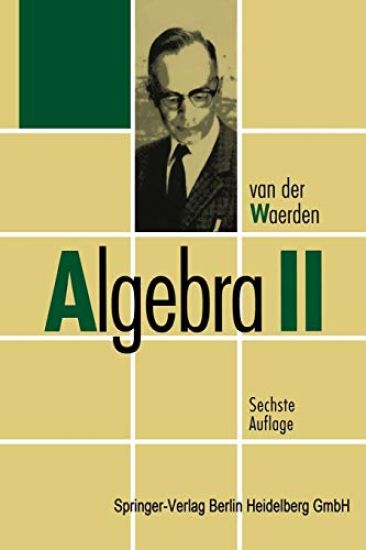
Unter Benutzung von Vorlesungen von E. Artin und E. Noether. Mit einem Geleitwort von Jürgen Neukirch
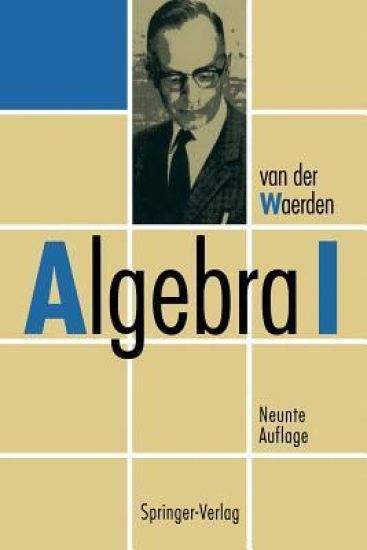
Algebra I
B.L.van der Waerden; J. Neukirch
Springer-Verlag Berlin and Heidelberg GmbH Co. K
2012
nidottu
Der Autor wurde am 2.2.1903 in Amsterdam geboren. Im Jahre 1924 ging er als Student nach Göttingen und wurde dort mit Emmy Noether und der abstrakten Algebra bekannt. Sein Hauptinteresse galt damals vor allem der Begründung der algebraischen Geometrie mit Hilfe der neuen algebraischen Methoden. Als er im Jahre 1926 als junger Doktor mit einem Rockefeller-Stipendium nach Hamburg kam, hatte er Gelegenheit, eine didaktisch hervorragende Algebra-Vorlesung von Emil Artin zu hören. Die Ausarbeitung, die er von dieser Vorlesung machte, wurde zum Kern des vorliegenden Werkes. Es erschien zuerst 1930 bis 1931 unter dem Titel "Moderne Algebra" in der Sammlung "Grundlehren der mathematischen Wissenschaften". In der Folge wurde das Werk in die englische, russische und chinesische Sprache übersetzt. Im Jahre 1928 wurde der Autor Professor an der Universität Groningen. Seit 1951 lebte und arbeitete er bis zu seiner Emeritierung in Zürich als Professor an der dortigen Universität. Heute lebt er in Zürich.

Soon after the publication of my"Ontwakende W etenschap"the need for an English translation was felt. We were very glad to find a translator fully familiar with the English and Dutch languages and with mathematical terminol· ogy. The publisher, Noordhoff, had the splendid idea to ask H. G. Beyen, professor of archeology, for his help in choosing a nice set of illustrations. It was a difficult task. The illustrations had to be both instructive and attractive, and they had t~ illustrate the history of science as well as the general background of ancient civilization. The publisher encouraged us to find better and still better illustrations, and he ordered photographs from all over the world, with never failing energy and enthusiasm. Mr. Beyen's highly instructive subscripts will help the reader to see the inter· relation between way of living, art, and science of the ancient world. Thanks are due to many correspondents, who have suggested additions and pointed out errors. Sections on Astrolabes and Stereographte Projection and on Archimedes' construction of the heptagon have been added. The sections on Perspective and on the Anaphorai of Hypsicles have been enlarged. In the second English edition I have incorporated an important discovery of P. Huber, which sheds new light upon the role of geometry In Babylonian algebra (see p. 73). The section on Heron's Metrics (see p. 277) was written anew, follOWing a suggestion of E. M. Bruins. Zurich. 1961 B. L.
... This beautiful and eloquent text served to transform the graduate teaching of algebra, not only in Germany, but elsewhere in Europe and the United States. It formulated clearly and succinctly the conceptual and structural insights which Noether had expressed so forcefully. This was combined with the elegance and understanding with which Artin had lectured... Its simple but austere style set the pattern for mathematical texts in other subjects, from Banach spaces to topological group theory... It is, in my view, the most influential text in algebra of the twentieth century. - Saunders MacLane, Notices of the AMS How exciting it must have been to hear Emil Artin and Emmy Noether lecture on algebra in the 1920's, when the axiomatic approach to the subject was amazing and new! Van der Waerden was there, and produced from his notes the classic textbook of the field. To Artin's clarity and Noether's originality he added his extraordinary gift for synthesis. At one time every would-be algebraist had to study this text. Even today, all who work in Algebra owe a tremendous debt to it; they learned from it by second or third hand, if not directly. It is still a first-rate (some would say, the best) source for the great range of material it contains. - David Eisenbud, Mathematical Sciences Research Institute Van der Waerden's book Moderne Algebra, first published in 1930, set the standard for the unified approach to algebraic structures in the twentieth century. It is a classic, still worth reading today. - Robin Hartshorne, University of California, Berkeley
... This beautiful and eloquent text served to transform the graduate teaching of algebra, not only in Germany, but elsewhere in Europe and the United States. It formulated clearly and succinctly the conceptual and structural insights which Noether had expressed so forcefully. This was combined with the elegance and understanding with which Artin had lectured... Its simple but austere style set the pattern for mathematical texts in other subjects, from Banach spaces to topological group theory... It is, in my view, the most influential text in algebra of the twentieth century. - Saunders MacLane, Notices of the AMS How exciting it must have been to hear Emil Artin and Emmy Noether lecture on algebra in the 1920's, when the axiomatic approach to the subject was amazing and new! Van der Waerden was there, and produced from his notes the classic textbook of the field. To Artin's clarity and Noether's originality he added his extraordinary gift for synthesis. At one time every would-be algebraist had to study this text. Even today, all who work in Algebra owe a tremendous debt to it; they learned from it by second or third hand, if not directly. It is still a first-rate (some would say, the best) source for the great range of material it contains. - David Eisenbud, Mathematical Sciences Research Institute Van der Waerden's book Moderne Algebra, first published in 1930, set the standard for the unified approach to algebraic structures in the twentieth century. It is a classic, still worth reading today. - Robin Hartshorne, University of California, Berkeley
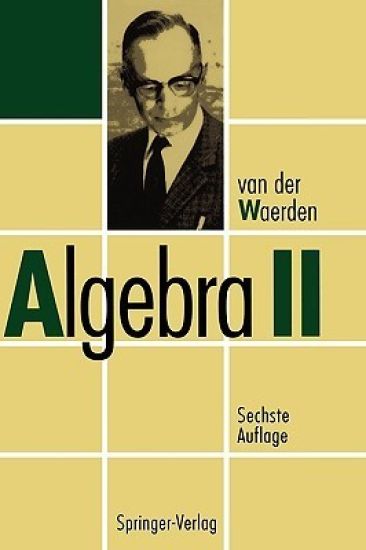
Unter Benutzung von Vorlesungen von E. Artin und E. Noether. Mit einem Geleitwort von Jürgen Neukirch