
Kirjojen hintavertailu – 12 859 819 kirjaa ja 27 kauppaa

Kirjailija

Balázs Kovács

Kirjat ja teokset yhdessä paikassa: 2 kirjaa, julkaisuja vuosilta 2019–2027, suosituimpiin kuuluu Smart Contrarians. Vertaile teosten hintoja ja tarkista saatavuus suomalaisista kirjakaupoista.

2 kirjaa

Kirjojen julkaisuvuodet: 2019–2027.

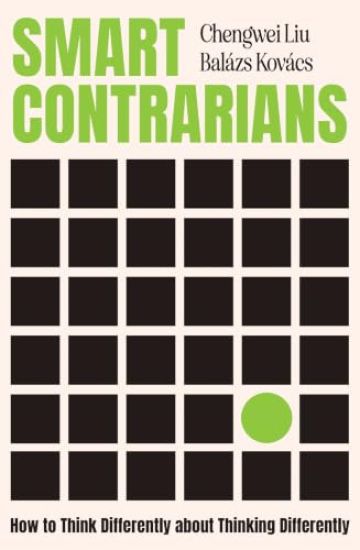
Smart Contrarians

Smart Contrarians

Liu Chengwei; Balázs Kovács

Harvard Business Review Press
2027
Kangassidos
Anyone can be a contrarian. Effective leaders are smart about when—and how—they go against conventional wisdom to succeed. Contrarians are, by and large, ineffective. Their countervailing ideas don't gain support. Their pleas for understanding are dismissed. Their efforts to change minds backfire. But it's not because they're always wrong. It's because they're not smart about going against the grain. People tend to think of contrarianism as some innate trait that you either have or you don't. It's not. It's a way of thinking and a set of skills that can be learned and practiced. This provocative and deeply researched book teaches those skills. Strategy scholars Chengwei Liu and Balázs Kovács reveal how exceptional performance is far less predictable—and far less meritocratic—than most people believe. Drawing on insights from behavioral science, business strategy, finance, sports, entertainment, and entrepreneurship, they show how luck, social dynamics, institutional conformity, and hidden biases shape who succeeds, who fails, and which ideas rise to the top. The authors uncover why consensus thinking so often leads organizations and leaders astray through fascinating stories ranging from PSY's "Gangnam Style" to the rise of Capital One to venture capital bets, celebrity CEOs, financial collapses, and viral cultural phenomena. They introduce a powerful framework for spotting overlooked opportunities, avoiding costly decision traps, and building organizations that learn faster than their competitors do. Leaders and professionals who thrive are not reckless rebels or irrational gamblers but disciplined, smart contrarians who know how to separate signal from hype, skill from luck, and genuine innovation from fashionable noise. Fresh and highly original—and a joy to read—Smart Contrarians is the guide for executives, leaders, entrepreneurs, and all ambitious professionals who want to zig when everyone else zags.

Concepts and Categories

Concepts and Categories

Michael T. Hannan; Gaël Le Mens; Greta Hsu; Balázs Kovács; Giacomo Negro; László Pólos; Elizabeth Pontikes; Amanda J. Sharkey

Columbia University Press
2019
sidottu
Why do people like books, music, or movies that adhere consistently to genre conventions? Why is it hard for politicians to take positions that cross ideological boundaries? Why do we have dramatically different expectations of companies that are categorized as social media platforms as opposed to news media sites? The answers to these questions require an understanding of how people use basic concepts in their everyday lives to give meaning to objects, other people, and social situations and actions. In this book, a team of sociologists presents a groundbreaking model of concepts and categorization that can guide sociological and cultural analysis of a wide variety of social situations. Drawing on research in various fields, including cognitive science, computational linguistics, and psychology, the book develops an innovative view of concepts. It argues that concepts have meanings that are probabilistic rather than sharp, occupying fuzzy, overlapping positions in a “conceptual space.” Measurements of distances in this space reveal our mental representations of categories. Using this model, important yet commonplace phenomena such as our routine buying decisions can be quantified in terms of the cognitive distance between concepts. Concepts and Categories provides an essential set of formal theoretical tools and illustrates their application using an eclectic set of methodologies, from micro-level controlled experiments to macro-level language processing. It illuminates how explicit attention to concepts and categories can give us a new understanding of everyday situations and interactions.