Kirjojen hintavertailu – 12 903 725 kirjaa ja 27 kauppaa

Kirjailija

Barbara Fuchs

Kirjat ja teokset yhdessä paikassa: 14 kirjaa, julkaisuja vuosilta 2001–2022, suosituimpiin kuuluu Representing Imperial Rivalry in the Early Modern Mediterranean. Vertaile teosten hintoja ja tarkista saatavuus suomalaisista kirjakaupoista.

14 kirjaa

Kirjojen julkaisuvuodet: 2001–2022.

Theater of Lockdown

Theater of Lockdown

Barbara Fuchs

BLOOMSBURY PUBLISHING PLC
2022
nidottu
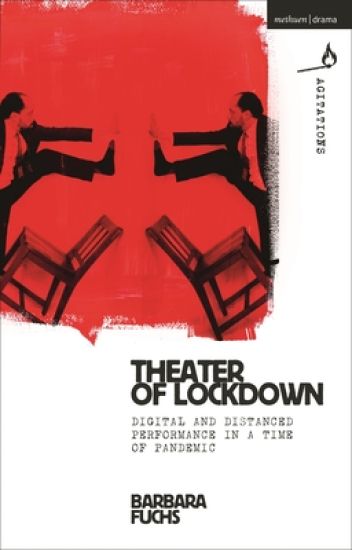
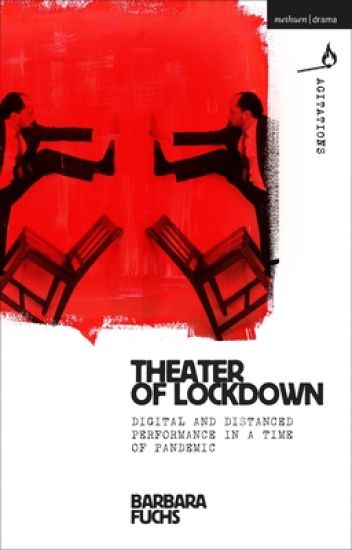
Offering one of the first scholarly examinations of digital and distanced performance since the global shutdown of theaters in March 2020, Barbara Fuchs provides both a record of the changes and a framework for thinking through theater's transformation. Though born of necessity, recent productions offer a new world of practice, from multi-platform plays on Zoom, WhatsApp, and Instagram, to enhancement via filters and augmented reality, to urban distanced theater that enlivens streetscapes and building courtyards. Based largely outside the commercial theater, these productions transcend geographic and financial barriers to access new audiences, while offering a lifeline to artists. This study charts how virtual theater puts pressure on existing assumptions and definitions, transforming the conditions of both theater-making and viewership. How are participatory, site-specific, or devised theater altered under physical-distancing requirements? How do digital productions blur the line between film and theater? What does liveness mean in a time of pandemic? In its seven chapters, Theater of Lockdown focuses on digital and distanced productions from the Americas, Europe, and Australia, offering scholarly analysis and interviews. Productions examined include Theater in Quarantine’s “closet work” in New York; Forced Entertainment’s (Sheffield, UK), End Meeting for All, I, II, and III; the work of Madrid-based company Grumelot; and the virtuosic showmanship of EFE Tres in Mexico City.
Theater of Lockdown

Theater of Lockdown

Barbara Fuchs

Methuen Drama
2021
sidottu
Offering one of the first scholarly examinations of digital and distanced performance since the global shutdown of theaters in March 2020, Barbara Fuchs provides both a record of the changes and a framework for thinking through theater's transformation. Though born of necessity, recent productions offer a new world of practice, from multi-platform plays on Zoom, WhatsApp, and Instagram, to enhancement via filters and augmented reality, to urban distanced theater that enlivens streetscapes and building courtyards. Based largely outside the commercial theater, these productions transcend geographic and financial barriers to access new audiences, while offering a lifeline to artists. This study charts how virtual theater puts pressure on existing assumptions and definitions, transforming the conditions of both theater-making and viewership. How are participatory, site-specific, or devised theater altered under physical-distancing requirements? How do digital productions blur the line between film and theater? What does liveness mean in a time of pandemic? In its seven chapters, Theater of Lockdown focuses on digital and distanced productions from the Americas, Europe, and Australia, offering scholarly analysis and interviews. Productions examined include Theater in Quarantine’s “closet work” in New York; Forced Entertainment’s (Sheffield, UK), End Meeting for All, I, II, and III; the work of Madrid-based company Grumelot; and the virtuosic showmanship of EFE Tres in Mexico City.
Knowing Fictions

Knowing Fictions

Barbara Fuchs

University of Pennsylvania Press
2021
sidottu
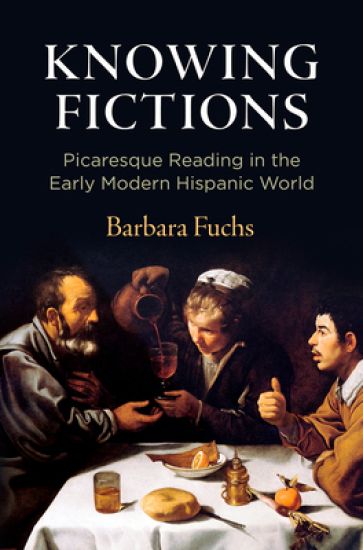
European exploration and conquest expanded exponentially in the late fifteenth and sixteenth centuries, and as the horizons of imperial experience grew more distant, strategies designed to convey the act of witnessing came to be a key source of textual authority. From the relación to the captivity narrative, the Hispanic imperial project relied heavily on the first-person authority of genres whose authenticity undergirded the ideological armature of national consolidation, expansion, and conquest. At the same time, increasing pressures for religious conformity in Spain, as across Europe, required subjects to bare themselves before external authorities in intimate confessions of their faith. Emerging from this charged context, the unreliable voice of the pícaro poses a rhetorical challenge to the authority of the witness, destabilizing the possibility of trustworthy representation precisely because of his or her intimate involvement in the narrative. In Knowing Fictions, Barbara Fuchs seeks at once to rethink the category of the picaresque while firmly centering it once more in the early modern Hispanic world from which it emerged. Venturing beyond the traditional picaresque canon, Fuchs traces Mediterranean itineraries of diaspora, captivity, and imperial rivalry in a corpus of texts that employ picaresque conventions to contest narrative authority. By engaging the picaresque not just as a genre with more or less strictly defined boundaries, but as a set of literary strategies that interrogate the mechanisms of truth-telling itself, Fuchs shows how self-consciously fictional picaresque texts effectively encouraged readers to adopt a critical stance toward the truth claims implicit in the forms of authoritative discourse proliferating in Imperial Spain.
Representing Imperial Rivalry in the Early Modern Mediterranean

Representing Imperial Rivalry in the Early Modern Mediterranean

Barbara Fuchs; Emily Weissbourd

University of Toronto Press
2020
pokkari
Representing Imperial Rivalry in the Early Modern Mediterranean explores representations of national, racial, and religious identities within a region dominated by the clash of empires. Bringing together studies of English, Spanish, Italian, and Ottoman literature and cultural artifacts, the volume moves from the broadest issues of representation in the Mediterranean to a case study – early modern England – where the “Mediterranean turn” has radically changed the field. The essays in this wide-ranging literary and cultural study examine the rhetoric which surrounds imperial competition in this era, ranging from poems commemorating the battle of Lepanto to elaborately adorned maps of contested frontiers. They will be of interest to scholars in fields such as history, comparative literary studies, and religious studies.
The Quest for Certainty in Early Modern Europe

The Quest for Certainty in Early Modern Europe

Barbara Fuchs; Mercedes García-Arenal

University of Toronto Press
2020
sidottu
This interdisciplinary collection explores how the early modern pursuit of knowledge in very different spheres – from Inquisitional investigations to biblical polemics to popular healing – was conditioned by a shared desire for certainty, and how epistemological crises produced by the religious upheavals of early modern Europe were also linked to the development of new scientific methods. Questions of representation became newly fraught as the production of knowledge increasingly challenged established orthodoxies. The volume focuses on the social and institutional dimensions of inquiry in light of political and cultural challenges, while also foregrounding the Hispanic world, which has often been left out of histories of scepticism and modernity. Featuring essays by historians and literary scholars from Europe and the United States, The Quest for Certainty in Early Modern Europe reconstructs the complexity of early modern epistemological debates across the disciplines, in a variety of cultural, social, and intellectual locales.
Representing Imperial Rivalry in the Early Modern Mediterranean

Representing Imperial Rivalry in the Early Modern Mediterranean

Barbara Fuchs; Emily Weissbourd

University of Toronto Press
2015
sidottu
Representing Imperial Rivalry in the Early Modern Mediterranean explores representations of national, racial, and religious identities within a region dominated by the clash of empires. Bringing together studies of English, Spanish, Italian, and Ottoman literature and cultural artifacts, the volume moves from the broadest issues of representation in the Mediterranean to a case study – early modern England – where the “Mediterranean turn” has radically changed the field. The essays in this wide-ranging literary and cultural study examine the rhetoric which surrounds imperial competition in this era, ranging from poems commemorating the battle of Lepanto to elaborately adorned maps of contested frontiers. They will be of interest to scholars in fields such as history, comparative literary studies, and religious studies.
The Poetics of Piracy

The Poetics of Piracy

Barbara Fuchs

University of Pennsylvania Press
2013
sidottu
With its dominance as a European power and the explosion of its prose and dramatic writing, Spain provided an irresistible literary source for English writers of the early modern period. But the deep and escalating political rivalry between the two nations led English writers to negotiate, disavow, or attempt to resolve their fascination with Spain and their debt to Spanish sources. Amid thorny issues of translation and appropriation, imperial competition, the rise of commercial authorship, and anxieties about authenticity, Barbara Fuchs traces how Spanish material was transmitted into English writing, entangling English literature in questions of national and religious identity, and how piracy came to be a central textual metaphor, with appropriations from Spain triumphantly reimagined as heroic looting. From the time of the attempted invasion by the Spanish Armada of the 1580s, through the rise of anti-Spanish rhetoric of the 1620s, The Poetics of Piracy charts this connection through works by Ben Jonson, William Shakespeare, Francis Beaumont, John Fletcher, and Thomas Middleton. Fuchs examines how their writing, particularly for the stage, recasts a reliance on Spanish material by constructing narratives of militaristic, forcible use. She considers how Jacobean dramatists complicated the texts of their Spanish contemporaries by putting them to anti-Spanish purposes, and she traces the place of Cervantes's Don Quixote in Beaumont's The Knight of the Burning Pestle and Shakespeare's late, lost play Cardenio. English literature was deeply transnational, even in the period most closely associated with the birth of a national literature. Recovering the profound influence of Spain on Renaissance English letters, The Poetics of Piracy paints a sophisticated picture of how nations can serve, at once, as rivals and resources.
Exotic Nation

Exotic Nation

Barbara Fuchs

University of Pennsylvania Press
2011
pokkari
In the Western imagination, Spain often evokes the colorful culture of al-Andalus, the Iberian region once ruled by Muslims. Tourist brochures inviting visitors to sunny and romantic Andalusia, home of the ingenious gardens and intricate arabesques of Granada's Alhambra Palace, are not the first texts to trade on Spain's relationship to its Moorish past. Despite the fall of Granada to the Catholic Monarchs in 1492 and the subsequent repression of Islam in Spain, Moorish civilization continued to influence both the reality and the perception of the Christian nation that emerged in place of al-Andalus. In Exotic Nation, Barbara Fuchs explores the paradoxes in the cultural construction of Spain in relation to its Moorish heritage through an analysis of Spanish literature, costume, language, architecture, and chivalric practices. Between 1492 and the expulsion of the Moriscos (Muslims forcibly converted to Christianity) in 1609, Spain attempted to come to terms with its own Moorishness by simultaneously repressing Muslim subjects and appropriating their rich cultural heritage. Fuchs examines the explicit romanticization of the Moors in Spanish literature-often referred to as "literary maurophilia"-and the complex, often silent presence of Moorish forms in Spanish material culture. The extensive hybridization of Iberian culture suggests that the sympathetic depiction of Moors in the literature of the period does not trade in exoticism but instead reminded Spaniards of the place of Moors and their descendants within Spain. Meanwhile, observers from outside Spain recognized its cultural debt to al-Andalus, often deliberately casting Spain as the exotic racial other of Europe.
Romance

Romance

Barbara Fuchs

Routledge
2004
sidottu
Often derided as an inferior form of literature, 'romance' as a literary mode or genre defies satisfactory definition, dividing critics, scholars and readers alike. This useful guidebook traces the myriad transformations of 'romance' from medieval courtly love to Mills and Boon, and claims that its elusive and complex nature serves as a touchstone for larger questions of literary and cultural theory, such as:How does the history of 'romance' as a category force us to rethink the historicization of literary genres? What definitions can we provide for our own time to help us recognize and analyze new forms of 'romance'? To what extent is the resistance to romance a resistance to the imaginative force of literature? The case for 'romance' as a concept is presented clearly and imaginatively, arguing that its usefulness to contemporary critics can be maintained if it is regarded as a literary strategy rather than a fixed genre. In encouraging the reader to consider the fluidity of literature, Romance will be of equal value to all students of historical and comparative literatures and of modern literary forms.
Romance

Romance

Barbara Fuchs

Routledge
2004
nidottu
Often derided as an inferior form of literature, 'romance' as a literary mode or genre defies satisfactory definition, dividing critics, scholars and readers alike. This useful guidebook traces the myriad transformations of 'romance' from medieval courtly love to Mills and Boon, and claims that its elusive and complex nature serves as a touchstone for larger questions of literary and cultural theory, such as:How does the history of 'romance' as a category force us to rethink the historicization of literary genres? What definitions can we provide for our own time to help us recognize and analyze new forms of 'romance'? To what extent is the resistance to romance a resistance to the imaginative force of literature? The case for 'romance' as a concept is presented clearly and imaginatively, arguing that its usefulness to contemporary critics can be maintained if it is regarded as a literary strategy rather than a fixed genre. In encouraging the reader to consider the fluidity of literature, Romance will be of equal value to all students of historical and comparative literatures and of modern literary forms.
Mimesis and Empire

Mimesis and Empire

Barbara Fuchs

Cambridge University Press
2004
pokkari
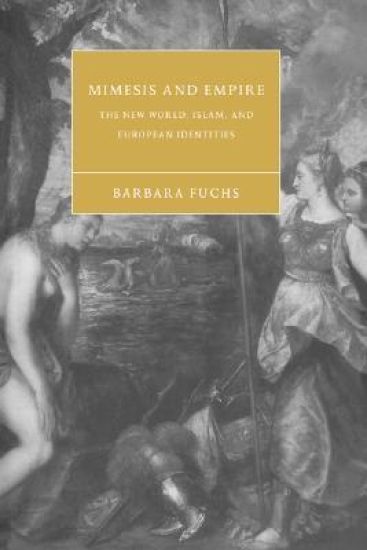
As powerful, pointed imitation, cultural mimesis can effect inclusion in a polity, threaten state legitimacy, or undo the originality upon which such legitimacy is based. In Mimesis and Empire Barbara Fuchs explores the intricate dynamics of imitation and contradistinction among early modern European powers in literary and historiographical texts from sixteenth- and early seventeenth-century Spain, Italy, England, and the New World. The book considers a broad sweep of material, including European representations of New World subjects and of Islam, both portrayed as ‘other’ in contemporary texts. It supplements the transatlantic perspective on early modern imperialism with an awareness of the situation in the Mediterranean and considers problems of reading and literary transmission; imperial ideology and colonial identities; counterfeits and forgery; and piracy.
Passing for Spain

Passing for Spain

Barbara Fuchs

University of Illinois Press
2002
sidottu
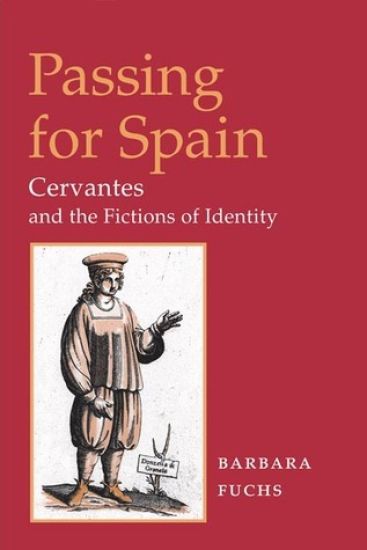
Passing for Spain charts the intersections of identity, nation, and literary representation in early modern Spain. Barbara Fuchs analyzes the trope of passing in Don Quijote and other works by Cervantes, linking the use of disguise to the broader historical and social context of Counter-Reformation Spain and the religious and political dynamics of the Mediterranean Basin. In five lucid and engaging chapters, Fuchs examines what passes in Cervantes’s fiction: gender and race in Don Quijote and “Las dos doncellas”; religion in “El amante liberal” and La gran sultana; national identity in the Persiles and “La española inglesa.” She argues that Cervantes represents cross-cultural impersonation -- or characters who pass for another gender, nationality, or religion -- as challenges to the state’s attempts to assign identities and categories to proper Spanish subjects. Fuchs demonstrates the larger implications of this challenge by bringing a wide range of literary and political texts to bear on Cervantes’s representations. Impeccably researched, Passing for Spain examines how the fluidity of individual identity in early modern Spain undermined a national identity based on exclusion and difference.
Mimesis and Empire

Mimesis and Empire

Barbara Fuchs

Cambridge University Press
2001
sidottu
As powerful, pointed imitation, cultural mimesis can effect inclusion in a polity, threaten state legitimacy, or undo the originality upon which such legitimacy is based. In Mimesis and Empire , first published in 2001, Barbara Fuchs explores the intricate dynamics of imitation and contradistinction among early modern European powers in literary and historiographical texts from sixteenth- and early seventeenth-century Spain, Italy, England and the New World. The book considers a broad sweep of material, including European representations of New World subjects and of Islam, both portrayed as 'other' in contemporary texts. It supplements the transatlantic perspective on early modern imperialism with an awareness of the situation in the Mediterranean and considers problems of reading and literary transmission; imperial ideology and colonial identities; counterfeits and forgery; and piracy.