Kirjojen hintavertailu – 12 903 733 kirjaa ja 27 kauppaa

Kirjailija

Barbara McPake

Kirjat ja teokset yhdessä paikassa: 5 kirjaa, julkaisuja vuosilta 2010–2020, suosituimpiin kuuluu Health Economics. Vertaile teosten hintoja ja tarkista saatavuus suomalaisista kirjakaupoista.

5 kirjaa

Kirjojen julkaisuvuodet: 2010–2020.

Health Economics

Health Economics

Barbara McPake; Charles Normand; Samantha Smith; Anne Nolan

Routledge
2020
sidottu
Health Economics: An International Perspective is the only textbook to provide a truly international, comparative treatment of health economics. Offering an analysis of health systems across borders, the fourth edition of this key text has been updated and revised to take account of changes in a host of countries. This edition features an expanded introduction, providing better grounding for many of the examples that come in subsequent chapters and making it easier for non-health care experts to see the links between the theory, the examples and the health care system components. It also boasts a restructured format, dividing the book into two broad sections: the first focuses on ideas and principles, along with evidence on their applications in the health sector, whereas the second focuses on introducing core tools and techniques used in applied health economics research. Further updates to this edition include: two new chapters on applied econometrics; a new chapter on equity, focusing on equity in access to health care, paying particular attention to how access and need for health care are defined and measured in applied research; a new chapter on emerging issues for health systems that are emanating from a series of global transitions both within (e.g. demographic change, epidemiological change, the global resolution on universal health coverage) and without the health sector (e.g. economic transitions). Throughout the text, examples and illustrations are taken from a wide range of settings and world regions, providing a unique overview of the performance of different health systems.

Health Economics

Health Economics

Barbara McPake; Charles Normand; Samantha Smith; Anne Nolan

Routledge
2020
nidottu
Health Economics: An International Perspective is the only textbook to provide a truly international, comparative treatment of health economics. Offering an analysis of health systems across borders, the fourth edition of this key text has been updated and revised to take account of changes in a host of countries. This edition features an expanded introduction, providing better grounding for many of the examples that come in subsequent chapters and making it easier for non-health care experts to see the links between the theory, the examples and the health care system components. It also boasts a restructured format, dividing the book into two broad sections: the first focuses on ideas and principles, along with evidence on their applications in the health sector, whereas the second focuses on introducing core tools and techniques used in applied health economics research. Further updates to this edition include: two new chapters on applied econometrics; a new chapter on equity, focusing on equity in access to health care, paying particular attention to how access and need for health care are defined and measured in applied research; a new chapter on emerging issues for health systems that are emanating from a series of global transitions both within (e.g. demographic change, epidemiological change, the global resolution on universal health coverage) and without the health sector (e.g. economic transitions). Throughout the text, examples and illustrations are taken from a wide range of settings and world regions, providing a unique overview of the performance of different health systems.

The Economics of Health Professional Education and Careers

The Economics of Health Professional Education and Careers

Barbara McPake; Allison Squires; Mahat Agya; Edson Araujo

World Bank Publications
2015
nidottu
The formation of health professionals is critical for the health system to function and to achieve its universal health coverage (UHC) goals, and this is well recognized by the majority of governments that plan to ensure enough training places and aim to regulate in order to ensure quality. But the importance of market forces is often overlooked, resulting in interventions and regulations that often fail to achieve their intended effects. This publication aims to inform the design of health professionals’ education policies to better manage health labor market forces toward UHC. It documents what is known about the influence of market forces on the health-professional formation process. The report sought to answer the following questions: What have been the large global and regional trends in the development of health professions? How have these trends affected the career decisions of current and potential health professionals? What is the evidence base on the value and effectiveness of health professional education of different types? How has the market for health professional education evolved, and with what interrelationships with the health labor and health care markets? The contexts of the market for health professional training have been subject to important changes in recent decades, in particular: the growing extent of employment of mid-level cadres of health professionals; changes in technology and the associated growth of high skilled occupations; the increasing interconnectedness of national health systems through globalization, with its implications for international health professional mobility; and the greater complexity of the public–private mix in employment options. There is a need to ensure that market forces align with the intentions of planning and regulation and the needs of UHC goals. This publication provides recommendations to support the design of policies that help to achieve these.
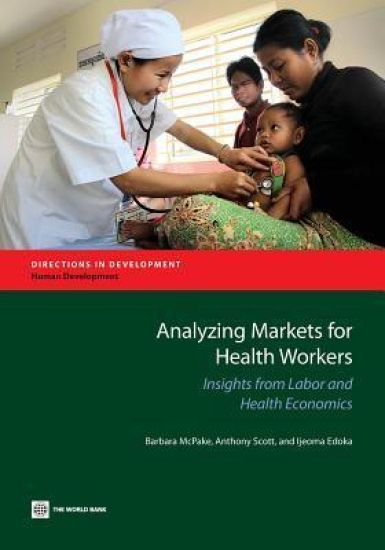
Analyzing Markets for Health Workers

Analyzing Markets for Health Workers

Barbara McPake; Anthony Scott; Ijeoma Edoka

World Bank Publications
2014
nidottu
Achieving universal health care requires understanding health labor markets dynamics to overcome constaints in human resources for health. This book helps to understand how key elements in health labor markets interact and how these interactions can help or hinder significant progress in health care coverage.