Kirjojen hintavertailu – 12 903 725 kirjaa ja 27 kauppaa

Kirjailija

Barry Buzan

Kirjat ja teokset yhdessä paikassa: 31 kirjaa, julkaisuja vuosilta 1986–2025, suosituimpiin kuuluu The Mind Map Book: How to Use Radiant Thinking to Maximize Your Brain's Untapped Potential. Vertaile teosten hintoja ja tarkista saatavuus suomalaisista kirjakaupoista.

31 kirjaa

Kirjojen julkaisuvuodet: 1986–2025.

The Evolution of International Security Studies

The Evolution of International Security Studies

Barry Buzan; Lene Hansen

Cambridge University Press
2009
pokkari

Halvin toimitettuna 42,00 €

International Security Studies (ISS) has changed and diversified in many ways since 1945. This book provides the first intellectual history of the development of the subject in that period. It explains how ISS evolved from an initial concern with the strategic consequences of superpower rivalry and nuclear weapons, to its current diversity in which environmental, economic, human and other securities sit alongside military security, and in which approaches ranging from traditional Realist analysis to Feminism and Post-colonialism are in play. It sets out the driving forces that shaped debates in ISS, shows what makes ISS a single conversation across its diversity, and gives an authoritative account of debates on all the main topics within ISS. This is an unparalleled survey of the literature and institutions of ISS that will be an invaluable guide for all students and scholars of ISS, whether traditionalist, 'new agenda' or critical.
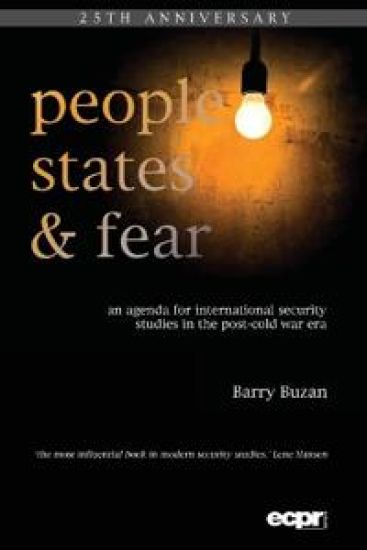
People, States and Fear

People, States and Fear

Barry Buzan

ECPR Press
2007
nidottu

Halvin toimitettuna 69,70 €

This widely acclaimed book examines how states and societies pursue freedom from threat in an environment in which competitive relations are inescapable across the political, economic, military, societal and environmental landscapes. Throughout, attention is placed on the interplay of threats and vulnerabilities, the policy consequences of overemphasising one or the other, and the existence of contradictions within and between ideas about security. Barry Buzan argues that the concept of security is a versatile, penetrating and useful way to approach the study of international relations. Security provides an analytical framework between the extremes of power and peace, incorporates most of their insights - and adds more of its own. People, States & Fearis essential reading for all students and researchers of international politics and security studies. 25th Anniversary Edition: A new introduction, placing this classic text in a current context, was added to this book by the author in 2007.
The United States and the Great Powers
The idea that world politics can be understood in terms of a US dominated unipolarity became generally accepted during the 1990s. Following the September 11 attacks, however, US foreign policy took an imperial turn and many began to question the form, style and substance of US leadership at the start of the 21st Century. But why is the US behaving as if it lived in a world of enemies? What can other great powers do to change the behaviour of the US, and what will be the consequences if they fail? Could the EU and China become superpowers alongside the US? And what would happen if the US stepped down from its superpowers role creating a world with only great powers and no superpowers? In this important new book, Barry Buzan seeks to provide answers to these pressing questions. He begins by introducing the core concepts of polarity and identity in world politics, which he uses to develop three possible scenarios for the future development of the international political system. Buzan contends that we are not living in a strictly unipolar world, where the great powers are helpless in the face of the US. Instead he argues that the existence of great powers alongside an American superpower plays a crucial role in creating both opportunities and responsibilities which will shape the way in which world politics unfolds in the coming decades. What the great powers do or don't do will be crucial to how long US dominance lasts. It will also help determine whether the period of American hegemony will develop or destroy the unique multilateral international society built up by US foreign policy over the last half century.
The United States and the Great Powers
The idea that world politics can be understood in terms of a US dominated unipolarity became generally accepted during the 1990s. Following the September 11 attacks, however, US foreign policy took an imperial turn and many began to question the form, style and substance of US leadership at the start of the 21st Century. But why is the US behaving as if it lived in a world of enemies? What can other great powers do to change the behaviour of the US, and what will be the consequences if they fail? Could the EU and China become superpowers alongside the US? And what would happen if the US stepped down from its superpowers role creating a world with only great powers and no superpowers? In this important new book, Barry Buzan seeks to provide answers to these pressing questions. He begins by introducing the core concepts of polarity and identity in world politics, which he uses to develop three possible scenarios for the future development of the international political system. Buzan contends that we are not living in a strictly unipolar world, where the great powers are helpless in the face of the US. Instead he argues that the existence of great powers alongside an American superpower plays a crucial role in creating both opportunities and responsibilities which will shape the way in which world politics unfolds in the coming decades. What the great powers do or don't do will be crucial to how long US dominance lasts. It will also help determine whether the period of American hegemony will develop or destroy the unique multilateral international society built up by US foreign policy over the last half century.
From International to World Society?

From International to World Society?

Barry Buzan

Cambridge University Press
2004
sidottu
In this 2004 book, Barry Buzan offers an extensive critique and reappraisal of the English school approach to International Relations. Starting on the neglected concept of world society and bringing together the international society tradition and the Wendtian mode of constructivism, Buzan offers a new theoretical framework that can be used to address globalisation as a complex political interplay among state and non-state actors. This approach forces English school theory to confront neglected questions about both its basic concepts and assumptions, and about the constitution of society in terms of what values are shared, how and why they are shared, and by whom. Buzan highlights the idea of primary institutions as the central contribution of English school theory and shows how this both differentiates English school theory from realism and neoliberal institutionalism, and how it can be used to generate distinctive comparative and historical accounts of international society.
From International to World Society?

From International to World Society?

Barry Buzan

Cambridge University Press
2004
pokkari
Barry Buzan offers an extensive and long overdue critique and reappraisal of the English school approach to International Relations. Starting on the neglected concept of world society and bringing together the international society tradition and the Wendtian mode of constructivism, Buzan offers a new theoretical framework that can be used to address globalisation as a complex political interplay among state and non-state actors. This approach forces English school theory to confront neglected questions about both its basic concepts and assumptions, and about the constitution of society in terms of what values are shared, how and why they are shared, and by whom. Buzan highlights the idea of primary institutions as the central contribution of English school theory and shows how this both differentiates English school theory from realism and neoliberal institutionalism, and how it can be used to generate distinctive comparative and historical accounts of international society.
Regions and Powers

Regions and Powers

Barry Buzan; Ole Wæver

Cambridge University Press
2003
sidottu
This book develops the idea that since decolonisation, regional patterns of security have become more prominent in international politics. The authors combine an operational theory of regional security with an empirical application across the whole of the international system. Individual chapters cover Africa, the Balkans, CIS Europe, East Asia, EU Europe, the Middle East, North America, South America, and South Asia. The main focus is on the post-Cold War period, but the history of each regional security complex is traced back to its beginnings. By relating the regional dynamics of security to current debates about the global power structure, the authors unfold a distinctive interpretation of post-Cold War international security, avoiding both the extreme oversimplifications of the unipolar view, and the extreme deterritorialisations of many globalist visions of a new world disorder. Their framework brings out the radical diversity of security dynamics in different parts of the world.
International Systems in World History

International Systems in World History

Barry Buzan; Richard Little

Oxford University Press
2000
nidottu
This book tells the 60,000 year story of how humankind evolved from a scattering of hunter-gatherer bands to todays highly integrated global international political economy. It traces the evolution of ever-wider economic, societal and military-political international systems, and the interplay between these systems and the tribes, city states, empires, and modern states into which humans have organised themselves. Buzan and Little marry a wide range of mainstream International Relations theories to a world historical perspective. They mount a stinging attack on International Relations as a discipline, arguing that its Eurocentrism, historical narrowness, and theoretical fragmentation have reduced almost to nothing both its cross-disclipinary influence and its ability to think coherently about either the past or the future. Seeking to emulate and challenge the cross-disciplinary influence of the world systems model, the book recasts the study of International Relations into a macro-historical perspective, shows how its core concepts work across time, and sets out a new theoretical agenda and a new intellectual role for the discipline.