Kirjojen hintavertailu – 12 903 724 kirjaa ja 27 kauppaa
Kirjailija
Barry Cipra
Kirjat ja teokset yhdessä paikassa: 6 kirjaa, julkaisuja vuosilta 1997–2020, suosituimpiin kuuluu What's Happening in the Mathematical Sciences. Vertaile teosten hintoja ja tarkista saatavuus suomalaisista kirjakaupoista.
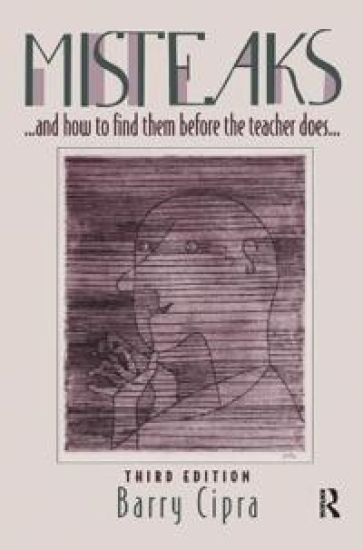
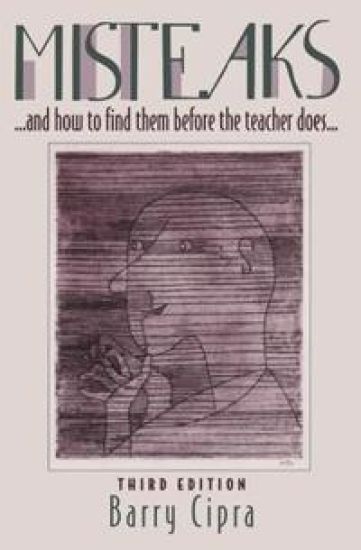
An unusual supplement to every calculus textbook, Misteaks and How to Find Them before the Teacher Does is popular with students and teachers alike. Teachers love the way it encourages students to truly think about mathematics rather than simply plugging numbers into equations to crank out answers, and students love the author's straightforward, tongue-in-cheek style. The title of this light-hearted and amusing book might well have been "Going Gray in Elementary Calculus and How to Avoid it." Changing the metaphor, Barry has hit the nail on the finger in hundreds of fine examples. --Philip J. Davis, coauthor of The Mathematical Experience. "How I wish that something like this had been available when I was a student!" --Ralph P. Boas, former editor of The American Mathematical Monthly. Bonus: Solution to LeWitt Puzzle
The "AMS" series "What's Happening in the Mathematical Sciences" distills the amazingly rich brew of current research in mathematics down to a few choice samples. This volume leads off with an update on the Poincare Conjecture, a hundred-year-old problem that has apparently been solved by Grigory Perelman of St. Petersburg, Russia. So what did topologists do when the oldest and most famous problem about closed manifolds was vanquished? As the second chapter describes, they confronted a suite of problems concerning the 'ends' of open manifolds...and solved those, too. Not to be outdone, number theorists accomplished several unexpected feats in the first five years of the new century, from computing a trillion digits of pi to finding arbitrarily long equally-spaced sequences of prime numbers. Undergraduates made key discoveries, as explained in the chapters on Venn diagrams and primality testing. In applied mathematics, the Navier-Stokes equations of fluid mechanics continued to stir up interest. One team proved new theorems about the long-term evolution of vortices, while others explored the surprising ways that insects use vortices to move around. The random jittering of Brownian motion became a little less mysterious. Finally, an old and trusted algorithm of computer science had its trustworthiness explained in a novel way. Barry Cipra explains these new developments in his wry and witty style, familiar to readers of Volumes 1-5, and is joined in this volume by Dana Mackenzie. Volume 6 of "What's Happening" will convey to all readers - from mathematical novices to experts - the beauty and wonder that is mathematics.
Mathematicians like to point out that mathematics is universal. In spite of this, most people continue to view it as either mundane (balancing a checkbook) or mysterious (cryptography). This fifth volume of the "What's Happening" series contradicts that view by showing that mathematics is indeed found everywhere - in science, art, history, and our everyday lives. Here is some of what you'll find in this volume: Mathematics and Science: Mathematical biology - Mathematics was key to cracking the genetic code. Now, new mathematics is needed to understand the three-dimensional structure of the proteins produced from that code; Celestial mechanics and cosmology - New methods have revealed a multitude of solutions to the three-body problem. And other new work may answer one of cosmology's most fundamental questions: What is the size and shape of the universe? Mathematics and Everyday Life: Traffic jams - New models are helping researchers understand where traffic jams come from-and maybe what to do about them; Small worlds - Researchers have found a short distance from theory to applications in the study of small world networks. Elegance in Mathematics: Beyond Fermat's Last Theorem - Number theorists are reaching higher ground after Wiles' astounding 1994 proof: new developments in the elegant world of elliptic curves and modular functions; The Millennium Prize Problems - The Clay Mathematics Institute has offered a million dollars for solutions to seven important and difficult unsolved problems. These are just some of the topics of current interest that are covered in this latest volume of "What's Happening in the Mathematical Sciences". The book has broad appeal for a wide spectrum of mathematicians and scientists, from high school students through advanced-level graduates and researchers.
An unusual supplement to every calculus textbook, Misteaks and How to Find Them before the Teacher Does is popular with students and teachers alike. Teachers love the way it encourages students to truly think about mathematics rather than simply plugging numbers into equations to crank out answers, and students love the author's straightforward, tongue-in-cheek style. The title of this light-hearted and amusing book might well have been "Going Gray in Elementary Calculus and How to Avoid it." Changing the metaphor, Barry has hit the nail on the finger in hundreds of fine examples. --Philip J. Davis, coauthor of The Mathematical Experience. "How I wish that something like this had been available when I was a student!" --Ralph P. Boas, former editor of The American Mathematical Monthly. Bonus: Solution to LeWitt Puzzle
Beautifully produced and marvelously written, "What's Happening in the Mathematical Sciences, Volume 3", contains 10 articles on recent developments in the field. In an engaging, reader-friendly style, Barry Cipra explores topics ranging from Fermat's Last Theorem to Computational Fluid Dynamics. The volumes in this series highlight the many roles mathematics plays in the modern world. This volume includes articles on: a new mathematical method that's taking Wall Street by storm 'Ultra-parallel' supercomputing with DNA, and how a mathematician found the famous flaw in the Pentium chip. Unique in kind, and lively in style, "What's Happening in the Mathematical Sciences, Volume 3" is a delight to read and a valuable source of information.