

Kirjailija
Barry Sanders
Kirjat ja teokset yhdessä paikassa: 7 kirjaa, julkaisuja vuosilta 1988–2026, suosituimpiin kuuluu Embrace Your Pain. Vertaile teosten hintoja ja tarkista saatavuus suomalaisista kirjakaupoista.
7 kirjaa
Kirjojen julkaisuvuodet: 1988–2026.
Etsitkö jännitystä, uusia näkökulmia tai rentouttavaa lukuelämystä? Tutustu kirjakategorioihimme ja löydä seuraava suosikkikirjasi.
In this iconoclastic and sure to be contentious re-casting by a renowned critic, the great American novel Moby Dick is presented as a work that has been widely misread, an error that continues to this day. According to Barry Sanders, Herman Melville’s best- known work is not a novel, does not pretend to be a novel, and was not intended by its author to be read as a novel. Moby Dick is this country’s first manifesto, a tocsin sounded to warn us about the encroaching end of nature. The Manifesto of Herman Melville traces the evolution of Moby Dick—from its awful, initial reception, very rapidly passing out of print, to its remarkable revival to become lauded as one of America’s great literary classics. That turnaround happened in the early decades of the 20th century and was, in great part, the result of the new and radical aesthetic movements such as surrealism, dadaism, and cubism that allowed for a radical reading of the book. The novel’s new standing as one of the keystones of the American cannon disguises its deeper meaning as an alarm bell, an obscuring which Barry Sanders, in a critical assessment that is as persuasive as it is provocative, seeks to clear away. Sanders argues that Moby Dick needs to be recognized as Melville's manifesto: a bold statement warning of the destruction of the natural world made most evident in the book’s central metaphor the relentless pursuit to kill the whale, the first sentient being in Genesis and one of the most startling mammals—possessed of hair and scales, a tail and breasts—and the largest of the creatures on earth, weighing up to 400,000 pounds. Whalers in Melville’s day hunted down and killed these extraordinary behemoths of nature, for their oil, sold to people for cooking and to light their homes. Today the pursuit for energy has shifted dramatically, from sea to land, but the prize remains the same: energy producing fuel for which entrepreneurs and adventurers are prepared to kill off all of nature.
In Unsuspecting Souls, Barry Sanders examines modern society's indifference to the individual. Beginning with the Industrial Revolution, when care for human beings began to disappear slowly, and ending with the modern era, when societal events require less person-to-person interaction and introduce radical changes in common attitudes toward death and life, Sanders laments that what makes us most human is slowly dying. Our days are filled with a continuous bombardment of  information" that demands our attention and brings us out of our world and into a sterile one of inhumanity and abstraction. We've also lost the original sense of a collective consciousness. This loss has been culminating for two centuries now, dating back to the rise of European powers and worldwide colonization. We pick our poisons among several forms of radical fundamentalisms, each one not only a threat to the other but a threat to humanity itself. From references of Edgar Allan Poe to Abu Ghraib, this is a fascinating and worrisome story, impeccably researched and compellingly written.
During the nineteeth century, something vital went missing: the human being. In Unsuspecting Souls, Barry Sanders examines modern society's indifference to the individual. From the Industrial Revolution, where the disappearance of care for human beings begins slowly, to our own age, where societal events require less person-to-person interaction, Sanders laments that what makes us most human is slowly dying. Our days are filled with little but a continuous bombardment of  information," demands on our attention, that brings us out of our world and into one of inhumanity and abstraction. We are losing entirely any palpable attachment to our physical reality. And we've also lost the original sense of a collective consciousness. This loss has been fomenting for two centuries now, dating back to the rise of European powers and worldwide colonization. This has led to the notion that we need to define what is torture, an idea that not long ago would have seemed absurd, and need to pick our poisons among several forms of radical fundamentalisms, each one not only a threat to the other but a threat to humanity itself. From Edgar Allen Poe to Abu Ghraib, this is a fascinating and worrisome story, impeccably researched and compellingly written.
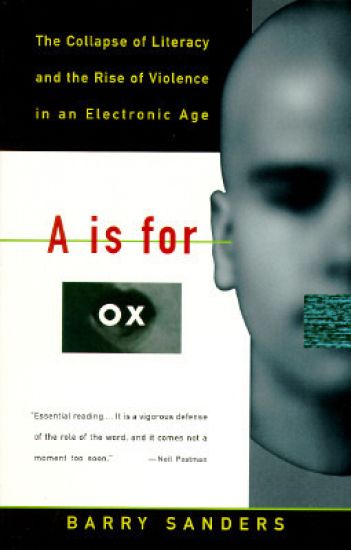

ABC: The Alphabetization of the Popular Mind
Ivan Illich; Barry Sanders
Marion Boyars Publishers
1988
sidottu