Kirjojen hintavertailu – 12 859 827 kirjaa ja 27 kauppaa

Kirjailija

Beata Zielosko

Kirjat ja teokset yhdessä paikassa: 8 kirjaa, julkaisuja vuosilta 2009–2023, suosituimpiin kuuluu Three Approaches to Data Analysis. Vertaile teosten hintoja ja tarkista saatavuus suomalaisista kirjakaupoista.

8 kirjaa

Kirjojen julkaisuvuodet: 2009–2023.

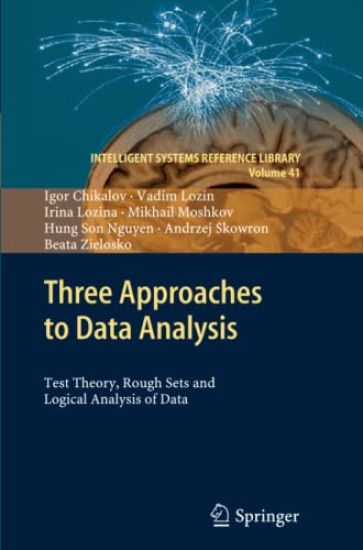
Three Approaches to Data Analysis

Three Approaches to Data Analysis

Igor Chikalov; Vadim Lozin; Irina Lozina; Mikhail Moshkov; Hung Son Nguyen; Andrzej Skowron; Beata Zielosko

Springer-Verlag Berlin and Heidelberg GmbH Co. K
2014
nidottu
In this book, the following three approaches to data analysis are presented: - Test Theory, founded by Sergei V. Yablonskii (1924-1998); the first publications appeared in 1955 and 1958,- Rough Sets, founded by Zdzislaw I. Pawlak (1926-2006); the first publications appeared in 1981 and 1982,- Logical Analysis of Data, founded by Peter L. Hammer (1936-2006); the first publications appeared in 1986 and 1988. These three approaches have much in common, but researchers active in one of these areas often have a limited knowledge about the results and methods developed in the other two. On the other hand, each of the approaches shows some originality and we believe that the exchange of knowledge can stimulate further development of each of them. This can lead to new theoretical results and real-life applications and, in particular, new results based on combination of these three data analysis approaches can be expected.- Logical Analysis of Data, founded by Peter L. Hammer (1936-2006); the firstpublications appeared in 1986 and 1988. These three approaches have much in common, but researchers active in one of these areas often have a limited knowledge about the results and methods developed in the other two. On the other hand, each of the approaches shows some originality and we believe that the exchange of knowledge can stimulate further development of each of them. This can lead to new theoretical results and real-life applications and, in particular, new results based on combination of these three data analysis approaches can be expected. These three approaches have much in common, but researchers active in one of these areas often have a limited knowledge about the results and methods developed in the other two. On the other hand, each of the approaches shows some originality and we believe that the exchange of knowledge can stimulate further development of each of them. This can lead to new theoretical results and real-life applications and, in particular, new results based on combination of these three data analysis approaches can be expected.
Three Approaches to Data Analysis

Three Approaches to Data Analysis

Igor Chikalov; Vadim Lozin; Irina Lozina; Mikhail Moshkov; Hung Son Nguyen; Andrzej Skowron; Beata Zielosko

Springer-Verlag Berlin and Heidelberg GmbH Co. K
2012
sidottu
In this book, the following three approaches to data analysis are presented: - Test Theory, founded by Sergei V. Yablonskii (1924-1998); the first publications appeared in 1955 and 1958,- Rough Sets, founded by Zdzislaw I. Pawlak (1926-2006); the first publications appeared in 1981 and 1982,- Logical Analysis of Data, founded by Peter L. Hammer (1936-2006); the first publications appeared in 1986 and 1988. These three approaches have much in common, but researchers active in one of these areas often have a limited knowledge about the results and methods developed in the other two. On the other hand, each of the approaches shows some originality and we believe that the exchange of knowledge can stimulate further development of each of them. This can lead to new theoretical results and real-life applications and, in particular, new results based on combination of these three data analysis approaches can be expected.- Logical Analysis of Data, founded by Peter L. Hammer (1936-2006); the firstpublications appeared in 1986 and 1988. These three approaches have much in common, but researchers active in one of these areas often have a limited knowledge about the results and methods developed in the other two. On the other hand, each of the approaches shows some originality and we believe that the exchange of knowledge can stimulate further development of each of them. This can lead to new theoretical results and real-life applications and, in particular, new results based on combination of these three data analysis approaches can be expected. These three approaches have much in common, but researchers active in one of these areas often have a limited knowledge about the results and methods developed in the other two. On the other hand, each of the approaches shows some originality and we believe that the exchange of knowledge can stimulate further development of each of them. This can lead to new theoretical results and real-life applications and, in particular, new results based on combination of these three data analysis approaches can be expected.
Decision Trees with Hypotheses

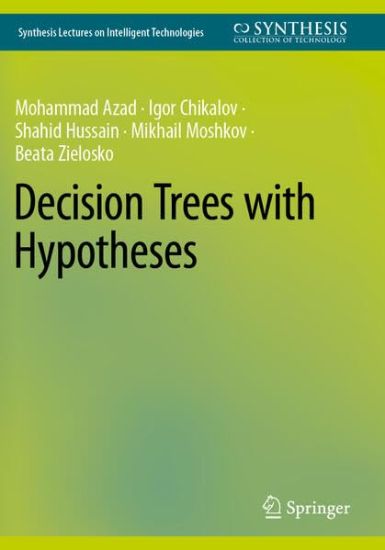
Decision Trees with Hypotheses

Mohammad Azad; Igor Chikalov; Shahid Hussain; Mikhail Moshkov; Beata Zielosko

Springer International Publishing AG
2023
nidottu
In this book, the concept of a hypothesis about the values of all attributes is added to the standard decision tree model, considered, in particular, in test theory and rough set theory. This extension allows us to use the analog of equivalence queries from exact learning and explore decision trees that are based on various combinations of attributes, hypotheses, and proper hypotheses (analog of proper equivalence queries). The two main goals of this book are (i) to provide tools for the experimental and theoretical study of decision trees with hypotheses and (ii) to compare these decision trees with conventional decision trees that use only queries, each based on a single attribute. Both experimental and theoretical results show that decision trees with hypotheses can have less complexity than conventional decision trees. These results open up some prospects for using decision trees with hypotheses as a means of knowledge representation and algorithms for computing Boolean functions. The obtained theoretical results and tools for studying decision trees with hypotheses are useful for researchers using decision trees and rules in data analysis. This book can also be used as the basis for graduate courses.
Decision Trees with Hypotheses

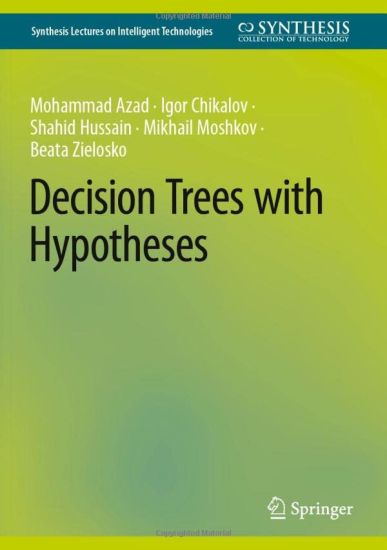
Decision Trees with Hypotheses

Mohammad Azad; Igor Chikalov; Shahid Hussain; Mikhail Moshkov; Beata Zielosko

Springer International Publishing AG
2022
sidottu
In this book, the concept of a hypothesis about the values of all attributes is added to the standard decision tree model, considered, in particular, in test theory and rough set theory. This extension allows us to use the analog of equivalence queries from exact learning and explore decision trees that are based on various combinations of attributes, hypotheses, and proper hypotheses (analog of proper equivalence queries). The two main goals of this book are (i) to provide tools for the experimental and theoretical study of decision trees with hypotheses and (ii) to compare these decision trees with conventional decision trees that use only queries, each based on a single attribute. Both experimental and theoretical results show that decision trees with hypotheses can have less complexity than conventional decision trees. These results open up some prospects for using decision trees with hypotheses as a means of knowledge representation and algorithms for computing Boolean functions. The obtained theoretical results and tools for studying decision trees with hypotheses are useful for researchers using decision trees and rules in data analysis. This book can also be used as the basis for graduate courses.
Combinatorial Machine Learning

Combinatorial Machine Learning

Mikhail Moshkov; Beata Zielosko

Springer-Verlag Berlin and Heidelberg GmbH Co. K
2013
nidottu
Decision trees and decision rule systems are widely used in different applicationsas algorithms for problem solving, as predictors, and as a way forknowledge representation. Reducts play key role in the problem of attribute(feature) selection. The aims of this book are (i) the consideration of the setsof decision trees, rules and reducts; (ii) study of relationships among theseobjects; (iii) design of algorithms for construction of trees, rules and reducts;and (iv) obtaining bounds on their complexity. Applications for supervisedmachine learning, discrete optimization, analysis of acyclic programs, faultdiagnosis, and pattern recognition are considered also. This is a mixture ofresearch monograph and lecture notes. It contains many unpublished results. However, proofs are carefully selected to be understandable for students. The results considered in this book can be useful for researchers in machinelearning, data mining and knowledge discovery, especially for those who areworking in rough set theory, test theory and logical analysis of data. The bookcan be used in the creation of courses for graduate students.
Combinatorial Machine Learning

Combinatorial Machine Learning

Mikhail Moshkov; Beata Zielosko

Springer-Verlag Berlin and Heidelberg GmbH Co. K
2011
sidottu
Decision trees and decision rule systems are widely used in different applicationsas algorithms for problem solving, as predictors, and as a way forknowledge representation. Reducts play key role in the problem of attribute(feature) selection. The aims of this book are (i) the consideration of the setsof decision trees, rules and reducts; (ii) study of relationships among theseobjects; (iii) design of algorithms for construction of trees, rules and reducts;and (iv) obtaining bounds on their complexity. Applications for supervisedmachine learning, discrete optimization, analysis of acyclic programs, faultdiagnosis, and pattern recognition are considered also. This is a mixture ofresearch monograph and lecture notes. It contains many unpublished results. However, proofs are carefully selected to be understandable for students. The results considered in this book can be useful for researchers in machinelearning, data mining and knowledge discovery, especially for those who areworking in rough set theory, test theory and logical analysis of data. The bookcan be used in the creation of courses for graduate students.
Partial Covers, Reducts and Decision Rules in Rough Sets

Partial Covers, Reducts and Decision Rules in Rough Sets

Mikhail Ju. Moshkov; Marcin Piliszczuk; Beata Zielosko

Springer-Verlag Berlin and Heidelberg GmbH Co. K
2010
nidottu
This monograph is devoted to theoretical and experimental study of partial reductsandpartialdecisionrulesonthebasisofthestudyofpartialcovers. The use of partial (approximate) reducts and decision rules instead of exact ones allowsustoobtainmorecompactdescriptionofknowledgecontainedindecision tables,andtodesignmorepreciseclassi?ers. Weconsideralgorithmsforconstructionofpartialreductsandpartialdecision rules,boundsonminimalcomplexityofpartialreductsanddecisionrules,and algorithms for construction of the set of all partial reducts and the set of all irreducible partial decision rules. We discuss results of numerous experiments with randomly generated and real-life decision tables. These results show that partial reducts and decision rules can be used in data mining and knowledge discoverybothforknowledgerepresentationandforprediction. Theresultsobtainedinthe monographcanbe usefulforresearchersinsuch areasasmachinelearning,dataminingandknowledgediscovery,especiallyfor thosewhoareworkinginroughsettheory,testtheoryandLAD(LogicalAnalysis ofData). The monographcan be usedunder the creationofcoursesforgraduates- dentsandforPh. D. studies. An essential part of software used in experiments will be accessible soon in RSES-RoughSetExplorationSystem(InstituteofMathematics,WarsawU- versity,headofproject-ProfessorAndrzejSkowron). We are greatly indebted to Professor Andrzej Skowron for stimulated d- cussionsand varioussupportof ourwork. We aregratefulto ProfessorJanusz Kacprzykforhelpfulsuggestions. Sosnowiec,Poland MikhailJu. Moshkov April2008 MarcinPiliszczuk BeataZielosko Contents Introduction...1 1 PartialCovers,ReductsandDecisionRules ...7 1. 1 PartialCovers...8 1. 1. 1 MainNotions...8 1. 1. 2 Known Results...9 1. 1. 3 PolynomialApproximateAlgorithms...10 1. 1. 4 Bounds on C (?)Based on Information about min GreedyAlgorithm Work...13 1. 1. 5 UpperBoundon C (?)...17 greedy 1. 1. 6 Covers fortheMostPartofSetCoverProblems...18 1. 2 PartialTests and Reducts...22 1. 2. 1 MainNotions...22 1. 2. 2Relationships betweenPartialCovers and Partial Tests...23 1. 2. 3 PrecisionofGreedyAlgorithm...24 1. 2. 4 PolynomialApproximateAlgorithms...25 1. 2. 5 Bounds on R (?)Based on Information about min GreedyAlgorithm Work...26 1. 2. 6 UpperBoundon R (?)...28 greedy 1. 2. 7 Tests fortheMostPartofBinaryDecisionTables...29 1. 3 PartialDecision Rules...
Partial Covers, Reducts and Decision Rules in Rough Sets

Partial Covers, Reducts and Decision Rules in Rough Sets

Mikhail Ju. Moshkov; Marcin Piliszczuk; Beata Zielosko

Springer-Verlag Berlin and Heidelberg GmbH Co. K
2009
sidottu
This monograph is devoted to theoretical and experimental study of partial reductsandpartialdecisionrulesonthebasisofthestudyofpartialcovers. The use of partial (approximate) reducts and decision rules instead of exact ones allowsustoobtainmorecompactdescriptionofknowledgecontainedindecision tables,andtodesignmorepreciseclassi?ers. Weconsideralgorithmsforconstructionofpartialreductsandpartialdecision rules,boundsonminimalcomplexityofpartialreductsanddecisionrules,and algorithms for construction of the set of all partial reducts and the set of all irreducible partial decision rules. We discuss results of numerous experiments with randomly generated and real-life decision tables. These results show that partial reducts and decision rules can be used in data mining and knowledge discoverybothforknowledgerepresentationandforprediction. Theresultsobtainedinthe monographcanbe usefulforresearchersinsuch areasasmachinelearning,dataminingandknowledgediscovery,especiallyfor thosewhoareworkinginroughsettheory,testtheoryandLAD(LogicalAnalysis ofData). The monographcan be usedunder the creationofcoursesforgraduates- dentsandforPh. D. studies. An essential part of software used in experiments will be accessible soon in RSES-RoughSetExplorationSystem(InstituteofMathematics,WarsawU- versity,headofproject-ProfessorAndrzejSkowron). We are greatly indebted to Professor Andrzej Skowron for stimulated d- cussionsand varioussupportof ourwork. We aregratefulto ProfessorJanusz Kacprzykforhelpfulsuggestions. Sosnowiec,Poland MikhailJu. Moshkov April2008 MarcinPiliszczuk BeataZielosko Contents Introduction...1 1 PartialCovers,ReductsandDecisionRules ...7 1. 1 PartialCovers...8 1. 1. 1 MainNotions...8 1. 1. 2 Known Results...9 1. 1. 3 PolynomialApproximateAlgorithms...10 1. 1. 4 Bounds on C (?)Based on Information about min GreedyAlgorithm Work...13 1. 1. 5 UpperBoundon C (?)...17 greedy 1. 1. 6 Covers fortheMostPartofSetCoverProblems...18 1. 2 PartialTests and Reducts...22 1. 2. 1 MainNotions...22 1. 2. 2Relationships betweenPartialCovers and Partial Tests...23 1. 2. 3 PrecisionofGreedyAlgorithm...24 1. 2. 4 PolynomialApproximateAlgorithms...25 1. 2. 5 Bounds on R (?)Based on Information about min GreedyAlgorithm Work...26 1. 2. 6 UpperBoundon R (?)...28 greedy 1. 2. 7 Tests fortheMostPartofBinaryDecisionTables...29 1. 3 PartialDecision Rules...