Kirjojen hintavertailu – 12 903 725 kirjaa ja 27 kauppaa

Kirjailija

Beatrice Hale

Kirjat ja teokset yhdessä paikassa: 6 kirjaa, julkaisuja vuosilta 2013–2025, suosituimpiin kuuluu Caring for the Elderly from Prehistory to the Twentieth Century. Vertaile teosten hintoja ja tarkista saatavuus suomalaisista kirjakaupoista.

6 kirjaa

Kirjojen julkaisuvuodet: 2013–2025.

Caring for the Elderly  from Prehistory to the Twentieth Century

Caring for the Elderly from Prehistory to the Twentieth Century

Beatrice Hale

Springer International Publishing AG
2025
sidottu
The book builds a picture of caregiving for the elderly throughout history, by means of a 'carerscape'. This idea is based on Appudurai's 'ethnoscape', and is used here with different concepts highlighted in each chapter to create a picture of caregiving. It explores care by individuals, starting with kin and household members, then through various systems, such as spirituality, aspects of legal systems and aspects of social care through various community-based groups. The book begins by discussing the variety of sources. The first historical chapter refers to prehistoric times, with findings from different paleontologists. Chapters on ancient Egypt, Greece and Rome discuss spirituality, legality and care and abuse. Next, early Christianity is examined, with its communal spirit of care, and then to parish care in medieval times. Personal experiences are highlighted through diaries in nineteenth-century America. Other chapters consider ageing and care in folklore and in fiction and the media. To conclude, there is a discussion on modern caregiving and the 'carerscape' is presented based on the concepts highlighted in the different chapters. A final chapter summarizes the acknowledgement of the general carer role, by listing how different countries now accept caregiving.

The Resolute Heart

The Resolute Heart

Beatrice Hale

The Kellas Cat Press
2022
nidottu
A determined woman … When Napoleon is threatening the shores of Britain, Nelson’s navy needs all the men it can get – and they’re not all volunteers. Mary’s husband is snatched from the shores of Fife to serve in the biggest naval battle of the age. But Mary’s no sit-at-home wife: she’s going after him. On the way she’ll make enemies and friends - sometimes it’s hard to tell which is which. Not everyone wants Nelson to win. Will she find Harry? And if she does, can she rescue him – from the navy and from the country’s worst enemies?
Ice Escape

Ice Escape

Beatrice Hale

The Kellas Cat Press
2021
nidottu
John wants to be part of the first family to fly around the world. Colin wants to stay at home, not sail out on a fishing trawler into the Arctic Ocean where his father drowned. But one little accident leads to disaster, and that means the boys have to overcome their fears to meet far from home, in one of the coldest, harshest places on earth.
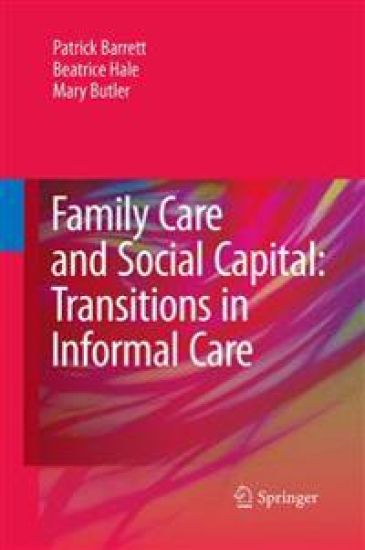
Family Care and Social Capital: Transitions in Informal Care

Family Care and Social Capital: Transitions in Informal Care

Patrick Barrett; Beatrice Hale; Mary Butler

Springer
2015
nidottu
Becoming a caregiver is increasingly an inevitable experience for many people and, therefore, a likely life transition. Drawing on research and personal experiences of working with family caregivers, this book examines a range of family caregiving situations from across the life course. It seeks to capture the dynamics of caregiving in a number of common situations: caregiving during infancy, for adults who acquire a disability through accidents or illness, for older people with age-related issues, and caregiving by children and adolescent carers and grandparent carers. In drawing attention to key moments of vulnerability faced by family and informal caregivers, and by suggesting how to assist ‘reconnection’ at these moments, the book provides a guide for those working in the area of health, disability and care. Informal care is conceptualised as occurring with the context of personal interrelationships, these being nested within wider kin networks and linked with wider professional formal care networks. Informal care is seen both as an expression of social capital and as an activity that builds social capital. It is an indicator of resources of mutual support within social networks, and it has the effect of adding to the stock of social resources. The book makes a case, therefore, for facilitating the development of social capital by strengthening the capacity of informal caregivers and caregiver groups, and by improving the linkages with formal care organisations.
The Age of Supported Independence

The Age of Supported Independence

Beatrice Hale; Patrick Barrett; Robin Gauld

Springer
2014
nidottu
This book investigates the experiences of older people who remain at home with care. It examines the transition points for the important life changes faced by family members who take on a greater care-giving role. The book draws on demographic analyses and qualitative fieldwork to explore the shift from independence to increasing dependence, and suggests that this transition constitutes movement into a new stage of life, that of an Age of Supported Independence. Applying the anthropological concept of rites of passage in their analysis, the authors focus on the changes in everyday living within the spatial environment of the home, the temporal organization of daily life, and the reshaping of relationships. They suggest that many older people – as well as the family members who become carers – remain in a state of ‘liminality’: unable to make sense of their new situation and experience and, despite assumptions that ageing-in-place sustains social connectedness, excluded from their communities.
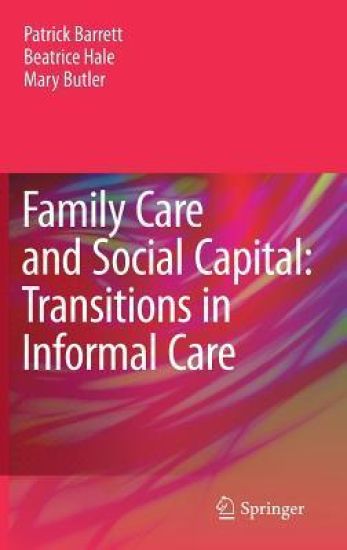
Family Care and Social Capital: Transitions in Informal Care

Family Care and Social Capital: Transitions in Informal Care

Patrick Barrett; Beatrice Hale; Mary Butler

Springer
2013
sidottu
Becoming a caregiver is increasingly an inevitable experience for many people and, therefore, a likely life transition. Drawing on research and personal experiences of working with family caregivers, this book examines a range of family caregiving situations from across the life course. It seeks to capture the dynamics of caregiving in a number of common situations: caregiving during infancy, for adults who acquire a disability through accidents or illness, for older people with age-related issues, and caregiving by children and adolescent carers and grandparent carers. In drawing attention to key moments of vulnerability faced by family and informal caregivers, and by suggesting how to assist ‘reconnection’ at these moments, the book provides a guide for those working in the area of health, disability and care. Informal care is conceptualised as occurring with the context of personal interrelationships, these being nested within wider kin networks and linked with wider professional formal care networks. Informal care is seen both as an expression of social capital and as an activity that builds social capital. It is an indicator of resources of mutual support within social networks, and it has the effect of adding to the stock of social resources. The book makes a case, therefore, for facilitating the development of social capital by strengthening the capacity of informal caregivers and caregiver groups, and by improving the linkages with formal care organisations.