Kirjojen hintavertailu – 12 859 819 kirjaa ja 27 kauppaa
Kirjailija
Ben Connable
Kirjat ja teokset yhdessä paikassa: 22 kirjaa, julkaisuja vuosilta 2010–2025, suosituimpiin kuuluu Adaptive Engagement for Undergoverned Spaces. Vertaile teosten hintoja ja tarkista saatavuus suomalaisista kirjakaupoista.
Aaron B Frank; Elizabeth M Bartels; Adam R Grissom; Jonathan S Blake; Gabrielle Tarini; Kelly Elizabeth Eusebi; Joseph N Mait; Elisa Jayne Bienenstock; Andrew M Parker; Steven W Popper; Paul K Davis; Edward Geist; Ben Connable; Zev Winkelman; Robert L Axtell; Justin Grana; Robert J Lempert; Kelly Klima; Sara Turner; James R Watson; Michael J Gaines; Yuna Huh Wong; Jasmin Léveillé; Timothy Marler
Daniel Egel; Charles P. Ries; Ben Connable; Todd C. Helmus; Eric Robinson; Isaac Baruffi; Melissa A. Bradley; Kurt Card; Kathleen Loa; Sean Mann; Fernando Sedano; Stephan B. Seabrook; Robert Stewart
This report examines the use of the Commander's Emergency Response Program (CERP) in Afghanistan. It explores the effectiveness of CERP in supporting tactical operations in Afghanistan during the counterinsurgency-focused 2010-2013 time frame using both qualitative and quantitative methods and describes CERP's origins, history, and existing research on the effectiveness of CERP in Iraq and Afghanistan.
This document presents the second edition ruleset for the wargame played at the Marine Corps' Information Warfighter Exercise (IWX)--an event designed to provide training on information activities and capabilities. In the IWX wargame, two teams compete in a notional scenario, providing their side with a detailed plan for information activities and amending that plan dynamically in response to in-game events and the actions of the other team.
This document presents the full ruleset for the wargame played at the Marine Corps? Information Warfighter Exercise (IWX)?an event designed to provide training for aspects of operations in the information environment (OIE). In the IWX wargame, two teams compete in a notional scenario, providing their side with a detailed plan for OIE and amending that plan dynamically in response to in-game events and the actions of the other team.
Ben Connable; Michael J McNerney; William Marcellino; Aaron Frank; Henry Hargrove; Marek N Posard; S Rebecca Zimmerman; Natasha Lander; Jasen J Castillo; James Sladden
This report defines and describes will to fight and provides a model of unit will to fight that can be applied to ground combat units of any scale. The model provides a research-grounded template for case-by-case adviser assessment of partner or allied military forces and the intelligence analysis of adversary forces. This report also provides a theoretical basis for adding will to fight to military war gaming and simulation.
Richard Brennan; Charles P. Ries; Larry Hanauer; Ben Connable; Terrence K. Kelly; Michael J. McNerney; Stephanie Young; Jason H. Campbell; K. Scott McMahon
A challenge to common assumptions about the future of land warfareGround Combat reveals the gritty details of land warfare at the tactical level and challenges today's overly subjective and often inaccurate approaches to characterizing war. Ben Connable's motivation for writing the book is to offer an evidence-based approach to examining the future of war. Connable created and analyzed an original dataset of more than four hundred global ground combat cases, showing that there was an evolutionary rather than revolutionary shift in the characteristics of ground combat from World War II through the early 2020s. Despite advances in military technology, tanks, artillery, and infantry remain central to how war is waged on land. This book asks readers to stop and think about the implications of these findings for force planning and future predictions about military-technical revolutions. This book sets an essential evidentiary baseline for military officers, policymakers, and scholars who think about the future of modern war.
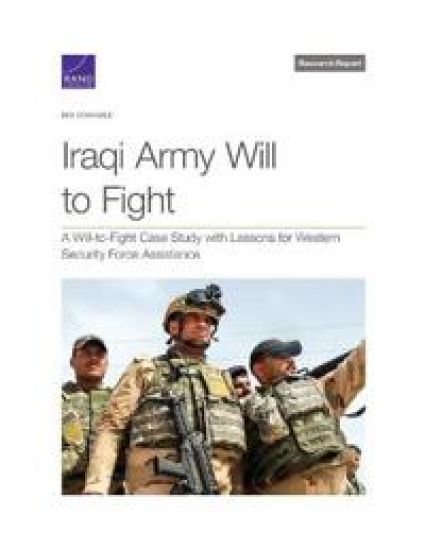
The Iraqi Army's collapse in summer 2014 has been widely attributed to a lack of will to fight. In this report, Ben Connable applies RAND's analytic model of will to fight to the regular Iraqi Army, identifying factors that contribute to or undermine Iraqi Army will to fight and providing recommendations for the U. S. security force assistance mission in Iraq.
Analysis of Russian military capabilities reveals stark limitations in Russia's ability to safely and effectively deploy and sustain ground forces around the world. Notional deployment scenarios highlight a lack of readily deployable forces and transportation assets and limited freedom of movement. Collectively, these challenges suggest a modern Russian force that is far less deployable than the Soviet military it replaced.
Russia's ability to deploy military forces around the world is significantly depleted from the Soviet era. This report describes the strengths and weaknesses of Russia's ground force deployment capacity. Russia's armed forces are much improved from the 1990s, but lack of adequate transportation, political limitations, shortfalls in sustainment, limits on conscript deployment, and other factors constrain its global ground force deployment.
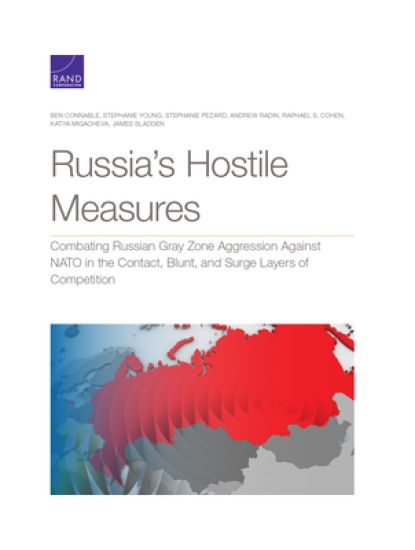
Russia has historically succeeded in using various hostile measures to sow disorder, weaken democratic institutions, and undermine Western alliances. However, it also has a long track record of strategic shortfalls and even ineptitude. Exploring opportunities to deter, prevent, and counter Russian hostile behavior will benefit NATO and other Western powers in the so-called gray zone short of war, as well as in a conventional warfare scenario.
In this report, RAND researchers explore the factors, contexts, and mechanisms that shape a national government's decision to continue or end military and other operations during a conflict (i.e., national will to fight). To help U. S. leaders better understand and influence will to fight, the researchers propose an exploratory model of 15 variables that can be tailored and applied to a wide set of conflict scenarios.
This report presents findings from an examination of six historical case studiesa "in Iraq, Jordan, Pakistan, the Philippines, Uganda, and Yemena "in which the mission of special operations forces in each of the six countries transitioned over time to include some level of inclusion in the U. S. embassya (TM)s Security Cooperation Office, with a focus on what lessons these experiences offer for the transition of SOF in Afghanistan.
Since 9/11, Russia, China, and Iran have successfully exploited or stretched U. S. thresholds for high-order war in order to further their strategic ends and, in the process, undermine U. S. interests. Each of these countries has made expert use of some combination of measures short of war to enact its strategies. This report describes those measures and how these nation-states use them and explains why U. S. notions of thresholds might be outdated.
This report s analytic forecasts should help the United States determine how to support Jordan as it faces the Syrian refugee crisis. Jordanians are dissatisfied with many aspects of their government, but the chaos in neighboring states has thus far deterred civil or violent actions. If Jordan wisely invests international refugee support, it can increase popular opinion by improving the lives of Syrian refugees and Jordanian citizens."
RAND researchers conducted a lessons learned examination of operations analysis, modeling, and simulation in support of Operation Enduring Freedom and Operation Iraqi Freedom. Researchers identified ways in which analysts have attempted to support commanders decision-making and describe a selection of the models and tools they employed."
Richard R. Brennan; Charles P. Ries; Larry Hanauer; Ben Connable; Terrence K. Kelly; Michael J. McNerney; Stephanie Young; Jason Campbell; K. Scott McMahon
Ending the U. S. war in Iraq required redeploying 100,000 military and civilian personnel; handing off responsibility for 431 activities to the Iraqi government, U. S. embassy, USCENTCOM, or other U. S. government entities; and moving or transferring ownership of over a million pieces of property in accordance with U. S. and Iraqi laws, national policy, and DoD requirements. This book examines the planning and execution of this transition.
The unpredictable counterinsurgency environment challenges centralized, quantitative campaign assessment. A comprehensive examination of the centralized, quantitative approach to assessment, as described in the literature and doctrine and applied in two primary case studies (Vietnam and Afghanistan), reveals weaknesses and gaps and proposes an alternative process: contextual assessment. An examination of the approach used through early 2011 reveals weaknesses and gaps and proposes an alternative, bottom-up methodology.