Kirjailija
Benedetto Croce
Kirjat ja teokset yhdessä paikassa: 109 kirjaa, julkaisuja vuosilta 1931–2026, suosituimpiin kuuluu Ariosto, Shakespeare and Corneille. Vertaile teosten hintoja ja tarkista saatavuus suomalaisista kirjakaupoista.
109 kirjaa
Kirjojen julkaisuvuodet: 1931–2026.
Historical Materialism And The Economics Of Karl Marx
Benedetto Croce
KESSINGER PUBLISHING CO
2004
pokkari
Aesthetic As Science Of Expression And General Linguistic
Benedetto Croce
Kessinger Pub
2004
pokkari
Written in 1938 when the Western world had succumbed to the notion that history is a creature of blind force. A reviewer at the time noted the importance of Croce's belief that "the central trend in the evolution of man is the unfolding of new potentialities, and that the task of the historian is to discover and emphasise this trend: the story of liberty". As Croce himself writes, "Even in the darkest and crassest times liberty trembles in the lines of poets and affirms itself in the pages of thinkers and burns, solitary and magnificent, in some men who cannot be assimilated by the world around them." The first edition in English of HISTORY AS THE STORY OF LIBERTY appeared in London in 1941. The new Liberty Fund edition includes modest improvements to the translation by Folke Leander and arranged by Claes Ryn.
A reprint of the Library of Liberal Arts edition of 1965. Croce’s Guide presents one of the clearest and strongest defenses of the intuitive nature of art in Western philosophical thought.
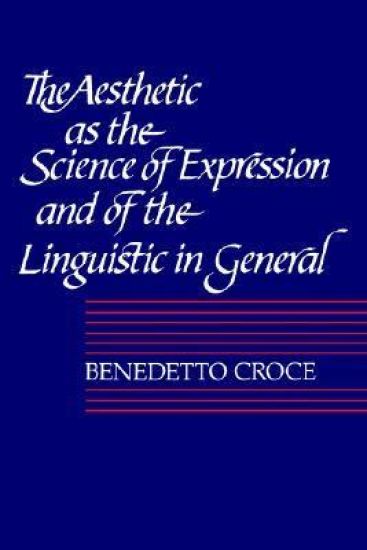
The Aesthetic as the Science of Expression and of the Linguistic in General, Part 1, Theory
Benedetto Croce
Cambridge University Press
1992
pokkari
The Italian philosopher Benedetto Croce (1866–1952) spent most of his life as a private scholar in Naples. His Estetica, which first appeared in 1902, has remained a seminal work not only for aesthetics but also for general linguistics. As the full title indicates, this is not a narrow work dealing with the theory of art and criticism. For Croce intended this to be the first part of his ‘philosophy of the spirit’ and he thus presents a systematic general theory intended to solve all philosophical problems. The work presents an account of the structure of the human mind and shows how art arises naturally from that structure, as well as introducing the influential notion of the organic unity of a work of art. As a result, art is shown to be integral to any life and an essential aspect of what it is to be human.