Kirjailija
Benjamin Franklin
Kirjat ja teokset yhdessä paikassa: 677 kirjaa, julkaisuja vuosilta 1791–2026, suosituimpiin kuuluu The Autobiography of Benjamin Franklin. Vertaile teosten hintoja ja tarkista saatavuus suomalaisista kirjakaupoista.
677 kirjaa
Kirjojen julkaisuvuodet: 1791–2026.
Benjamin Franklin's writings represent a long career of literary, scientific and political efforts over a lifetime which extended nearly the entire eighteenth century. This volume includes Franklin's reflections on such diverse questions as philosophy and religion, social status, electricity, American national characteristics, war, and the status of women. Nearly sixty years separate the earliest writings from the latest, an interval during which Franklin was continually balancing between the puritan values of his upbringing and the modern American world to which his career served as prologue. This edition provides a new text of the Autobiography, established with close reference to Franklin's original manuscript. It also includes a new transcription of the 1726 journal and several pieces which have recently been identified as Franklin's own work.

Autobiography of Benjamin Franklin 1903
Benjamin Franklin; Nathan Haskell Dole
Kessinger Pub
2003
pokkari
Benjamin Franklin's Autobiographical Writings
Benjamin Franklin; Carl (EDT) Van Doren; Benjamin Franklin
Simon Pubns
2002
pokkari
Benjamin Franklin's Autobiographical Writings
Benjamin Franklin; Carl (EDT) Van Doren; Benjamin Franklin
Simon Pubns
2002
pokkari
The thirty-sixth volume of the collected writings and correspondences of the American statesman, ambassador, and Founding Father Benjamin Franklin As this volume opens, Franklin despairs of living long enough to see the war come to an end. He had been plagued by continued financial demands from Congress that he could not meet and was worried about how much further he could draw on France’s goodwill. But on the evening of November 19, Vergennes received and forwarded to Franklin the news of Cornwallis’s capitulation at Yorktown a month earlier. All France celebrated the Franco-American victory, and Franklin’s life became a whirl of dinner parties and congratulations. Franklin spent the winter in excellent health and used this period of relative respite to intellectual advantage, buying books and attending scientific meetings. He could do little to hasten the war’s end, however, and waited patiently for a change of policy by the British government. With the approach of spring, he received a series of letters on the failing fortunes of Lord North and his colleagues in the House of Commons. As the volume ends, Lord Cholmondeley is on his way to Paris. His arrival will offer Franklin a chance to make contact with a new British government that might negotiate for peace.
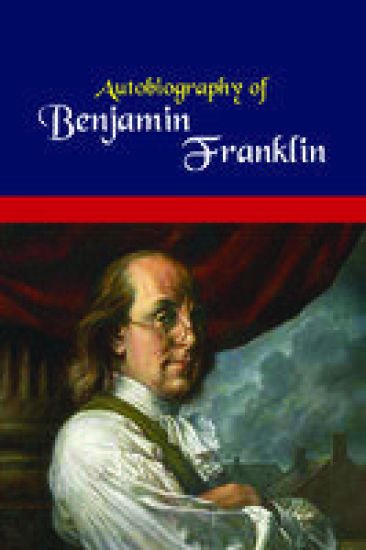
Franklin’s Autobiography is one of the most famous works in American literature. He started it as a private collection of anecdotes for his son, but soon it was transformed into a work of history, both personal and national, revealing Franklin as the man who, as Herman Melville said, possessed “deep worldly wisdom and polished Italian tact, gleaming under an air of Arcadian unaffectedness. "If you want the brutal truth, I did not expect to get much useful information out of Poor Richard's Almanack. I wondered, what could Benjamin Franklin--a guy who has been, no offense, dead for more than two hundred years--possibly have to say that would be relevant to a resident of today's dot-com world? Plenty, as it turns out."--from the Introduction by Dave Barry
The Autobiography of Benjamin Franklin
Benjamin Franklin
Dover Publications Inc.
2000
nidottu
Halvin toimitettuna 12,90 €
One of the most popular works of American literature, this charming self-portrait has been translated into nearly every language. It covers Franklin's life up to his prewar stay in London as representative of the Pennsylvania Assembly, including his boyhood years, work as a printer, experiments with electricity, political career, much more.
The thirty-fifth volume of the collected writings and correspondences of the American statesman, ambassador, and Founding Father Benjamin Franklin During the six months from May through October 1781, Benjamin Franklin continues to address important diplomatic, political, and economic matters as minister plenipotentiary to France. While the decisive Yorktown campaign is waged in America, Franklin, a distant observer, faces a battle of his own--to save America’s financial credit in Europe. Congress has drawn so many bills on him, on John Jay in Spain, and on John Adams in the Netherlands that Franklin, ultimately responsible for all of them, faces the danger of bankruptcy. Here, as at Yorktown, French help permits the young nation to weather the crisis. Having recovered from a prolonged spell of gout and having learned that he will be retained as American minister in France, Franklin is revived in health and spirits. He undertakes his many public responsibilities with renewed vigor and is appointed by Congress to a five-member commission to negotiate peace with Britain. Franklin finds time for experiments with different inks and paper, masonic activities, purchasing books and exchanging them with friends, and maintaining a wide correspondence that provides exceptionally revealing glimpses of his thinking on science, politics, and Indian languages. Publication of this volume was assisted by a grant from the National Historical Publications and Records Commission.
The thirty-third volume of the collected writings and correspondences of the American statesman, ambassador, and Founding Father Benjamin Franklin This volume, which covers the late summer and autumn of 1780, shows Franklin responding to adversity with courage, dedication, and resilience. During this period Franklin finds himself "terrified and vexed" by the "Storm of Bills," "indisposed by continual Anxiety," and bedridden with gout as the volume ends. However, he receives some advice on his health in the form of a poem by his witty neighbor Madame Brillon, and soon his health and spirits will revive. Publication of this volume was assisted by a grant from the National Historical Publications and Records Commission.
The thirty-first volume of the collected writings and correspondences of the American statesman, ambassador, and Founding Father Benjamin Franklin Volume 31 of The Papers of Benjamin Franklin is the fourth volume in the sequence dealing with Franklin’s tenure as sole minister to the French court, and it is the ninth of a projected twenty volumes covering Franklin’s years in France. Franklin’s public life was exceptionally busy. Among his duties were supervising the collection of arms and uniforms for the American army and conducting an inquiry into the conduct of Captain Pierre Landais at the Battle off Flamborough Head. This volume gives much information about Franklin’s other interests as well, ranging from a fascinating tailor’s bill to a lengthy memorial describing his western land ventures. Five of his bagatelles—including “The Whistle” and “The Elysian Fields,” composed for the two most important women in his French life, Mme. Brillon and Mme. Helvétius—appear here. Students of a variety of subjects, from cryptography to the history of printing, will find material of interest in this richly varied collection of letters and documents. Volume 31 is a major addition not only to Franklin studies but also to the study of early American history. Publication of this volume was assisted by a grant from the National Historical Publications and Records Commission
The twenty-ninth volume of the collected writings and correspondences of the American statesman, ambassador, and Founding Father Benjamin Franklin This volume marks the first full months of Franklin’s tenure as sole American minister to the Court of France. Relieved from the necessity of having to work any longer with John Adams and Arthur Lee, Franklin took charge of the American mission with new-found vigor, writing on average fifty letters a month, sometimes in spurts of six or seven a day. No other period of his life has left so full a documentary record. In the absence of a network of American consuls in France, the business of receiving cargoes, fitting out ships, supervising the procurement of supplies, and tending to the interests of American citizens abroad fell to the American minister plenipotentiary. Prominent among the naval captains with whom he dealt was John Paul Jones; this volume reveals the first attempts of Franklin and the French Court to devise a mission for the Bonhomme Richard squadron. Busy diplomat that he was, Franklin always had time for scientific and other pursuits. His paper on the aurora borealis was delivered to the Academie des sciences. He attended experiments on the ingenious microscope solaire by the young scientist of future Revolutionary fame, Jean-Paul Marat. In May, he was elected Venerable of his Masonic lodge. During these months too, Franklin resumed his earliest profession and avocation, printing. He established a type foundry at Passy in 1778 and had his press in operation by the following spring. In this volume is reproduced the first Passy imprint that can be dated with any certainty, his invitation to an Independence Day celebration. Also in the spring he reworked an essay that he had conceived over sixty years before. Entitled “The Morals of Chess,” it became one of his best-known lighter pieces.
This volume marks the beginning of hostilities between Britain and France. Although Franklin and his fellow commissioners do not play a major role in the new wartime diplomacy and military strategy, the documents richly illustrate his relationship with his American colleagues, his neighbors in Passy, and a wide variety of French correspondents. Franklin, in a moment of personal discouragement at the failure of his amorous pursuit of Mme. Brillon, writes a haunting literary piece the “Ephemera.” Part of his wistful mood undoubtedly stems from his expectation of recall by Congress. Instead Congress at the end of this volume elects him America’s first minister plenipotentiary to the French court.
The First American Book on Personal FinanceThe Way to Wealth by Benjamin Franklin is still the best and wisest book on money and wealth ever written. Originally published in 1758 as the preface to Poor Richard's Almanack, this little gem has been through innumerable printings and sold millions of copies to those in search of smart but entertaining advice about hard work, earning and saving money and debt.
Bild 1 Die Beatification, wie sie in dem Werk von B. Rackstrow: Miscellaneous observations, tagether with a co/lection of experiments on electricity, London 1748, dargestellt ist. Elektrische Materie wird von einem Reibungsgenerator auf die Platte oberhalb der Krone geleitet. Die Krone selbst ist evakuiert, um die Wirkung zu verstarken. Zusatzlich zu den Entladungen an den ausseren Spitzen der Krone ist das partielle Vakuum in ihrem Inneren von einem diffusen Leuchten erftillt. Einleitung XVII Bild 2 Wilckes Notizen zu Franklins Versuch, eine isolierte Person B stetig durch Funken aufzuladen; diese werden einer Roehre entzogen, welche von einer zweiten, isolierten Person A gehalten wird. "X" bezeichnet einen Isolator. "Literaria electrica", f. 10 (Wilcke: Handschriften Nr. 45, KV A). Er beobachtete, dass sowohlAalsauch B nach dem Austausch einen Funken an C (der wahrenddessen auf dem Boden gestanden hatte (Bild 2)) weitergeben koennen. Um ihr Verhalten zu deuten, ftihrte Franklin die Bezeichnungen und Begriffe von Plus-und Minus- Elektrizitat ein: Alle Koerper besitzen eine gewisse naturliche Menge elektrischer Materie.
One of the founding fathers of the United States of America, Benjamin Franklin was a leading author, satirist, political theorist, politician, scientist, inventor, civic activist, statesman and diplomat. Franklin was interested in science and technology, and gained international fame for his famous experiments, discoveries and theories regarding electricity. An early supporter of colonial unity, Franklin invented the idea of an American nation and secured the French alliance that helped to make independence possible. Franklin is also credited as being foundational to the roots of American values and character, a marriage of the practical and democratic.