Kirjojen hintavertailu – 12 859 818 kirjaa ja 27 kauppaa

Kirjailija

Benjamin K. Sovacool

Kirjat ja teokset yhdessä paikassa: 24 kirjaa, julkaisuja vuosilta 2008–2020, suosituimpiin kuuluu The Governance of Energy Megaprojects. Vertaile teosten hintoja ja tarkista saatavuus suomalaisista kirjakaupoista.

Nimi esiintyy myös muodoissa: Benjamin K Sovacool

24 kirjaa

Kirjojen julkaisuvuodet: 2008–2020.

Global Energy Politics

Global Energy Politics

Thijs Van de Graaf; Benjamin K. Sovacool

Polity Press
2020
nidottu

Halvin toimitettuna 30,80 €

Ever since the Industrial Revolution energy has been a key driver of world politics. From the oil crises of the 1970s to today’s rapid expansion of renewable energy sources, every shift in global energy patterns has important repercussions for international relations. In this new book, Thijs Van de Graaf and Benjamin Sovacool uncover the intricate ways in which our energy systems have shaped global outcomes in four key areas of world politics: security, the economy, the environment and global justice. Moving beyond the narrow geopolitical focus that has dominated much of the discussion on global energy politics, they also deftly trace the connections between energy, environmental politics, and community activism. The authors argue that we are on the cusp of a global energy shift that promises to be no less transformative for the pursuit of wealth and power in world politics than the historical shifts from wood to coal and from coal to oil. This ongoing energy transformation will not only upend the global balance of power; it could also fundamentally transfer political authority away from the nation state, empowering citizens, regions and local communities. Global Energy Politics will be an essential resource for students of the social sciences grappling with the major energy issues of our times.
Global Energy Politics

Global Energy Politics

Thijs Van de Graaf; Benjamin K. Sovacool

Polity Press
2020
sidottu
Ever since the Industrial Revolution energy has been a key driver of world politics. From the oil crises of the 1970s to today’s rapid expansion of renewable energy sources, every shift in global energy patterns has important repercussions for international relations. In this new book, Thijs Van de Graaf and Benjamin Sovacool uncover the intricate ways in which our energy systems have shaped global outcomes in four key areas of world politics: security, the economy, the environment and global justice. Moving beyond the narrow geopolitical focus that has dominated much of the discussion on global energy politics, they also deftly trace the connections between energy, environmental politics, and community activism. The authors argue that we are on the cusp of a global energy shift that promises to be no less transformative for the pursuit of wealth and power in world politics than the historical shifts from wood to coal and from coal to oil. This ongoing energy transformation will not only upend the global balance of power; it could also fundamentally transfer political authority away from the nation state, empowering citizens, regions and local communities. Global Energy Politics will be an essential resource for students of the social sciences grappling with the major energy issues of our times.
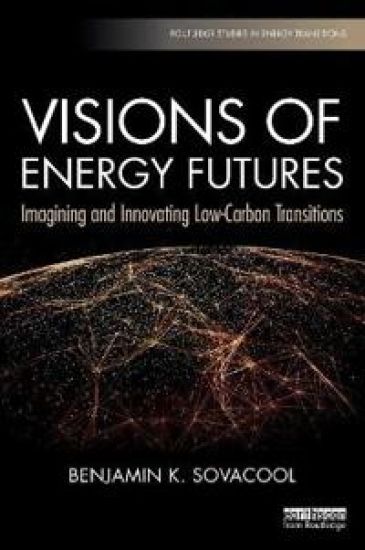
Visions of Energy Futures

Visions of Energy Futures

Benjamin K. Sovacool

Routledge
2019
nidottu

Halvin toimitettuna 59,30 €

This book examines the visions, fantasies, frames, discourses, imaginaries, and expectations associated with six state-of-the-art energy systems—nuclear power, hydrogen fuel cells, shale gas, clean coal, smart meters, and electric vehicles—playing a key role in current deliberations about low-carbon energy supply and use. Visions of Energy Futures: Imagining and Innovating Low-Carbon Transitions unveils what the future of energy systems could look like, and how their meanings are produced, often alongside moments of contestation. Theoretically, it analyzes these technological case studies with emerging concepts from various disciplines: utopianism (history of technology), symbolic convergence (communication studies), technological frames (social construction of technology), discursive coalitions (discourse analysis and linguistics), sociotechnical imaginaries (science and technology studies), and the sociology of expectations (innovation studies, future studies). It draws from these cases to create a synthetic set of dichotomies and frameworks for energy futures based on original data collected across two global epistemic communities— nuclear physicists and hydrogen engineers—and experts in Eastern Europe and the Nordic region, stakeholders in South Africa, and newspapers in the United Kingdom. This book is motivated by the premise that tackling climate change via low-carbon energy systems and practices is one of the most significant challenges of the twenty-first century, and that success will require not only new energy technologies, but also new ways of understanding language, visions, and discursive politics. The discursive creation of the energy systems of tomorrow are propagated in polity, hoping to be realized as the material fact of the future, but processed in conflicting ways with underlying tensions as to how contemporary societies ought to be ordered. This book will be essential reading for students and scholars of energy policy, energy and environment, and technology assessment.
Visions of Energy Futures

Visions of Energy Futures

Benjamin K. Sovacool

Routledge
2019
sidottu
This book examines the visions, fantasies, frames, discourses, imaginaries, and expectations associated with six state-of-the-art energy systems—nuclear power, hydrogen fuel cells, shale gas, clean coal, smart meters, and electric vehicles—playing a key role in current deliberations about low-carbon energy supply and use. Visions of Energy Futures: Imagining and Innovating Low-Carbon Transitions unveils what the future of energy systems could look like, and how their meanings are produced, often alongside moments of contestation. Theoretically, it analyzes these technological case studies with emerging concepts from various disciplines: utopianism (history of technology), symbolic convergence (communication studies), technological frames (social construction of technology), discursive coalitions (discourse analysis and linguistics), sociotechnical imaginaries (science and technology studies), and the sociology of expectations (innovation studies, future studies). It draws from these cases to create a synthetic set of dichotomies and frameworks for energy futures based on original data collected across two global epistemic communities— nuclear physicists and hydrogen engineers—and experts in Eastern Europe and the Nordic region, stakeholders in South Africa, and newspapers in the United Kingdom. This book is motivated by the premise that tackling climate change via low-carbon energy systems and practices is one of the most significant challenges of the twenty-first century, and that success will require not only new energy technologies, but also new ways of understanding language, visions, and discursive politics. The discursive creation of the energy systems of tomorrow are propagated in polity, hoping to be realized as the material fact of the future, but processed in conflicting ways with underlying tensions as to how contemporary societies ought to be ordered. This book will be essential reading for students and scholars of energy policy, energy and environment, and technology assessment.
Vehicle-to-Grid

Vehicle-to-Grid

Lance Noel; Gerardo Zarazua de Rubens; Johannes Kester; Benjamin K. Sovacool

Springer Nature Switzerland AG
2019
sidottu
? This book defines and charts the barriers and future of vehicle-to-grid technology: a technology that could dramatically reduce emissions, create revenue, and accelerate the adoption of battery electric cars. This technology connects the electric power grid and the transportation system in ways that will enable electric vehicles to store renewable energy and offer valuable services to the electricity grid and its markets. To understand the complex features of this emergent technology, the authors explore the current status and prospect of vehicle-to-grid, and detail the sociotechnical barriers that may impede its fruitful deployment. The book concludes with a policy roadmap to advise decision-makers on how to optimally implement vehicle-to-grid and capture its benefits to society while attempting to avoid the impediments discussed earlier in the book.
Energy Access, Poverty, and Development

Energy Access, Poverty, and Development

Benjamin K. Sovacool; Ira Martina Drupady

Routledge
2016
nidottu
This book showcases how small-scale renewable energy technologies such as solar panels, cookstoves, biogas digesters, microhydro units, and wind turbines are helping Asia respond to a daunting set of energy governance challenges. Using extensive original research this book offers a compendium of the most interesting renewable energy case studies over the last ten years from one of the most diverse regions in the world. Through an in-depth exploration of case studies in Bangladesh, China, India, Laos, Indonesia, Malaysia, Mongolia, Nepal, Papua New Guinea, and Sri Lanka, the authors highlight the applicability of different approaches and technologies and illuminates how household and commercial innovations occur (or fail to occur) within particular energy governance regimes. It also, uniquely, explores successful case studies alongside failures or "worst practice" examples that are often just as revealing as those that met their targets. Based on these successes and failures, the book presents twelve salient lessons for policymakers and practitioners wishing to expand energy access and raise standards of living in some of the world's poorest communities. It also develops an innovative framework consisting of 42 distinct factors that explain why some energy development interventions accomplish all of their goals while others languish to achieve any.
Fact and Fiction in Global Energy Policy

Fact and Fiction in Global Energy Policy

Benjamin K. Sovacool; Marilyn A. Brown; Scott V. Valentine

Johns Hopkins University Press
2016
pokkari
Energy sustainability and climate change are two of the greatest challenges facing humankind. Unraveling these complex and interconnected issues demands careful and objective assessment. Fact and Fiction in Global Energy Policy aims to change the prevailing discourse by examining fifteen core energy questions from a variety of perspectives, demonstrating how, for each of them, no clear-cut answer exists. Is industry the chief energy villain? Can we sustainably feed and fuel the planet at the same time? Is nuclear energy worth the risk? Should geoengineering be outlawed? Touching on pollution, climate mitigation and adaptation, energy efficiency, government intervention, and energy security, the authors explore interrelated concepts of law, philosophy, ethics, technology, economics, psychology, sociology, and public policy. This book offers a much-needed critical appraisal of the central energy technology and policy dilemmas of our time and the impact of these on multiple stakeholders.
The Political Economy of Climate Change Adaptation

The Political Economy of Climate Change Adaptation

Benjamin K. Sovacool; Björn-Ola Linnér

Palgrave Macmillan
2015
sidottu
Drawing on concepts in political economy, political ecology, justice theory, and critical development studies, the authors offer the first comprehensive, systematic exploration of the ways in which adaptation projects can produce unintended, undesirable results. This work is on the Global Policy: Next Generation list of six key books for understanding the politics of global climate change.
Global Energy Justice

Global Energy Justice

Benjamin K. Sovacool; Michael H. Dworkin

Cambridge University Press
2014
sidottu
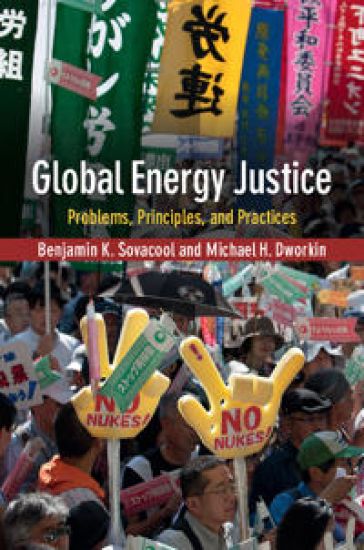
We need new ways of thinking about, and approaching, the world's energy problems. Global energy security and access is one of the central justice issues of our time, with profound implications for happiness, welfare, freedom, equity, and due process. This book combines up-to-date data on global energy security and climate change with fresh perspectives on the meaning of justice in social decision-making. Benjamin K. Sovacool and Michael H. Dworkin address how justice theory can help people to make more meaningful decisions about the production, delivery, use, and effects of energy. Exploring energy dilemmas in real-life situations, they link recent events to eight global energy injustices and employ philosophy and ethics to make sense of justice as a tool in the decision-making process. They go on to provide remedies and policies that planners and individuals can utilize to create a more equitable and just energy future.
Global Energy Justice

Global Energy Justice

Benjamin K. Sovacool; Michael H. Dworkin

Cambridge University Press
2014
pokkari
We need new ways of thinking about, and approaching, the world's energy problems. Global energy security and access is one of the central justice issues of our time, with profound implications for happiness, welfare, freedom, equity, and due process. This book combines up-to-date data on global energy security and climate change with fresh perspectives on the meaning of justice in social decision-making. Benjamin K. Sovacool and Michael H. Dworkin address how justice theory can help people to make more meaningful decisions about the production, delivery, use, and effects of energy. Exploring energy dilemmas in real-life situations, they link recent events to eight global energy injustices and employ philosophy and ethics to make sense of justice as a tool in the decision-making process. They go on to provide remedies and policies that planners and individuals can utilize to create a more equitable and just energy future.
Energy Security, Equality and Justice

Energy Security, Equality and Justice

Benjamin K. Sovacool; Roman V. Sidortsov; Benjamin R. Jones

Routledge
2013
sidottu
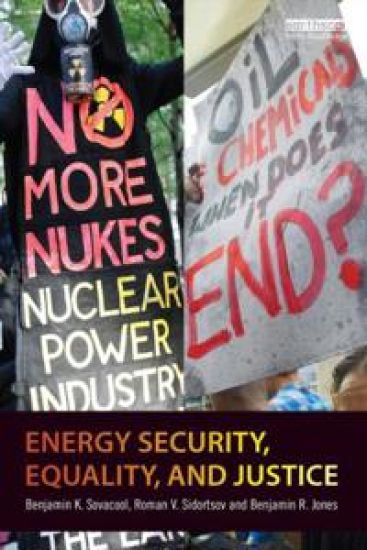
This book applies concepts from ethics, justice, and political philosophy to five sets of contemporary energy problems cutting across time, economics, politics, geography, and technology. In doing so, the authors derive two key energy justice principles from modern theories of distributive justice, procedural justice, and cosmopolitan justice. The prohibitive principle states that "energy systems must be designed and constructed in such a way that they do not unduly interfere with the ability of people to acquire those basic goods to which they are justly entitled." The affirmative principle states that "if any of the basic goods to which people are justly entitled can only be secured by means of energy services, then in that case there is also a derivative entitlement to the energy services." In laying out and employing these principles, the book details a long list of current energy injustices ranging from human rights abuses and energy-related civil conflict to energy poverty and pervasive and growing negative externalities. The book illustrates the significance of energy justice by combining the most up-to-date data on global energy security and climate change, including case studies and examples from the electricity supply, transport, and heating and cooking sectors, with appraisals based on centuries of thought about the meaning of justice in social decisions.
Energy Security, Equality and Justice

Energy Security, Equality and Justice

Benjamin K. Sovacool; Roman V. Sidortsov; Benjamin R. Jones

Routledge
2013
nidottu
This book applies concepts from ethics, justice, and political philosophy to five sets of contemporary energy problems cutting across time, economics, politics, geography, and technology. In doing so, the authors derive two key energy justice principles from modern theories of distributive justice, procedural justice, and cosmopolitan justice. The prohibitive principle states that "energy systems must be designed and constructed in such a way that they do not unduly interfere with the ability of people to acquire those basic goods to which they are justly entitled." The affirmative principle states that "if any of the basic goods to which people are justly entitled can only be secured by means of energy services, then in that case there is also a derivative entitlement to the energy services." In laying out and employing these principles, the book details a long list of current energy injustices ranging from human rights abuses and energy-related civil conflict to energy poverty and pervasive and growing negative externalities. The book illustrates the significance of energy justice by combining the most up-to-date data on global energy security and climate change, including case studies and examples from the electricity supply, transport, and heating and cooking sectors, with appraisals based on centuries of thought about the meaning of justice in social decisions.
The National Politics of Nuclear Power

The National Politics of Nuclear Power

Benjamin K. Sovacool; Scott Victor Valentine

Routledge
2013
nidottu
This book offers a comprehensive assessment of the dynamics driving, and constraining, nuclear power development in Asia, Europe and North America, providing detailed comparative analysis. The book formulates a theory of nuclear socio-political economy which highlights six factors necessary for embarking on nuclear power programs: (1) national security and secrecy, (2) technocratic ideology, (3) economic interventionism, (4) a centrally coordinated energy stakeholder network, (5) subordination of opposition to political authority, and (6) social peripheralization. The book validates this theory by confirming the presence of these six drivers during the initial nuclear power developmental periods in eight countries: the United States, France, Japan, Russia (the former Soviet Union), South Korea, Canada, China, and India. The authors then apply this framework as a predictive tool to evaluate contemporary nuclear power trends. They discuss what this theory means for developed and developing countries which exhibit the potential for nuclear development on a major scale, and examine how the new "renaissance" of nuclear power may affect the promotion of renewable energy, global energy security, and development policy as a whole. The volume also assesses the influence of climate change and the recent nuclear accident in Fukushima, Japan, on the nuclear power industry’s trajectory. This book will be of interest to students of energy policy and security, nuclear proliferation, international security, global governance and IR in general.
Energy and Ethics

Energy and Ethics

Benjamin K. Sovacool

Palgrave Macmillan
2013
nidottu
Benjamin K. Sovacool applies concepts from justice and ethics theory to contemporary energy problems, and illustrates particular solutions to those problems with examples and case studies from around the world.
Energy and Ethics

Energy and Ethics

Benjamin K. Sovacool

Palgrave Macmillan
2013
sidottu
Benjamin K. Sovacool applies concepts from justice and ethics theory to contemporary energy problems, and illustrates particular solutions to those problems with examples and case studies from around the world.
The Governance of Energy Megaprojects

The Governance of Energy Megaprojects

Benjamin K. Sovacool; Christopher J. Cooper

Edward Elgar Publishing Ltd
2013
sidottu
Based on extensive original research, this book explores the technical, social, political, and economic dimensions of four Asian energy megaprojects: a regional natural gas pipeline network in Southeast Asia, a series of hydroelectric dams on the island of Borneo, an oil pipeline linking Europe with the Caspian Sea, and a very large solar energy array in the Gobi desert. This book investigates why energy megaprojects fail to deliver their promised benefits. It offers the first comprehensive assessment of the complicated dynamics driving - and constraining - megaprojects initiated in the rapid scramble for energy resources and efforts to improve energy security. The authors approach the assessment of megaprojects from a socio-technical angle, emphasizing broad issues of political leadership, regulation, financing, interest group opposition and environmental impact, as well as conventional technological factors such as engineering design and project management. The Governance of Energy Megaprojects will prove insightful for academics concerned about energy policy, energy security, environmental impact and technology assessment. But the book should prove equally compelling to those engaged in the practical management and implementation of large-scale energy projects anywhere in the world. Contents: 1. Introduction 2. Understanding Why Energy Megaprojects Fail 3. The Trans-ASEAN Gas Pipeline Network (TAGP) 4. The Baku-Tbilisi-Ceyhan (BTC) Oil Pipeline 5. The Sarawak Corridor of Renewable Energy (SCORE) 6. The Gobitec Solar Array 7. Conclusions Bigger is Blunder Index
Energy Access, Poverty, and Development

Energy Access, Poverty, and Development

Benjamin K. Sovacool; Ira Martina Drupady

Ashgate Publishing Limited
2012
sidottu
This book showcases how small-scale renewable energy technologies such as solar panels, cookstoves, biogas digesters, microhydro units, and wind turbines are helping Asia respond to a daunting set of energy governance challenges. Using extensive original research this book offers a compendium of the most interesting renewable energy case studies over the last ten years from one of the most diverse regions in the world. Through an in-depth exploration of case studies in Bangladesh, China, India, Laos, Indonesia, Malaysia, Mongolia, Nepal, Papua New Guinea, and Sri Lanka, the authors highlight the applicability of different approaches and technologies and illuminates how household and commercial innovations occur (or fail to occur) within particular energy governance regimes. It also, uniquely, explores successful case studies alongside failures or "worst practice" examples that are often just as revealing as those that met their targets. Based on these successes and failures, the book presents twelve salient lessons for policymakers and practitioners wishing to expand energy access and raise standards of living in some of the world's poorest communities. It also develops an innovative framework consisting of 42 distinct factors that explain why some energy development interventions accomplish all of their goals while others languish to achieve any.
The National Politics of Nuclear Power

The National Politics of Nuclear Power

Benjamin K. Sovacool; Scott Victor Valentine

Routledge
2012
sidottu
This book offers a comprehensive assessment of the dynamics driving, and constraining, nuclear power development in Asia, Europe and North America, providing detailed comparative analysis. The book formulates a theory of nuclear socio-political economy which highlights six factors necessary for embarking on nuclear power programs: (1) national security and secrecy, (2) technocratic ideology, (3) economic interventionism, (4) a centrally coordinated energy stakeholder network, (5) subordination of opposition to political authority, and (6) social peripheralization. The book validates this theory by confirming the presence of these six drivers during the initial nuclear power developmental periods in eight countries: the United States, France, Japan, Russia (the former Soviet Union), South Korea, Canada, China, and India. The authors then apply this framework as a predictive tool to evaluate contemporary nuclear power trends. They discuss what this theory means for developed and developing countries which exhibit the potential for nuclear development on a major scale, and examine how the new "renaissance" of nuclear power may affect the promotion of renewable energy, global energy security, and development policy as a whole. The volume also assesses the influence of climate change and the recent nuclear accident in Fukushima, Japan, on the nuclear power industry’s trajectory. This book will be of interest to students of energy policy and security, nuclear proliferation, international security, global governance and IR in general.
Climate Change and Global Energy Security

Climate Change and Global Energy Security

Marilyn A. Brown; Benjamin K. Sovacool

MIT Press
2011
pokkari
An exploration of commercially available technologies that can enhance energy security and address climate change and public policy options crucial to their adoption. Tackling climate change and improving energy security are two of the twenty-first century's greatest challenges. In this book, Marilyn Brown and Benjamin Sovacool offer detailed assessments of the most advanced commercially available technologies for strengthening global energy security, mitigating the effects of climate change, and enhancing resilience through adaptation and geo-engineering. They also evaluate the barriers to the deployment of these technologies and critically review public policy options crucial to their adoption. Arguing that society has all the technologies necessary for the task, Brown and Sovacool discuss an array of options available today, including high-efficiency transportation, renewable energy, carbon sequestration, and demand-side management. They offer eight case studies from around the world that document successful approaches to reducing emissions of greenhouse gases and improving energy security. These include the Danish approach to energy policy and wind power, Brazil's ethanol program, China's improved cookstove program; and the U. S. Toxics Release Inventory. Brown and Sovacool argue that meeting the twin challenges of climate change and energy security will allow us to provide energy, maintain economic growth, and preserve the natural environment-without forcing tradeoffs among them.
Contesting The Future Of Nuclear Power: A Critical Global Assessment Of Atomic Energy

Contesting The Future Of Nuclear Power: A Critical Global Assessment Of Atomic Energy

Benjamin K Sovacool

World Scientific Publishing Co Pte Ltd
2011
sidottu
This book provides a concise but rigorous appraisal about the future of nuclear power and the presumed nuclear renaissance. It does so by assessing the technical, economic, environmental, political, and social risks related to all aspects of the nuclear fuel cycle, from uranium mills and mines to nuclear reactors and spent fuel storage facilities. In each case, the book argues that the costs of nuclear power significantly outweigh its benefits. It concludes by calling for investments in renewable energy and energy efficiency as a better path towards an affordable, secure, and socially acceptable future. The prospect of a global nuclear renaissance could change the way that energy is produced and used the world over. Sovacool takes a hard look at who would benefit — mostly energy companies and manufacturers — and who would suffer — mostly taxpayers, those living near nuclear facilities, and electricity customers. This book is a must-read for anyone even remotely concerned about a sustainable energy future, and also for those with a specific interest in modern nuclear power plants.