Kirjojen hintavertailu – 12 903 724 kirjaa ja 27 kauppaa

Kirjailija

Benjamin Robert Haydon

Kirjat ja teokset yhdessä paikassa: 30 kirjaa, julkaisuja vuosilta 1972–2025, suosituimpiin kuuluu The Autobiography and Memoirs of Benjamin Robert Haydon 1786-1846. Vertaile teosten hintoja ja tarkista saatavuus suomalaisista kirjakaupoista.

30 kirjaa

Kirjojen julkaisuvuodet: 1972–2025.

Correspondence and Table-Talk

Correspondence and Table-Talk

Benjamin Robert Haydon

Cambridge University Press
2013
pokkari
Artist, diarist, and devotee of the Elgin Marbles, Benjamin Robert Haydon (1786–1846) is best known for his large-scale paintings, such as Christ's Entry into Jerusalem and The Raising of Lazarus. After he entered the Royal Academy in 1805 as a student of Henry Fuseli, his forthright views and combative manner fuelled a feud with the institution and perceived enemies. His unshakeable belief in his own genius and his unwillingness to compromise his artistic standards drew him ever further into debt, which ultimately contributed to his suicide. As a writer, Haydon's acute eye for the humorous is demonstrated throughout his correspondence and diary. In this two-volume work, first published in 1876, his son Frederick Wordsworth Haydon (1827–86) brings together letters and extracts from his father's journals. Volume 1 opens with Frederick's biography of his father, followed by general correspondence to and from many eminent figures of the age.
Correspondence and Table-Talk

Correspondence and Table-Talk

Benjamin Robert Haydon

Cambridge University Press
2013
pokkari
Artist, diarist, and devotee of the Elgin Marbles, Benjamin Robert Haydon (1786–1846) is best known for his large-scale paintings, such as Christ's Entry into Jerusalem and The Raising of Lazarus. After he entered the Royal Academy in 1805 as a student of Henry Fuseli, his forthright views and combative manner fuelled a feud with the institution and perceived enemies. His unshakeable belief in his own genius and his unwillingness to compromise his artistic standards drew him ever further into debt, which ultimately contributed to his suicide. As a writer, Haydon's acute eye for the humorous is demonstrated throughout his correspondence and diary. In this two-volume work, first published in 1876, his son Frederick Wordsworth Haydon (1827–86) brings together letters and extracts from his father's journals. Volume 2 contains selected letters, including those to and from Keats and Wordsworth, along with a host of witty and erudite journal extracts.
Description of Mr. Haydon's Picture of Christ's Triumphant Entry Into Jerusalem, and Other Pictures; Now Exhibiting at Bullock's Great Room, Egyptian Hall, Piccadilly.
Title: Description of Mr. Haydon's picture of Christ's triumphant entry into Jerusalem, and other pictures; now exhibiting at Bullock's Great Room, Egyptian Hall, Piccadilly. Publisher: British Library, Historical Print EditionsThe British Library is the national library of the United Kingdom. It is one of the world's largest research libraries holding over 150 million items in all known languages and formats: books, journals, newspapers, sound recordings, patents, maps, stamps, prints and much more. Its collections include around 14 million books, along with substantial additional collections of manuscripts and historical items dating back as far as 300 BC. The HISTORY OF THE MIDDLE EAST collection includes books from the British Library digitised by Microsoft. This collection reflects the changing perceptions of Western historians, travellers, traders, and others surveying the Middle East. Texts and first-person travelogues include illustrated volumes. Other works focus on the earlier history of Persian and Arabic areas of the world. ++++The below data was compiled from various identification fields in the bibliographic record of this title. This data is provided as an additional tool in helping to insure edition identification: ++++ British Library Haydon, Benjamin Robert; 1820. 15 p.; 8 . 10025.c.18.(2.)
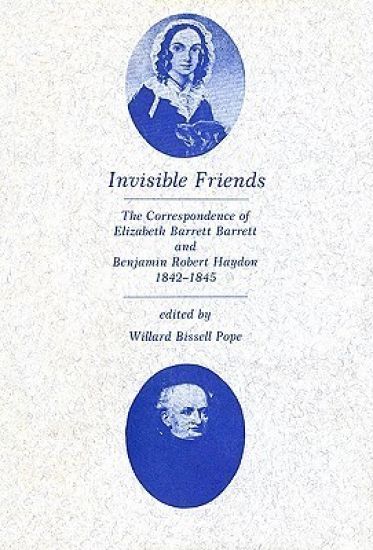
Invisible Friends

Invisible Friends

Elizabeth Barrett Browning; Benjamin Robert Haydon

Harvard University Press
1972
sidottu
Although Elizabeth Barrett Browning and Benjamin Robert Haydon never met, their lively and topical conversation, initiated in 1842, continued unabated until 1845, about a year before the painter’s suicide. It was a somewhat lopsided correspondence in which ninety-four letters written by Haydon, most of which have not been published before, received fewer replies from Miss Barrett, twenty-eight of which are included in this book. Judging from the contents of the letters, the epistolary friendship was truly meaningful to both. To Miss Barrett, Haydon was “my dear kind friend”; he was far more effusive, addressing her as “you Ingenious little darling invisible” and “my dearest dream & invisible intellectuality.” In spite of Haydon’s frequent pleas for a meeting, Miss Barrett never agreed to receive him. However, as the correspondence progressed, they exchanged more and more confidences and each recognized the other as a responsive and sympathetic listener. With complete candor Haydon admitted at one point that egotism was the basis of his pleasure in the correspondence; “I never ask what you are doing,” he wrote, “but take it for granted what I am doing must be delightful to you.” Evincing warmth and poignancy, the letters range over a variety of colorful subjects covering art, literature, current events, and gossip. The Elgin Marbles and Queen Victoria are discussed, and the correspondents air opposing views on mesmerism and Napoleon versus Wellington. After a thoughtful introduction which provides background information on Miss Barrett and Haydon, Willard Pope presents the letters—carefully annotated with identifying information on people, places, and current events—in chronological order.