Kirjojen hintavertailu – 12 903 725 kirjaa ja 27 kauppaa

Kirjailija

Benjamin Weiss

Kirjat ja teokset yhdessä paikassa: 13 kirjaa, julkaisuja vuosilta 1999–2025, suosituimpiin kuuluu Obelisk. Vertaile teosten hintoja ja tarkista saatavuus suomalaisista kirjakaupoista.

Nimi esiintyy myös muodoissa: Benjamin Weiß

13 kirjaa

Kirjojen julkaisuvuodet: 1999–2025.

Obelisk

Obelisk

Brian A. Curran; Anthony Grafton; Pamela O. Long; Benjamin Weiss

MIT Press
2009
pokkari
The many meanings of obelisks across nearly forty centuries, from Ancient Egypt (which invented them) to twentieth-century America (which put them in Hollywood epics). Nearly every empire worthy of the name-from ancient Rome to the United States-has sought an Egyptian obelisk to place in the center of a ceremonial space. Obelisks-giant standing stones, invented in Ancient Egypt as sacred objects-serve no practical purpose. For much of their history their inscriptions, in Egyptian hieroglyphics, were completely inscrutable. Yet over the centuries dozens of obelisks have made the voyage from Egypt to Rome, Constantinople, and Florence; to Paris, London, and New York. New obelisks and even obelisk-shaped buildings rose as well-the Washington Monument being a noted example. Obelisks, everyone seems to sense, connote some very special sort of power. This beautifully illustrated book traces the fate and many meanings of obelisks across nearly forty centuries-what they meant to the Egyptians, and how other cultures have borrowed, interpreted, understood, and misunderstood them through the years. In each culture obelisks have taken on new meanings and associations. To the Egyptians, the obelisk was the symbol of a pharaoh's right to rule and connection to the divine. In ancient Rome, obelisks were the embodiment of Rome's coming of age as an empire. To nineteenth-century New Yorkers, the obelisk in Central Park stood for their country's rejection of the trappings of empire just as it was itself beginning to acquire imperial power. And to a twentieth-century reader of Freud, the obelisk had anatomical and psychological connotations. The history of obelisks is a story of technical achievement, imperial conquest, Christian piety and triumphalism, egotism, scholarly brilliance, political hubris, bigoted nationalism, democratic self-assurance, Modernist austerity, and Hollywood kitsch-in short, the story of Western civilization.

A New Art

A New Art

Jeff L. Rosenheim; Benjamin Weiss

Metropolitan Museum of Art
2025
sidottu
This new study of nineteenth-century American photography presents a bottom-up history of the United States, featuring works by lesser-known practitioners that capture the changing scene across the country In this groundbreaking history of early American photography, Jeff L. Rosenheim explores how the medium’s evolution as a cultural, commercial, and artistic preoccupation mirrored the dramatic development of the nation’s sense of itself before, during, and after the Civil War and throughout its westward expansion. Alongside acknowledged early masters such as Josiah Johnson Hawes and Carleton E. Watkins, this publication highlights exceptional portraits, landscapes, still lifes, and genre scenes produced by little-known makers in small towns and cities outside the major urban centers. These daguerreotypes, ambrotypes, tintypes, cartes de visite, cyanotypes, cabinet cards, and gelatin silver prints span the gamut of early formats and processes and present a portrait of the burgeoning nation outside of the traditional grand narratives. Tracing the history of technological advances—such as the advent of the Kodak roll-film camera in the 1880s, which increased the accessibility of the medium—this landmark publication both highlights photography as the most democratic of art forms and celebrates the beguiling physical materiality that photographs possessed in the nineteenth and early twentieth centuries. Published by The Metropolitan Museum of Art/Distributed by Yale University Press Exhibition Schedule: The Metropolitan Museum of Art, New York (TBD)
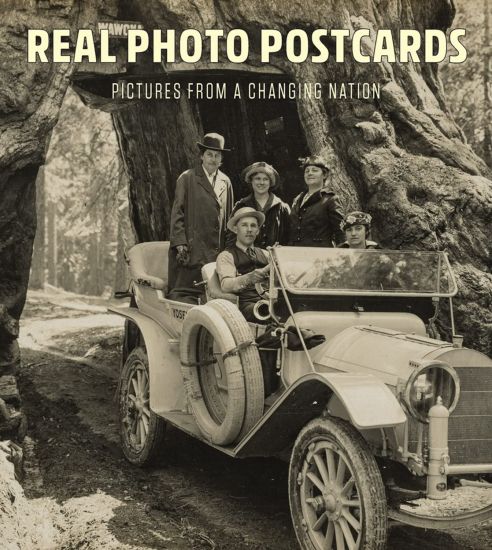
Real Photo Postcards

Real Photo Postcards

Lynda Klich; Benjamin Weiss

MUSEUM OF FINE ARTS,BOSTON
2022
sidottu
Postcards of a nation embracing a new democratic technology The ubiquity of photography and social media today makes it hard to imagine a time when it was not possible for ordinary people to take their own pictures and send them with short messages over long distances. But it was revolutionary when the Eastman Kodak Company, in 1903, unveiled a new postcard camera that produced a postcard-size negative that could print directly onto a blank card. Suddenly almost anyone, amateurs and entrepreneurial photographers alike, could take a picture—of neighbors at home and at work, local celebrations, newsworthy disasters, sightseeing trips—and turn it into a postcard. This book captures this moment in the history of communications—from around 1900 to 1930—through a generous selection of what came to be known as “real photo postcards” from the extensive Leonard A. Lauder Postcard Archive. As the formality of earlier photography falls away, these postcards remind us that the past was occupied by people with distinct and individual stories, dramatic, humorous, puzzling and surprising.
Talker Quality in Human and Machine Interaction

Talker Quality in Human and Machine Interaction

Benjamin Weiss

Springer Nature Switzerland AG
2020
nidottu
The book discusses subjective ratings of quality and preference of unknown voices and dialog partners – their likability, for example. Human natural and artificial voices are studied in passive listening and interactive scenarios. In this book, the background, state of research, and contributions to the assessment and prediction of talker quality that is constituted in voice perception and in dialog are presented. Starting from theories and empirical findings from human interaction, major results and approaches are transferred to the domain of human-computer interaction (HCI). The main objective of this book is to contribute to the evaluation of spoken interaction in humans and between humans and computers, and in particular to the quality subsequently attributed to the speaking system or person based on the listening and interactive experience. Provides a comprehensive overview of research in evaluation of speakers and dialog partners;Presents recent results on the relevance of a first passive and interactive impression;Includes human and HCI evaluation results from a communicative perspective.
Talker Quality in Human and Machine Interaction

Talker Quality in Human and Machine Interaction

Benjamin Weiss

Springer Nature Switzerland AG
2019
sidottu
The book discusses subjective ratings of quality and preference of unknown voices and dialog partners – their likability, for example. Human natural and artificial voices are studied in passive listening and interactive scenarios. In this book, the background, state of research, and contributions to the assessment and prediction of talker quality that is constituted in voice perception and in dialog are presented. Starting from theories and empirical findings from human interaction, major results and approaches are transferred to the domain of human-computer interaction (HCI). The main objective of this book is to contribute to the evaluation of spoken interaction in humans and between humans and computers, and in particular to the quality subsequently attributed to the speaking system or person based on the listening and interactive experience. Provides a comprehensive overview of research in evaluation of speakers and dialog partners;Presents recent results on the relevance of a first passive and interactive impression;Includes human and HCI evaluation results from a communicative perspective.
The Propaganda Front

The Propaganda Front

Anna Jozefacka; Lynda Klich; Juliana Kreinik; Benjamin Weiss

Museum of Fine Arts,Boston
2018
sidottu
The first comprehensive exploration of postcards used as propaganda on all sides of the major military and political conflicts of the twentieth century, including World Wars I and II A Russian Socialist worker raises the red flag. Adoring crowds greet Hitler and Mussolini. Uncle Sam orders Americans to enlist. These images and many more circulated by the millions on postcards intended to change minds and inspire actions around the time of the two World Wars. Whether produced by government propaganda bureaus, opportunistic publishers, aid organizations, or resistance movements, postcards conveyed their messages with striking graphics, pithy slogans, and biting caricatures – and in a uniquely personal format. The more than 350 cards reproduced in full colour in this book advocate for political causes and celebrate war efforts on all sides of the major conflicts of the first half of the twentieth century. The accompanying text shows how a ubiquitous form of communication served increasingly sophisticated campaigns in an age of propaganda, and highlights the postcards collected here as both priceless historical documents and masterworks of graphic design.
Single Orbit Dynamics

Single Orbit Dynamics

Benjamin Weiss

Amer Mathematical Society
1999
pokkari
This book presents the expanded notes from ten lectures given by the author at the NSF/CBMS conference held at California State University (Bakersfield). The author describes what he calls single orbit dynamics, which is an approach to the analysis of dynamical systems via the study of single orbits, rather than the study of a system as a whole. He presents single orbit interpretations of several areas of topological dynamics and ergodic theory and some new applications of dynamics to graph theory. In the concluding lectures, single orbit approaches to generalizations of the Shannon-Breiman-McMillan theorem and related problems of compression and universal coding are presented. Complete proofs and illuminating discussions are included and references for further study are given. Some of the material appears here for the first time in print.