Kirjojen hintavertailu – 12 903 725 kirjaa ja 27 kauppaa
Kirjailija
Bernard A. Wood
Kirjat ja teokset yhdessä paikassa: 4 kirjaa, julkaisuja vuosilta 2012–2019, suosituimpiin kuuluu Photographic and Descriptive Musculoskeletal Atlas of Gibbons and Siamangs (Hylobates). Vertaile teosten hintoja ja tarkista saatavuus suomalaisista kirjakaupoista.
Rui Diogo; Josep M. Potau; Juan F. Pastor; Felix J. dePaz; Eva M. Ferrero; Gaelle Bello; Mercedes Barbosa; M. Ashraf Aziz; Anne M. Burrows; Julia Arias-Martorell; Bernard A. Wood
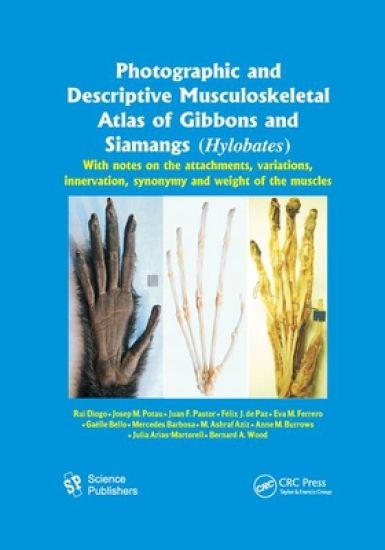
This book is the first photographic and descriptive musculoskeletal atlas of Hylobates, and adopts the same format as the photographic atlas of Gorilla published by the same authors in 2010. These two books are part of a series of monographs that will set out the comparative and phylogenetic context of the gross anatomy and evolutionary history of the soft tissue morphology of modern humans and their closest relatives. This atlas, which includes detailed high-quality photographs of musculoskeletal structures from most anatomical regions of the body as well as textual information about the attachments, innervation and weight of the respective muscles, is based on dissections and on an extensive review of the literature. It provides an updated review of the anatomical variations within hylobatids as well as an extensive list of the synonyms used in the literature to designate the structures we discuss. The atlas will be of interest to students, teachers and researchers studying primatology, comparative anatomy, functional morphology, zoology, and physical anthropology and to medical students, doctors and researchers who are curious about the origin, evolution, homology and variations of the musculoskeletal structures of modern humans.

This book results from a two-day symposium and three-day workshop held in Cambridge between March 22nd and March 26th 1982 and sponsored by the Primate Society of Great Britain and the Anatomical Society of Great Britain and Ireland. More than 100 primatologists attended the symposium and some 35 were invited to participate in the workshop. Speakers from Prance, Germany, the Netherlands, South Africa and the U. S. A. , as weIl as the U. K. , were invited to contribute. In recent years feeling had strengthened that primatologists in Europe did not gather together sufficiently often. Distinctive tradit ions in primatology have developed in Germany, France, the Netherlands, Italy and the U. K. in particular, and it was feIt that attempts to blend them could only benefit primatology. Furthermore, studies of primate ecology, behaviour, anatomy, physiology and evolution have reached the points where further advances depend on inter-disciplinary collaboration. It was resolved to arrange a regular series of round table discussions on primate biology in Europe at the biennial meeting of the German Society for Anthropology and Human Genetics in Heidel berg in September 1979, where Holger Preuschoft organised sessions on primate ecology and anatomy. In June 1980 Michel Sakka convened a most effective working group in Paris to discuss cranial morphology and evolution. In 1982 it was the turn of the U. K.
Rui Diogo; Josep M. Potau; Juan F. Pastor; Felix J. dePaz; Eva M. Ferrero; Gaelle Bello; Mercedes Barbosa; M. Ashraf Aziz; Anne M. Burrows; Julia Arias-Martorell; Bernard A. Wood
This book is the first photographic and descriptive musculoskeletal atlas of Hylobates, and adopts the same format as the photographic atlas of Gorilla published by the same authors in 2010. These two books are part of a series of monographs that will set out the comparative and phylogenetic context of the gross anatomy and evolutionary history of the soft tissue morphology of modern humans and their closest relatives. This atlas, which includes detailed high-quality photographs of musculoskeletal structures from most anatomical regions of the body as well as textual information about the attachments, innervation and weight of the respective muscles, is based on dissections and on an extensive review of the literature. It provides an updated review of the anatomical variations within hylobatids as well as an extensive list of the synonyms used in the literature to designate the structures we discuss. The atlas will be of interest to students, teachers and researchers studying primatology, comparative anatomy, functional morphology, zoology, and physical anthropology and to medical students, doctors and researchers who are curious about the origin, evolution, homology and variations of the musculoskeletal structures of modern humans.

This book challenges the assumption that morphological data are inherently unsuitable for phylogeny reconstruction, argues that both molecular and morphological phylogenies should play a major role in systematics, and provides the most comprehensive review of the comparative anatomy, homologies and evolution of the head, neck, pectoral and upper limb muscles of primates. Chapters 1 and 2 provide an introduction to the main aims and methodology of the book. Chapters 3 and 4 and Appendices I and II present the data obtained from dissections of the head, neck, pectoral and upper limb muscles of representative members of all the major primate groups including modern humans, and compare these data with the information available in the literature. Appendices I and II provide detailed textual (attachments, innervation, function, variations and synonyms) and visual (high quality photographs) information about each muscle for the primate taxa included in the cladistic study of Chapter 3, thus providing the first comprehensive and up to date overview of the comparative anatomy of the head, neck, pectoral and upper limb muscles of primates. The most parsimonious tree obtained from the cladistic analysis of 166 head, neck, pectoral and upper limb muscle characters in 18 primate genera, and in representatives of the Scandentia, Dermoptera and Rodentia, is fully congruent with the evolutionary molecular tree of Primates, thus supporting the idea that muscle characters are particularly useful to infer phylogenies. The combined anatomical materials provided in this book point out that modern humans have fewer head, neck, pectoral and upper limb muscles than most other living primates, but are consistent with the proposal that facial and vocal communication and specialized thumb movements have probably played an important role in recent human evolution. This book will be of interest to primatologists, comparative anatomists, functional morphologists, zoologists, physical anthropologists, and systematicians, as well as to medical students, physicians and researchers interested in understanding the origin, evolution, homology and variations of the muscles of modern humans. Contains 132 color plates.