Kirjojen hintavertailu – 12 903 724 kirjaa ja 27 kauppaa

Kirjailija

Bernard D. Beitman

Kirjat ja teokset yhdessä paikassa: 7 kirjaa, julkaisuja vuosilta 1999–2007, suosituimpiin kuuluu (PAL Version). Vertaile teosten hintoja ja tarkista saatavuus suomalaisista kirjakaupoista.

7 kirjaa

Kirjojen julkaisuvuodet: 1999–2007.

(PAL Version)

(PAL Version)

Bernard D. Beitman

W. W. Norton Co.
1999
muu
Psychotherapy is a crucial element in the nation's healthcare system; yet there is no standard introduction to its practice. Each training program finds its own, sometimes idiosyncratic, niche and is not called to the task of demonstrating effectiveness. Those programs that offer structured training in key approaches tend not to present models that integrate the various schools. This Learning Psychotherapy Vignettes VHS (in PAL format, for European VCRs, 80 minutes) accompanies the main book and provides a much-needed foundation for training beginning psychotherapists in the crucial elements of psychotherapy. Unlike other programs, it is low on reading volume and high on homework. The homework includes rating transcripts according to standard research scales, discerning dysfunctional patterns from written and videotaped case vignettes, and analyzing transference and countertransference in actual sessions. Participants proceed through six modules: (1) verbal response modes and intentions, (2) working alliance, (3) inducing patterns, (4) change, (5) resistance, and (6) transference and countertransference. Pre- and post-training modules offer the opportunity to measure the effects of training. The Learning Psychotherapy program has been endorsed by the American Psychiatric Association as "an example of innovative training in the fundamentals of psychotherapy, with built-in assessment that is consistent with the objectives of the Commission on Psychotherapy by Psychiatrists and the APA to strengthen the psychotherapy education of future psychiatrists." The program has been piloted in the psychiatric residency training program at the University of Missouri-Columbia for four years, at Stanford University for two years, and at several other sites across the United States.
Counseling and Psychotherapy Essentials

Counseling and Psychotherapy Essentials

Bernard D. Beitman; Glenn E. Good

WW Norton Co
2007
sidottu
In an age when actual psychotherapeutic practice is predominantly eclectic, most psychotherapy textbooks are outdated and impractically bound in theoretical pigeon holes. Counseling and Psychotherapy Essentials incorporates into a single source the latest advances in the field and focuses on psychotherapy's core processes—rather than ideologies—to provide a comprehensive and imminently pragmatic textbook for learning integrative counseling and psychotherapy. The central lessons of this book are framed on one side by a theoretical overview in which essential therapeutic concepts and techniques are synthesized, and on the other side by a detailed review of frequently encountered concerns such as depression, anxiety, substance abuse, couple/marital issues, and psychopharmacology. From the general to the specific, Good and Beitman keep their discussion grounded in the core processes of psychotherapy—engagement, pattern search, change, and termination—that facilitate therapeutic change. In Counseling and Psychotherapy Essentials, students have a textbook that seamlessly connects their classroom experience with their actual work with clients, preparing them to be effective clinicians.
Learning Psychotherapy Seminar Leader's Manual

Learning Psychotherapy Seminar Leader's Manual

Bernard D. Beitman; Dongmei Yue

WW Norton Co
2005
nidottu
Beitman and Yue expand upon their widely adopted training program in interpersonal psychotherapy. New modules are added covering the critical topics of listening on the part of the therapist and the termination of therapy. Homework and exercises aid both teachers and students in mastering this type of health-care delivery. This A Seminar Leader's Manual provides guidelines for instructors.
Learning Psychotherapy

Learning Psychotherapy

Bernard D. Beitman; Dongmei Yue

WW Norton Co
2004
nidottu
The seminar leader is the conduit of basic psychotherapeutic knowledge. The Learning Psychotherapy Seminar Leader's Manual helps instructors introduce beginners to the concepts and processes that define psychotherapy. With the help of the main text and the Learning Psychotherapy Vignettes videotape, seminar leaders show trainees not only the diversity of useful ideas from psychotherapeutic schools but also those variations that fit their own personalities. The program is well-structured but flexible as seminar leaders are encouraged to adapt them to individual training situations-bring in your own cases and encourage trainees to regularly bring in their current clinical problems. Make psychotherapeutic learning come alive by using the modules as the jumping off point!
Integrating Psychotherapy and Pharmacotherapy

Integrating Psychotherapy and Pharmacotherapy

Bernard D. Beitman; Barton J. Blinder; Michael E. Thase; Debra L. Safer

WW Norton Co
2003
nidottu
This book invites the reader to participate in a major initiative of the 21st century: dissolving Cartesian mind-brain dualism. This book will help all mental health clinicians to dissolve their conceptual mind/brain barriers by recognizing the reciprocal influences of psychological and pharmacological interventions. This task is approached by challenging the reader to respond to thought-provoking questions and problematic case vignettes in the following subject areas: combined treatment research, pharmacotherapy during psychotherapy, psychotherapy during pharmacotherapy, the pharmacotherapy-psychotherapy triangle and integrated treatment algorithms. Each of these homework-based sections is introduced by a brief overview. Part I invites the reader to an overview of these many issues. Topics covered include: 1) research in combined treatments, 2) pharmacotherapy during psychotherapy, 3) psychotherapeutic aspects of pharmacotherapy, 4) the pharmacotherapy-psychotherapy triangle, 5) treatment algorithms for combined treatments, and 6) the neurobiology of psychotherapy. With thought-provoking questions and vignettes of problematic cases, the authors invite readers to participate in working out these complicated issues. Part II provides cutting edge information on issues of integrated and split treatment and psychodynamic neurobiology. Answers to the problems are provided at the end of the book. Two additional chapters thoroughly review the research in combined treatments and what is known about the neurobiology of psychotherapy.
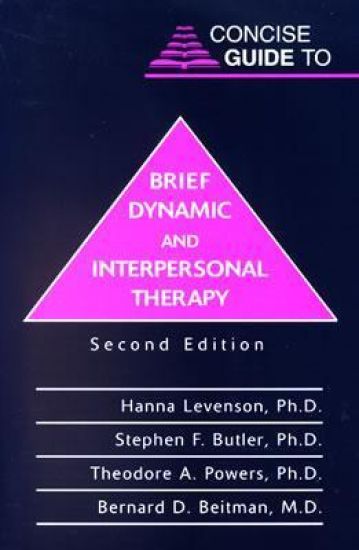
Concise Guide to Brief Dynamic and Interpersonal Therapy

Concise Guide to Brief Dynamic and Interpersonal Therapy

Hanna Levenson; Stephen F. Butler; Theodore A. Powers; Bernard D. Beitman

American Psychiatric Association Publishing
2002
pokkari
In today's world of managed care—characterized by limited mental health resources, emphasis on accountability, concerns of third-party payers, and consumer need—the demand for mental health professionals to use briefer therapeutic approaches is on the rise. Fully 84% of all clinicians are doing some form of planned brief therapy (6-20 sessions per year per patient). Yet despite clinical advances and outcome data that demonstrate the effectiveness of short-term therapy, many therapists—in fact, 90% of those whose theoretical orientation is psychodynamic rather than cognitive-behavioral—are reluctant to learn briefer interventions, seeing value only in long-term, depth-oriented work. The second edition of this Concise Guide is intended to help educate both beginning and experienced clinicians in the strategies and techniques of time-attentive models and to foster more positive and optimistic attitudes toward using these important therapies. • The seven therapeutic models presented here—including an entirely new chapter on time-limited group therapy—highlight the importance of the interpersonal perspective. • The seven models, one per chapter, represent well-established short-term approaches to clinical issues that therapists commonly encounter in their clinical practices. These models also have clearly defined intervention techniques and formulation strategies and can be used within the 10- to 20-session time frame of most managed care settings. • The first part of each chapter dealing with a therapeutic model lists the various presenting problems the authors deem most suitable for treatment by that particular approach. The authors discuss the overall framework of each model, selection criteria, goals, therapeutic tasks and strategies, empirical support, and relevance for managed care, with clinical cases to illustrate the application of each model. The authors include updated chapters on supportive, time-limited, and interpersonal therapies; time-limited dynamic psychotherapy; short-term dynamic therapy for patients with posttraumatic stress disorder; brief dynamic therapy for patients with substance abuse disorders; an entirely new chapter on time-limited group therapy; and a final chapter on the reciprocal relationship between pharmacotherapy and psychotherapy. Meant to complement the more detailed information found in lengthier psychiatric texts, this Concise Guide (it is designed to fit into a jacket or lab coat pocket) is a practical and convenient reference for psychiatrists, psychiatric residents, and medical students working in a variety of treatment settings, such as inpatient psychiatry units, outpatient clinics, consultation-liaison services, and private offices.
Learning Psychotherapy Seminar Leader's Manual

Learning Psychotherapy Seminar Leader's Manual

Bernard D. Beitman; Dongmei Yue

WW Norton Co
1999
nidottu
Each training program finds its own, sometimes idiosyncratic, niche and is not called to the task of demonstrating effectiveness. Those programs that offer structured training in key approaches tend not to present models that integrate the various schools. This book, along with the accompanying Seminar Leader's Manual and Learning Psychotherapy Vignettes videotape, provides a much-needed foundation for training beginning psychotherapists in the crucial elements of psychotherapy. Unlike other programs, it is low on reading volume and high on homework. The homework includes rating transcripts according to standard research scales, discerning dysfunctional patterns from written and videotaped case vignettes, and analyzing transference and countertransference in actual sessions. Participants proceed through six modules: (1) verbal response modes and intentions, (2) working alliance, (3) inducing patterns, (4) change, (5) resistance, and (6) transference and countertransference. Pre- and post-training modules offer the opportunity to measure the effects of training. The Learning Psychotherapy program has been endorsed by the American Psychiatric Association as "an example of innovative training in the fundamentals of psychotherapy, with built-in assessment that is consistent with the objectives of the Commission on Psychotherapy by Psychiatrists and the APA to strengthen the psychotherapy education of future psychiatrists." The program has been piloted in the psychiatric residency training program at the University of Missouri-Columbia for four years, at Stanford University for two years, and at several other sites across the United States.