Kirjojen hintavertailu – 12 859 824 kirjaa ja 27 kauppaa

Kirjailija

Bernard Linsky

Kirjat ja teokset yhdessä paikassa: 7 kirjaa, julkaisuja vuosilta 1999–2020, suosituimpiin kuuluu Russell's Metaphysical Logic. Vertaile teosten hintoja ja tarkista saatavuus suomalaisista kirjakaupoista.

7 kirjaa

Kirjojen julkaisuvuodet: 1999–2020.

The Problem of China

The Problem of China

Bertrand Russell; Bernard Linsky

Routledge
2020
sidottu
'China, by her resources and her population, is capable of being the greatest power in the world after the United States.' Bertrand Russell, The Problem of China In 1920 the philosopher Bertrand Russell spent a year in China as Professor of Philosophy at the University of Beijing (then Peking), where his lectures on mathematical logic enthralled students and listeners, including Mao Tse Tung, who attended some of Russell’s talks. Written at a time when China was largely regarded by the West as backward and weak, The Problem of China sees Russell rise above the prejudices of his era and presciently assess China's past, present and future. Russell brings his analytical and insightful eye to bear on some fundamental aspects of China’s history and politics, cautioning China against adopting a purely Western model of social and economic development, which he regarded as characterized by a combination of greed and militarism. Beginning with an overview of nineteenth-century Chinese history and considering China's relations with Japan and Russia, Russell then contrasts Chinese civilization with Western. He devotes a fascinating chapter to the character of the Chinese, which he argues is complex but ultimately defined by a ‘pacific temper’. With uncanny foresight, Russell predicts China’s resurgence, but only if it is able to establish an orderly government, promote industrial development under Chinese control and foster the spread of education. This Routledge Classics edition includes a new introduction by Bernard Linsky.
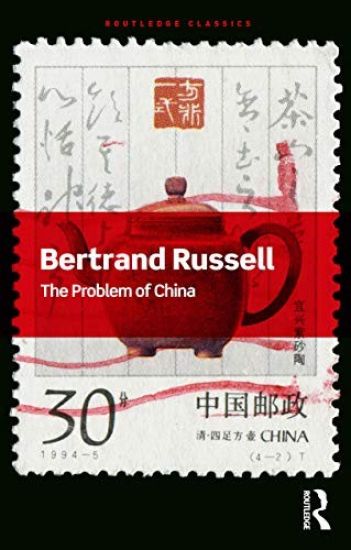
The Problem of China

The Problem of China

Bertrand Russell; Bernard Linsky

Routledge
2020
nidottu
'China, by her resources and her population, is capable of being the greatest power in the world after the United States.' Bertrand Russell, The Problem of China In 1920 the philosopher Bertrand Russell spent a year in China as Professor of Philosophy at the University of Beijing (then Peking), where his lectures on mathematical logic enthralled students and listeners, including Mao Tse Tung, who attended some of Russell’s talks. Written at a time when China was largely regarded by the West as backward and weak, The Problem of China sees Russell rise above the prejudices of his era and presciently assess China's past, present and future. Russell brings his analytical and insightful eye to bear on some fundamental aspects of China’s history and politics, cautioning China against adopting a purely Western model of social and economic development, which he regarded as characterized by a combination of greed and militarism. Beginning with an overview of nineteenth-century Chinese history and considering China's relations with Japan and Russia, Russell then contrasts Chinese civilization with Western. He devotes a fascinating chapter to the character of the Chinese, which he argues is complex but ultimately defined by a ‘pacific temper’. With uncanny foresight, Russell predicts China’s resurgence, but only if it is able to establish an orderly government, promote industrial development under Chinese control and foster the spread of education. This Routledge Classics edition includes a new introduction by Bernard Linsky.
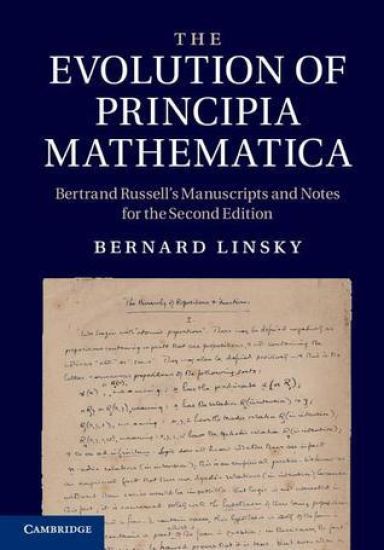
The Evolution of Principia Mathematica

The Evolution of Principia Mathematica

Bernard Linsky

Cambridge University Press
2011
sidottu
Originally published in 1910, Principia Mathematica led to the development of mathematical logic and computers and thus to information sciences. It became a model for modern analytic philosophy and remains an important work. In the late 1960s the Bertrand Russell Archives at McMaster University in Canada obtained Russell's papers, letters and library. These archives contained the manuscripts for the new Introduction and three Appendices that Russell added to the second edition in 1925. Also included was another manuscript, 'The Hierarchy of Propositions and Functions', which was divided up and re-used to create the final changes for the second edition. These documents provide fascinating insight, including Russell's attempts to work out the theorems in the flawed Appendix B, 'On Induction'. An extensive introduction describes the stages of the manuscript material on the way to print and analyzes the proposed changes in the context of the development of symbolic logic after 1910.
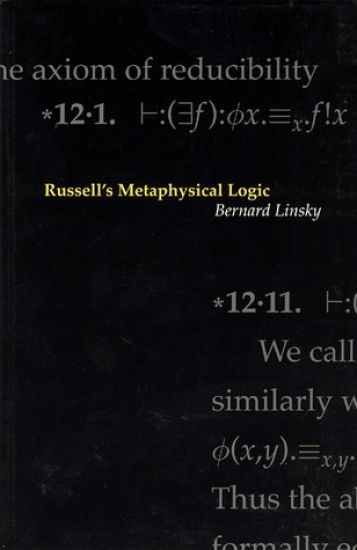
Russell's Metaphysical Logic

Russell's Metaphysical Logic

Bernard Linsky

Centre for the Study of Language Information
1999
pokkari
This study reconciles distinct aspects of Russell's thought long thought to be incompatible, the metaphysics of universals and facts from Russell's Logical Atomism period and the philosophical justification of the ramified theory of types in the Introduction to Principia Mathematica. This account, which interprets Russell as being a realist about both universals and propositional functions, while distinguishing the two, provides a defense of some problematic features of the logic of PM including the Axiom of Reducibility and the Vicious Circle Principle. Russell's seemingly ambivalent attitude towards propositions and functions is explained by interpreting both with a broadened notion of logical construction. Contrary to other recent interpretations, this account follows Alonzo Church's technical formulation of the ramified theory of types and interprets the quantifiers as objectual, ranging over functions as entities, while being consistent with the 'multiple relation' theory of judgment.
Russell's Metaphysical Logic

Russell's Metaphysical Logic

Bernard Linsky

Centre for the Study of Language Information
1999
sidottu
This study reconciles distinct aspects of Russell's thought long thought to be incompatible, the metaphysics of universals and facts from Russell's Logical Atomism period and the philosophical justification of the ramified theory of types in the Introduction to Principia Mathematica. This account, which interprets Russell as being a realist about both universals and propositional functions, while distinguishing the two, provides a defense of some problematic features of the logic of PM including the Axiom of Reducibility and the Vicious Circle Principle. Russell's seemingly ambivalent attitude towards propositions and functions is explained by interpreting both with a broadened notion of logical construction. Contrary to other recent interpretations, this account follows Alonzo Church's technical formulation of the ramified theory of types and interprets the quantifiers as objectual, ranging over functions as entities, while being consistent with the 'multiple relation' theory of judgment.