Kirjojen hintavertailu – 12 903 735 kirjaa ja 27 kauppaa

Kirjailija

Bernard M. Levinson

Kirjat ja teokset yhdessä paikassa: 9 kirjaa, julkaisuja vuosilta 1998–2013, suosituimpiin kuuluu The Right Chorale”. Vertaile teosten hintoja ja tarkista saatavuus suomalaisista kirjakaupoista.

9 kirjaa

Kirjojen julkaisuvuodet: 1998–2013.

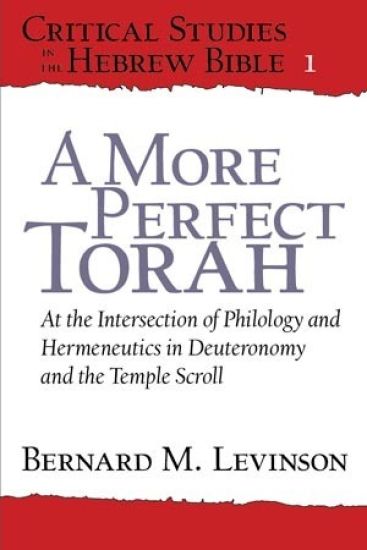
A More Perfect Torah

A More Perfect Torah

Bernard M. Levinson

Eisenbrauns
2013
pokkari
The historical-critical method that characterizes academic biblical studies too often remains separate from approaches that stress the history of interpretation, which are employed more frequently in the area of Second Temple or Dead Sea Scrolls research. Inaugurating the new series, Critical Studies in the Hebrew Bible, A More Perfect Torah explores a series of test-cases in which the two methods mutually reinforce one another. The volume brings together two studies that investigate the relationship between the composition history of the biblical text and its reception history at Qumran and in rabbinic literature. The Temple Scroll is more than the blueprint for a more perfect Temple. It also represents the attempt to create a more perfect Torah. Its techniques for doing so are the focus of part 1, entitled “Revelation Regained: The Hermeneutics of KI and ‘IM in the Temple Scroll.” This study illuminates the techniques for marking conditional clauses in ancient Near Eastern literature, biblical law, and the Dead Sea Scrolls. It also draws new attention to the relationship between the Temple Scroll’s use of conditionals and the manuscript’s organized spacing system for marking paragraphs. Part 2 is entitled “Reception History as a Window into Composition History: Deuteronomy’s Law of Vows as Reflected in Qoheleth and the Temple Scroll.” The law of vows in Deut 23:22–24 is difficult in both its syntax and its legal content. The difficulty is resolved once it is recognized that the law contains an interpolation that disrupts the original coherence of the law. The reception history of the law of vows in Numbers 20, Qoh 5:4–7, 11QTemple 53:11–14, and Sipre Deuteronomy confirms the hypothesis of an interpolation. Seen in this new light, the history of interpretation offers a window into the composition history of the biblical text.
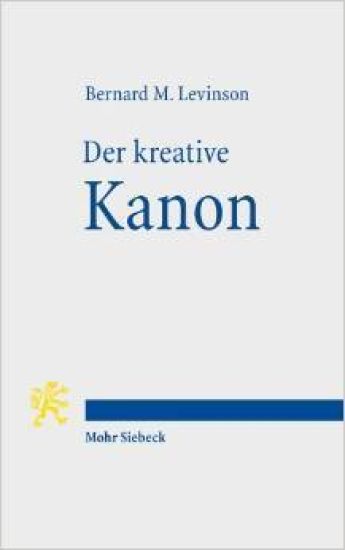
Der kreative Kanon

Der kreative Kanon

Bernard M. Levinson

Mohr Siebeck
2012
nidottu
Bernard M. Levinson nimmt das Prinzip der generationenübergreifenden Strafe aus dem Dekalog in den Blick, also die Vorstellung, dass Gott Sünder indirekt bestraft und die Bestrafung, die ihnen gebührt, auf drei oder vier Generationen ihrer Nachkommen ausdehnt. Trotz der Stilisierung als göttliches Recht wurde im alten Israel das Gerechtigkeitsproblem deutlich gesehen, das sich aus der Vorstellung ergibt, dass unschuldige Menschen allein dafür bestraft werden, Kinder oder Enkel von Übeltätern zu sein. Eine Reihe von innerbiblischen und nach-biblischen Reaktionen auf dieses Prinzip zeigt die Bemühungen späterer Autoren auf, dieses problematische Konzept zu kritisieren, zurückzuweisen und durch die alternative Vorstellung individueller Vergeltung zu ersetzen. So betrachtet ist der grundlegende Kanon die Quelle seiner eigenen Erneuerung: Er fördert das kritische Nachdenken über den überlieferten Text und trägt zur geistigen Freiheit bei. Um eine vertiefte Beschäftigung mit dem Thema zu ermöglichen, enthält das Buch auch einen weiterführenden forschungsgeschichtlichen Essay zum klar abgrenzbaren Ansatz der innerbiblischen Schriftauslegung. Darin werden Beiträge europäischer, israelischer und nordamerikanischer Forscher vorgestellt. Eine frühere, englischsprachige Fassung dieses Buches wurde unter dem Titel Legal Revision and Religious Renewal in Ancient Israel veröffentlicht. Die vorliegende Fassung stellt eine komplette Neuausgabe dar, die speziell mit Blick auf die deutschsprachige Leserschaft überarbeitet und mit umfangreichen Ergänzungen versehen wurde. Es ist das Ziel des Autors, neue Perspektiven auf aktuelle Debatten über Kanonizität, Autorität von Texten und Autorschaft innerhalb der Geisteswissenschaften zu ermöglichen." Es ist eine Wohltat, wenn sich Forscher in den Geistes- und Bibelwissenschaften nicht in ihrer eigenen Disziplin vergraben, sondern Themen in Angriff nehmen, die im eigenen Fach und in den Nachbardisziplinen von unverkennbarer Relevanz sind. B. M. Levinson gehört zu diesen mutigen Forschern. [...] Als Bibelwissenschaftler bahnt er den Weg zu den Geisteswissenschaften und macht sie mit dem bisher ungenutzten Forschungsschatz zur innerbiblischen Exegese vertraut." Aus dem Geleitwort von Hermann Spieckermann
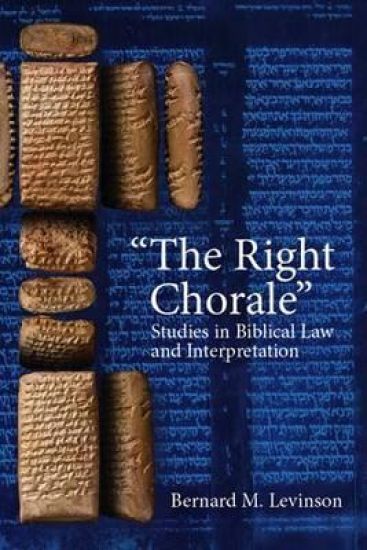
The Right Chorale”

The Right Chorale”

Bernard M. Levinson

Eisenbrauns
2011
pokkari
This book presents twelve selected investigations of textual composition, interpretation, revision, and transmission. With these studies, Bernard Levinson draws on the literary forebears of biblical law in cuneiform literature and its reinterpretation in the Second Temple period to provide the horizon of ancient Israelite legal exegesis. The volume makes a sustained argument about the nature of textuality in ancient Israel: Israelite scribes were sophisticated readers, authors, and thinkers who were conscious of their place in literary and intellectual history, even as they sought to renew and transform their cultural patrimony in significant ways. Originally published over a decade and a half, the significantly revised and updated studies gathered here explore the connections between law and narrative, show the close connections between Deuteronomy and the Neo-Assyrian loyalty oath tradition, address the literary relationship of Deuteronomy and the Covenant Code, reflect on important questions of methodology, and explore the contributions of the Bible to later Western intellectual history. The volume offers essential reading for an understanding of the Pentateuch and biblical law.
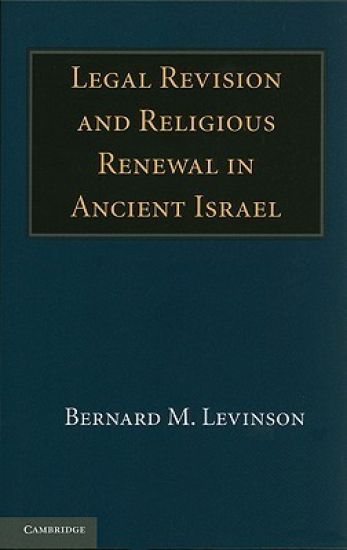
Legal Revision and Religious Renewal in Ancient Israel

Legal Revision and Religious Renewal in Ancient Israel

Bernard M. Levinson

Cambridge University Press
2010
pokkari
This book examines the doctrine of transgenerational punishment found in the Decalogue – the idea that God punishes sinners vicariously, extending the punishment due them to three or four generations of their progeny. Although a 'God-given' law, the unfairness of punishing innocent people in this way was clearly recognized in ancient Israel. A series of inner-biblical and post-biblical responses to the rule demonstrates that later writers were able to criticize, reject, and replace this doctrine with the notion of individual retribution. Supporting further study, it includes a valuable bibliographical essay on the distinctive approach of inner-biblical exegesis, showing the contributions of European, Israeli, and North American scholars. This Cambridge release represents a major revision and expansion of the French edition, L'Herméneutique de l'innovation: Canon et exégèse dans l'Israël biblique, nearly doubling its length with extensive content and offering alternative perspectives on debates about canonicity, textual authority, and authorship.
Gender and Law in the Hebrew Bible and the Ancient Near East

Gender and Law in the Hebrew Bible and the Ancient Near East

Victor H. Matthews; Tikva Frymer-Kensky; Bernard M. Levinson

Continuum International Publishing Group Ltd.
2009
nidottu
This striking new contribution to gender studies demonstrates the essential role of Israelite and Near East law in the historical analysis of gender. The theme of these studies of Babylonian, Hittite, Assyrian, and Israelite law is this: What is the significance of gender in the formulation of ancient law and custom? Feminist scholarship is enriched by these studies in family history and the status of women in antiquity. At the same time, conventional legal history is repositioned, as new and classical texts are interpreted from the vantage point of feminist theory and social history. Papers from SBL Biblical Law Section form the core of this collection.
"The Right Chorale": Studies in Biblical Law and Interpretation
This book presents twelve selected investigations of textual composition, interpretation, revision, and transmission. With these studies, Bernard Levinson draws upon the literary forebears of biblical law in cuneiform literature and its reinterpretation in the Second Temple period to provide the horizon of ancient Israelite legal exegesis. The volume makes a sustained argument about the nature of textuality in ancient Israel: Israelite scribes were sophisticated readers, authors, and thinkers who were conscious of their place in literary and intellectual history, even as they sought to renew and transform their cultural patrimony in significant ways. Originally published over a decade and a half, the significantly revised and updated studies gathered here explore the connections between law and narrative, show the close connections between Deuteronomy and the Neo-Assyrian loyalty oath tradition, address the literary relationship of Deuteronomy and the Covenant Code, reflect upon important questions of methodology, and explore the contributions of the Bible to later western intellectual history. The volume offers essential reading for an understanding of the Pentateuch and biblical law." This collection of essays is a testimony to Levinson's methodological brilliance and broad perspective as a bridge-builder between the various factions of Hebrew Bible scholarship." Armin Lange in Journal of Ancient Judaism 1 (2010), S. 122"The collection as a whole triumphantly vindicates the significance of biblical law, the essential function of diachronic analysis (source and redaction criticism, and historical contextualization) in interpretation, and, especially in the last section, the established positions of the critical tradition in the succession of Wellhausen. The footnotes and bibliography are a superb resource for the study of biblical law. And the publishers have produced a beautiful volume worthily complementing a fine text." Walter J. Houston in Journal of Semitic Studies 55 (2010), S. 312-313
Legal Revision and Religious Renewal in Ancient Israel

Legal Revision and Religious Renewal in Ancient Israel

Bernard M. Levinson

Cambridge University Press
2008
sidottu
This book examines the doctrine of transgenerational punishment found in the Decalogue – the idea that God punishes sinners vicariously, extending the punishment due them to three or four generations of their progeny. Although a 'God-given' law, the unfairness of punishing innocent people in this way was clearly recognized in ancient Israel. A series of inner-biblical and post-biblical responses to the rule demonstrates that later writers were able to criticize, reject, and replace this doctrine with the notion of individual retribution. Supporting further study, it includes a valuable bibliographical essay on the distinctive approach of inner-biblical exegesis, showing the contributions of European, Israeli, and North American scholars. This Cambridge release represents a major revision and expansion of the French edition, L'Herméneutique de l'innovation: Canon et exégèse dans l'Israël biblique, nearly doubling its length with extensive content and offering alternative perspectives on debates about canonicity, textual authority, and authorship.
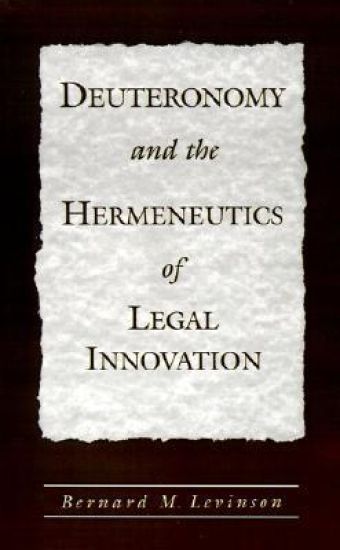
Deuteronomy and the Hermeneutics of Legal Innovation

Deuteronomy and the Hermeneutics of Legal Innovation

Bernard M. Levinson

Oxford University Press Inc
2002
nidottu
Positioned at the boundary of traditional biblical studies, legal history, and literary theory, Deuteronomy and the Hermeneutics of Legal Innovation shows how the legislation of Deuteronomy reflects the struggle of its authors to renew late seventh century Judean society. Seeking to defend their revolutionary vision during the neo-Assyrian crisis, the reformers turned to earlier laws, even when they disagreed with them, and revised them in such a way as to lend authority to their new understanding of God's will. Passages that other scholars have long viewed as redundant, contradictory, or displaced actually reflect the attempt by Deuteronomy's authors to sanction their new religious aims before the legacy of the past. Drawing on ancient Near Eastern law and informed by the rich insights of classical and medieval Jewish commentary, Levinson provides an extended study of three key passages in the legal corpus: the unprecedented requirement for the centralisation of worship, the law transforming the old Passover into a pilgrimage festival, and the unit replacing traditional village justice with a professional judiciary. He demonstrates the profound impact of centralisation upon the structure and arrangement of the legal corpus, while providing a theoretical analysis of religious change and cultural renewal in ancient Israel. The book's conclusion shows how the techniques of authorship developed in Deuteronomy provided a model for later Israelite and post- biblical literature. Integrating the most recent European research on the redaction of Deuteronomy with current American and Israeli scholarship, Levinson argues that biblical interpretation must attend to both the diachronic and the synchronic dimensions of the text. His study, which provides a new perspective on intertextuality, the history of authorship, and techniques of legal innovation in the ancient world, will engage pentateuchal critics and historians of Israelite religion, while reaching out toward current issues in literary theory and Critical Legal Studies.
Deuteronomy and the Hermeneutics of Legal Innovation

Deuteronomy and the Hermeneutics of Legal Innovation

Bernard M. Levinson

Oxford University Press Inc
1998
sidottu
Positioned at the boundary of traditional biblical studies, legal history, and literary theory, Deuteronomy and the Hermeneutics of Legal Innovation shows how the leglislation of Deuteromomy reflects the struggle of its authors to renew late seventh-century Judaean society. Seeking to defend their revolutionary vision during the neo-Assyrian crisis, the reformers turned to earlier laws, even when they disagreed with them, and revised them in such a way as to lend authority to their new understanding of God's will. Passages that other scholars have long viewed as redundant, contradictory, or displaced actually reflect the attempt by Deuteronomy's authors to sanction their new religious aims before the legacy of the past. Drawing on ancient Near Eastern law and informed by the rich insights of classical and medieval Jewish commentary, Levinson provides an extended study of three key passages in the legal corpus: the unprecedented requirement for the centralization of worship, the law transforming the old Passover into a pilgrimage festival, and the unit replacing traditional village justice with a professionalized judiciary. He demonstrates the profound impact of centralization upon the structure and arrangement of the legal corpus, while providing a theoretical analysis of religious change and cultural renewal in ancient Israel. The book's conclusion shows how the techniques of authorship developed in Deuteronomy provided a model for later Israelite and post-biblical literature. Integrating the most recent European research on the redaction of Deuteronomy with current American and Israeli scholarship, Levinson argues that biblical interpretation must attend to both the diachronic and the synchronic dimensions of the text. His study, which provides a new perspective on intertextuality, the history of authorship, and techniques of legal innovation in the ancient world, will engage Pentateuchal critics and historians of Israelite religion, while reaching out toward current issues in literary theory and Critical Legal Studies. `Bernard Levinson is a brilliant young scholar who has written an outstanding book about how the Covenant Code from Mount Sinai became the Code of Deuteronomy at the borders of the River Jordan. It is a fascinating discourse on how to change law without changing tradition. The importance of Biblical law for canon theory, Biblical narrative, and Israelite religion usually is underestimated; this new approach will hopefully get more people reading law, and especially Deuteronomy. It will be compelling to both American and European readers as it integrates the leading scholarly discourses of both communities.' Norbert Lohfink, SJ, Professor of Biblical Studies, Philosophisch-Theologische Hochschule Sankt Georgen, Frankfurt `An exemplary work of biblical scholarship--careful and controlled by analytic rigour, yet bold and innovative in its scope and suggestions. Students of ancient law, legal literature, religion, and culture will greatly benefit from Levinson's work.' Michael Fishbane, Nathan Cummings Professor of Jewish Studies, University of Chicago `In noting that the Deuteronomic innovations were not simply interpolated into a reworked version of the Covenant Code but rather presented in a new, complete composition, Levinson demonstrates his own primary commitment to the text, to the history of textual transmission, and to the social milieu in which the text functions. Levinson elegantly presents the use of the Covenant Code as both a source and resource for the Deuteronomic authors.' Martha T. Roth, Professor, Oriental Institute, University of Chicago and Editor-in-Charge of the Chicago Assyrian Dictionary `Bernard Levinson's book is a major study. He demonstrates the radical break with the past and the way in which the authors or composers of Deuteronomy not only transformed religion and society in ancient Israel but also radically revised its literary history. The power and accomplishment of the Deuteronomic movement has rarely been so clearly demonstrated. Levinson's work is a clarification of the way in which hermeneutics is not something that starts with the interpreter's handling of the canonical text but is a process by which the canonical text itself came into being. He shows how the new text subverts and dominates older texts in behalf of a radical cultural and religious transformation. With this book, Levinson places himself in the front rank of Deuteronomy scholars.' Patrick D. Miller, Charles P. Haley Professor of Old Testament Exegesis and Theology, Princeton Theological Seminary