Kirjojen hintavertailu – 12 859 819 kirjaa ja 27 kauppaa

Kirjailija

Bernard Mandeville

Kirjat ja teokset yhdessä paikassa: 94 kirjaa, julkaisuja vuosilta 1957–2026, suosituimpiin kuuluu Æsop Dress'd. Vertaile teosten hintoja ja tarkista saatavuus suomalaisista kirjakaupoista.

94 kirjaa

Kirjojen julkaisuvuodet: 1957–2026.

Free Thoughts on Religion, the Church, and National Happiness

Free Thoughts on Religion, the Church, and National Happiness

Bernard Mandeville

Transaction Publishers
2000
sidottu
Bernard Mandeville was best known for The Fable of the Bees, in which he demolishes the supposed moral basis of society by a Hobbesian demonstration that civilization depends on vice. Today Mandeville is seen as a trenchant satirist of the manners and foibles of his age. He is also seen as a precursor of some of Adam Smith's doctrines, a forerunner in the field of sociology. A prescient analyst of the dynamics of our modern consumer society, Mandeville is author of a striking naturalistic account of the gradual evolution of modern society from its primitive antecedents. His literary signature, in a manner of speaking, is his famous paradox, "private vices, public benefits." This new edition of Free Thoughts is prefaced by a lengthy and informative introduction by Irwin Primer, who recreates not only the literary, political, and religious atmosphere surrounding Mandeville, but also the controversies that surrounded his writing in mid-eighteenth-century England. Primer includes textual notes on the first and second editions of this classic work. To understand Mandeville's Free Thoughts, one needs to situate it within the context of the religious and political controversies, ongoing subversion, fear and dormant warfare of his times. Those would eventually erupt again and for the last time in the bloody Jacobite rebellion of 1745-46. The first five chapters of the book explore religious and theological issues including the nature of belief and knowledge, the significance of rites and ceremonies, and controversies about Christian mysteries such as the Trinity and free will and predestination. The next five chapters explore controversial issues of church politics, including persecution and toleration across the centuries, the basis of Mandeville's anticlericalism. In the eleventh chapter, he turns aside from matters of religion to review the balance of powers in Britain's government, a mixed or limited monarchy. The final chapter is essentially a repetition of Mandeville's pleas for civil and religious peace through mutual toleration by opposing religious parties. Mandeville's work is of continuing interest to students of culture and history, religion and theology, and political science. Irwin Primer is professor emeritus at Rutgers University who has written widely on Mandeville and the Scottish tradition in philosophy.

Fable of the Bees and Other Writings

Fable of the Bees and Other Writings

Bernard Mandeville

Hackett Publishing Co, Inc
1997
pokkari
Published anonymously in 1723, "The Fable of the Bees" by Bernard Mandeville came to be regarded as the epitome of immorality. It is a naturalistic account of the mechanism of human desire. This abridged edition also includes "The Fable" and background readings from two sources.
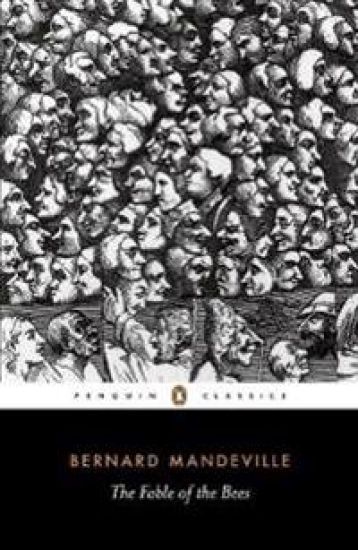
The Fable of the Bees

The Fable of the Bees

Bernard Mandeville; Phillip Harth

Penguin Classics
1989
pokkari
A physician with a particular interest in psychological disorders and satirist, Mandeville published versions of his notorious Fable of the Bees from 1714 to 1732. Each was a defence and elaboration of his short satirical poem The Angry Hive, 1705. The version of the Fable of 1723 and 1732 are the fullest defences of his early paradox that social benefit is the unintended consequence of personal vice. It is an argument that is generally held to lie behind Adam Smith's doctrine of the 'hidden hand' of economic development.
Fable of the Bees, Volumes 1 & 2

Fable of the Bees, Volumes 1 & 2

Bernard Mandeville

Liberty Fund Inc
1988
sidottu
It used to be that everyone read the "notorious" Bernard Mandeville (1670-1733). He was a great satirist and came to have a profound impact on economics, ethics and social philosophy. "The Fable of the Bees" begins with a poem and continues with a number of essays and dialogues. It is all tied together by the startling and original idea that "private vices" (self-interest) lead to "publick benefits" (the development and operation of society).
Fable of the Bees, Volumes 1 & 2

Fable of the Bees, Volumes 1 & 2

Bernard Mandeville

Liberty Fund Inc
1988
nidottu
It used to be that everyone read the "notorious" Bernard Mandeville (1670-1733). He was a great satirist and came to have a profound impact on economics, ethics and social philosophy. "The Fable of the Bees" begins with a poem and continues with a number of essays and dialogues. It is all tied together by the startling and original idea that "private vices" (self-interest) lead to "publick benefits" (the development and operation of society).