Kirjojen hintavertailu – 12 859 818 kirjaa ja 27 kauppaa

Kirjailija

Bernard Stiegler

Kirjat ja teokset yhdessä paikassa: 39 kirjaa, julkaisuja vuosilta 1998–2022, suosituimpiin kuuluu The Re-Enchantment of the World. Vertaile teosten hintoja ja tarkista saatavuus suomalaisista kirjakaupoista.

39 kirjaa

Kirjojen julkaisuvuodet: 1998–2022.

What Makes Life Worth Living

What Makes Life Worth Living

Bernard Stiegler

Polity Press
2013
nidottu

Halvin toimitettuna 28,10 €

In the aftermath of the First World War, the poet Paul Valéry wrote of a ‘crisis of spirit’, brought about by the instrumentalization of knowledge and the destructive subordination of culture to profit. Recent events demonstrate all too clearly that that the stock of mind, or spirit, continues to fall. The economy is toxically organized around the pursuit of short-term gain, supported by an infantilizing, dumbed-down media. Advertising technologies make relentless demands on our attention, reducing us to idiotic beasts, no longer capable of living. Spiralling rates of mental illness show that the fragile life of the mind is at breaking point. Underlying these multiple symptoms is consumer capitalism, which systematically immiserates those whom it purports to liberate. Returning to Marx’s theory, Stiegler argues that consumerism marks a new stage in the history of proletarianization. It is no longer just labour that is exploited, pushed below the limits of subsistence, but the desire that is characteristic of human spirit. The cure to this malaise is to be found in what Stiegler calls a ‘pharmacology of the spirit’. Here, pharmacology has nothing to do with the chemical supplements developed by the pharmaceutical industry. The pharmakon, defined as both cure and poison, refers to the technical objects through which we open ourselves to new futures, and thereby create the spirit that makes us human. By reference to a range of figures, from Socrates, Simondon and Derrida to the child psychoanalyst Donald Winnicott, Stiegler shows that technics are both the cause of our suffering and also what makes life worth living.

What Makes Life Worth Living

What Makes Life Worth Living

Bernard Stiegler

Polity Press
2013
sidottu
In the aftermath of the First World War, the poet Paul Valéry wrote of a ‘crisis of spirit’, brought about by the instrumentalization of knowledge and the destructive subordination of culture to profit. Recent events demonstrate all too clearly that that the stock of mind, or spirit, continues to fall. The economy is toxically organized around the pursuit of short-term gain, supported by an infantilizing, dumbed-down media. Advertising technologies make relentless demands on our attention, reducing us to idiotic beasts, no longer capable of living. Spiralling rates of mental illness show that the fragile life of the mind is at breaking point. Underlying these multiple symptoms is consumer capitalism, which systematically immiserates those whom it purports to liberate. Returning to Marx’s theory, Stiegler argues that consumerism marks a new stage in the history of proletarianization. It is no longer just labour that is exploited, pushed below the limits of subsistence, but the desire that is characteristic of human spirit. The cure to this malaise is to be found in what Stiegler calls a ‘pharmacology of the spirit’. Here, pharmacology has nothing to do with the chemical supplements developed by the pharmaceutical industry. The pharmakon, defined as both cure and poison, refers to the technical objects through which we open ourselves to new futures, and thereby create the spirit that makes us human. By reference to a range of figures, from Socrates, Simondon and Derrida to the child psychoanalyst Donald Winnicott, Stiegler shows that technics are both the cause of our suffering and also what makes life worth living.

Uncontrollable Societies of Disaffected Individuals
Max Weber argued that the development of capitalism would lead to the progressive rationalization and disenchantment of society: today this process is reaching its endpoint and capitalism is collapsing into a disturbing kind of irrationality. It engenders spiritual misery - a paralysis of the function of the human mind or spirit - where reason disappears as a motive of hope, a ‘kingdom of ends’ in Kant’s sense. Absolute disenchantment afflicts all those who no longer have anything to expect from the development of hyper-industrial society. Those who are desperate become ‘desperados’, and they are becoming more and more numerous. No longer having anything to expect means, at the same time, no longer having anything to fear. And the proliferating repressive mechanisms that are supposed to cope with the effects of this loss of authority turn out to be less and less effective. For such measures engender more and more the opposite of that for which they were intended, but in extreme and totally irrational, unpredictable forms. This is where we are today: the technical system of the hyper-industrial epoch can maintain its power only so long as it is backed up by blind trust, but this trust is undermined by the destructive irrationality stemming from the liquidation of the kingdom of ends. From the moment this trust is lost, hyper-power is inverted into hyper-vulnerability and impotence. The loss of motives of hope then expands, encompassing all of us like a contagious illness. But this ‘all’ is no longer a ‘we’: it is a panic.
Uncontrollable Societies of Disaffected Individuals

Uncontrollable Societies of Disaffected Individuals

Bernard Stiegler

Polity Press
2012
nidottu

Halvin toimitettuna 31,70 €

Max Weber argued that the development of capitalism would lead to the progressive rationalization and disenchantment of society: today this process is reaching its endpoint and capitalism is collapsing into a disturbing kind of irrationality. It engenders spiritual misery - a paralysis of the function of the human mind or spirit - where reason disappears as a motive of hope, a ‘kingdom of ends’ in Kant’s sense. Absolute disenchantment afflicts all those who no longer have anything to expect from the development of hyper-industrial society. Those who are desperate become ‘desperados’, and they are becoming more and more numerous. No longer having anything to expect means, at the same time, no longer having anything to fear. And the proliferating repressive mechanisms that are supposed to cope with the effects of this loss of authority turn out to be less and less effective. For such measures engender more and more the opposite of that for which they were intended, but in extreme and totally irrational, unpredictable forms. This is where we are today: the technical system of the hyper-industrial epoch can maintain its power only so long as it is backed up by blind trust, but this trust is undermined by the destructive irrationality stemming from the liquidation of the kingdom of ends. From the moment this trust is lost, hyper-power is inverted into hyper-vulnerability and impotence. The loss of motives of hope then expands, encompassing all of us like a contagious illness. But this ‘all’ is no longer a ‘we’: it is a panic.
Decadence of Industrial Democracies

Decadence of Industrial Democracies

Bernard Stiegler

Polity Press
2011
nidottu

Halvin toimitettuna 31,10 €

Translated by DANIEL ROSS Bernard Stiegler is one of the most original philosophers writing today about new technologies and their implications for social, political and personal life. Drawing on sources ranging from Plato and Marx to Freud, Heidegger and Derrida, he develops a highly original account of technology as grammatology, as a technics of writing that constitutes our experience of time, memory and desire, even of life itself. Society and our place within it are shaped by technical reproduction which can both expand and restrict the horizons and possibilities of human agency and experience. In the three volumes of Disbelief and Discredit Stiegler argues that this process of technical reproduction has become dangerously divorced from its role in the constitution of human experience. Radically challenging the optimistic view of new technologies as facilitators of learning and progress, he argues new marketing techniques shortcircuit thought and disenfranchise consumers, programming them to seek short-term gratification. These practices of ‘libidinal economics’ have profound consequences for nature of human desire and they underpin the social and psychological malaise of contemporaty industrial society. In this opening volume Stiegler argues that the industrial model implemented since the beginning of the twentieth century has become obsolete, leading capitalist democracies to an impasse. A sign of this impasse and of the decadence to which it leads is the banalization of consumers who become ensnared in a perpetual cycle of consumption. This is the new proletarianization of the technologically infused, hyper-industrial capitalism of today. It produces a society cut off from its past and its future, stultifying human development and turning democracy into a farce in which disbelief and discredit inevitably arise.
Decadence of Industrial Democracies

Decadence of Industrial Democracies

Bernard Stiegler

Polity Press
2011
sidottu
Translated by DANIEL ROSS Bernard Stiegler is one of the most original philosophers writing today about new technologies and their implications for social, political and personal life. Drawing on sources ranging from Plato and Marx to Freud, Heidegger and Derrida, he develops a highly original account of technology as grammatology, as a technics of writing that constitutes our experience of time, memory and desire, even of life itself. Society and our place within it are shaped by technical reproduction which can both expand and restrict the horizons and possibilities of human agency and experience. In the three volumes of Disbelief and Discredit Stiegler argues that this process of technical reproduction has become dangerously divorced from its role in the constitution of human experience. Radically challenging the optimistic view of new technologies as facilitators of learning and progress, he argues new marketing techniques shortcircuit thought and disenfranchise consumers, programming them to seek short-term gratification. These practices of ‘libidinal economics’ have profound consequences for nature of human desire and they underpin the social and psychological malaise of contemporaty industrial society. In this opening volume Stiegler argues that the industrial model implemented since the beginning of the twentieth century has become obsolete, leading capitalist democracies to an impasse. A sign of this impasse and of the decadence to which it leads is the banalization of consumers who become ensnared in a perpetual cycle of consumption. This is the new proletarianization of the technologically infused, hyper-industrial capitalism of today. It produces a society cut off from its past and its future, stultifying human development and turning democracy into a farce in which disbelief and discredit inevitably arise.
Technics and Time, 3

Technics and Time, 3

Bernard Stiegler

Stanford University Press
2010
pokkari

Halvin toimitettuna 34,60 €

In the first two volumes of Technics and Time, Bernard Stiegler worked carefully through Heidegger's and Husserl's relationship to technics and technology. Here, in volume three, he turns his attention to the prolematic relationship to technics he finds in Kant's Critique of Pure Reason, particularly in the two versions of the Transcendental Deduction. Stiegler relates this problematic to the "cinematic nature" of time, which precedes cinema itself but reaches an apotheosis in it as the exteriorization process of schema, through tertiary retentions and their mechanisms. The book focuses on the relationship between these themes and the "culture industry"— as defined by Adorno and Horkheimer—that has supplanted the educational institutions on which genuine cultural participation depends. This displacement, Stiegler says, has produced a malaise from which current global culture suffers. The result is potentially catastrophic.
Technics and Time, 3

Technics and Time, 3

Bernard Stiegler

Stanford University Press
2010
sidottu
In the first two volumes of Technics and Time, Bernard Stiegler worked carefully through Heidegger's and Husserl's relationship to technics and technology. Here, in volume three, he turns his attention to the prolematic relationship to technics he finds in Kant's Critique of Pure Reason, particularly in the two versions of the Transcendental Deduction. Stiegler relates this problematic to the "cinematic nature" of time, which precedes cinema itself but reaches an apotheosis in it as the exteriorization process of schema, through tertiary retentions and their mechanisms. The book focuses on the relationship between these themes and the "culture industry"— as defined by Adorno and Horkheimer—that has supplanted the educational institutions on which genuine cultural participation depends. This displacement, Stiegler says, has produced a malaise from which current global culture suffers. The result is potentially catastrophic.
For a New Critique of Political Economy

For a New Critique of Political Economy

Bernard Stiegler

Polity Press
2010
nidottu

Halvin toimitettuna 30,50 €

The catastrophic economic, social and political crisis of our time calls for a new and original critique of political economy - a rethinking of Marx's project in the very different conditions of twenty-first century capitalism. Stiegler argues that today the proletarian must be reconceptualized as the economic agent whose knowledge and memory are confiscated by machines. This new sense of the term ‘proletarian' is best understood by reference to Plato's critique of exteriorized memory. By bringing together Plato and Marx, Stiegler can show how a generalized proletarianization now encompasses not only the muscular system, as Marx saw it, but also the nervous system of the so-called creative workers in the information industries. The proletarians of the former are deprived of their practical know-how, whereas the latter are shorn of their theoretical practice, and both suffer from a confiscation of the very possibility of a genuine art of living. But the mechanisms at work in this new and accentuated form of proletarianization are the very mechanisms that may spur a reversal of the process. Such a reversal would imply a crucial distinction between one's life work, originating in otium (leisure devoted to the techniques of the self), and the job, consisting in a negotium (the negotiation and calculation, increasingly restricted to short-term expectations), leading to the necessity of a new conception of economic value. This short text offers an excellent introduction to Stiegler's work while at the same time representing a political call to arms in the face of a deepening economic and social crisis.
For a New Critique of Political Economy

For a New Critique of Political Economy

Bernard Stiegler

Polity Press
2010
sidottu
The catastrophic economic, social and political crisis of our time calls for a new and original critique of political economy - a rethinking of Marx's project in the very different conditions of twenty-first century capitalism. Stiegler argues that today the proletarian must be reconceptualized as the economic agent whose knowledge and memory are confiscated by machines. This new sense of the term ‘proletarian' is best understood by reference to Plato's critique of exteriorized memory. By bringing together Plato and Marx, Stiegler can show how a generalized proletarianization now encompasses not only the muscular system, as Marx saw it, but also the nervous system of the so-called creative workers in the information industries. The proletarians of the former are deprived of their practical know-how, whereas the latter are shorn of their theoretical practice, and both suffer from a confiscation of the very possibility of a genuine art of living. But the mechanisms at work in this new and accentuated form of proletarianization are the very mechanisms that may spur a reversal of the process. Such a reversal would imply a crucial distinction between one's life work, originating in otium (leisure devoted to the techniques of the self), and the job, consisting in a negotium (the negotiation and calculation, increasingly restricted to short-term expectations), leading to the necessity of a new conception of economic value. This short text offers an excellent introduction to Stiegler's work while at the same time representing a political call to arms in the face of a deepening economic and social crisis.
Taking Care of Youth and the Generations

Taking Care of Youth and the Generations

Bernard Stiegler

Stanford University Press
2010
pokkari
Bernard Stiegler works systematically through the current crisis in education and family relations resulting from the mesmerizing power of marketing technologies. He contends that the greatest threat to social and cultural development is the destruction of young people's ability to pay critical attention to the world around them. This phenomenon, prevalent throughout the first world, is the calculated result of technical industries and their need to capture the attention of the young, making them into a target audience and reversing the relationship between adults and children. Taking Care exposes the carelessness of these industries and urges the reader to re-enter the "battle for intelligence" against the drive-oriented culture of short-term ("short-circuited") attention characteristic of the negative aspects of the new technologies. Long-term attention, Stiegler shows, produces retentions of cultural memory mandatory for social development—and for the counteracting of ADD and ADHD. Examining the history of education from Plato to the current quagmires in France and the United States, he tracks the notion of critical thinking from its Enlightenment apotheosis to its current eradication. Stiegler is unique in combining the most radical of theoretical constructs—such as "grammatization"—with quite traditional values, values he proposes we re-address in our not-so-brave new world.
Taking Care of Youth and the Generations

Taking Care of Youth and the Generations

Bernard Stiegler

Stanford University Press
2010
sidottu
Bernard Stiegler works systematically through the current crisis in education and family relations resulting from the mesmerizing power of marketing technologies. He contends that the greatest threat to social and cultural development is the destruction of young people's ability to pay critical attention to the world around them. This phenomenon, prevalent throughout the first world, is the calculated result of technical industries and their need to capture the attention of the young, making them into a target audience and reversing the relationship between adults and children. Taking Care exposes the carelessness of these industries and urges the reader to re-enter the "battle for intelligence" against the drive-oriented culture of short-term ("short-circuited") attention characteristic of the negative aspects of the new technologies. Long-term attention, Stiegler shows, produces retentions of cultural memory mandatory for social development—and for the counteracting of ADD and ADHD. Examining the history of education from Plato to the current quagmires in France and the United States, he tracks the notion of critical thinking from its Enlightenment apotheosis to its current eradication. Stiegler is unique in combining the most radical of theoretical constructs—such as "grammatization"—with quite traditional values, values he proposes we re-address in our not-so-brave new world.
Technics and Time, 2

Technics and Time, 2

Bernard Stiegler

STANFORD UNIVERSITY PRESS
2008
sidottu
Disorientation is the first publication in English of the second volume of Technics and Time, in which French philosopher Bernard Stiegler engages in a close dialogue with Husserl, Derrida, and other philosophers who have devoted their energies to technics, such as Heidegger and Simondon. The author's broad intent is to respond to Western philosophy's historical exclusion of technics and techniques from its metaphysical questionings, and in so doing to rescue critical and philosophical thinking. For many years, Stiegler has explored the origins and philosophical, ethical, and political stakes of a global process he calls "the industrial temporalization of consciousness." Here, demonstrating that technology—including alphabetical writing—is memory, he argues that through new technologies of retention and inscription we have come to live in a world where time devours space, a disoriented world in which we have lost our bearings. Immersed in the multimedia of an over-connected world, with time and space as we know them abolished, we no longer find "cardinal points" to guide us and may even be led where we do not wish to go. We must therefore prepare to confront new spheres of ideological control and discover new possibilities in the digital environment.
Technics and Time, 2

Technics and Time, 2

Bernard Stiegler

Stanford University Press
2008
pokkari

Halvin toimitettuna 34,60 €

Disorientation is the first publication in English of the second volume of Technics and Time, in which French philosopher Bernard Stiegler engages in a close dialogue with Husserl, Derrida, and other philosophers who have devoted their energies to technics, such as Heidegger and Simondon. The author's broad intent is to respond to Western philosophy's historical exclusion of technics and techniques from its metaphysical questionings, and in so doing to rescue critical and philosophical thinking. For many years, Stiegler has explored the origins and philosophical, ethical, and political stakes of a global process he calls "the industrial temporalization of consciousness." Here, demonstrating that technology—including alphabetical writing—is memory, he argues that through new technologies of retention and inscription we have come to live in a world where time devours space, a disoriented world in which we have lost our bearings. Immersed in the multimedia of an over-connected world, with time and space as we know them abolished, we no longer find "cardinal points" to guide us and may even be led where we do not wish to go. We must therefore prepare to confront new spheres of ideological control and discover new possibilities in the digital environment.
Acting Out

Acting Out

Bernard Stiegler

Stanford University Press
2008
sidottu
Acting Out is the first appearance in English of two short books published by Bernard Stiegler in 2003. In How I Became a Philosopher, he outlines his transformation during a five-year period of incarceration for armed robbery. Isolated from what had been his world, Stiegler began to conduct a kind of experiment in phenomenological research. Inspired by the Greek stoic Epictetus, Stiegler began to read, write, and discover his vocation, eventually studying philosophy in correspondence with Gérard Granel who was an important influence on a number of French philosophers, including Jacques Derrida, who was later Stiegler's teacher. The second book, To Love, To Love Me, To Love Us, is a powerful distillation of Stiegler's analysis of the contemporary world. He maintains that a growing loss of a sense of individual and collective existence leads to a decreased ability to love oneself, and, by extension, others. This predicament is viewed through a tragic event: in 2002, in Nanterre, France, Richard Durn, a local activist, stormed the city's town hall, shooting and killing eight people. Durn committed suicide the following day. The later publication of Durn's his journal revealed a man struggling with the feeling that he did not exist, for which he tried to compensate by committing an atrocity. For Stiegler, this exemplifies how love of self becomes pathological: a "me" assassinates an "us" with which it cannot identify.
Acting Out

Acting Out

Bernard Stiegler

Stanford University Press
2008
pokkari
Acting Out is the first appearance in English of two short books published by Bernard Stiegler in 2003. In How I Became a Philosopher, he outlines his transformation during a five-year period of incarceration for armed robbery. Isolated from what had been his world, Stiegler began to conduct a kind of experiment in phenomenological research. Inspired by the Greek stoic Epictetus, Stiegler began to read, write, and discover his vocation, eventually studying philosophy in correspondence with Gérard Granel who was an important influence on a number of French philosophers, including Jacques Derrida, who was later Stiegler's teacher. The second book, To Love, To Love Me, To Love Us, is a powerful distillation of Stiegler's analysis of the contemporary world. He maintains that a growing loss of a sense of individual and collective existence leads to a decreased ability to love oneself, and, by extension, others. This predicament is viewed through a tragic event: in 2002, in Nanterre, France, Richard Durn, a local activist, stormed the city's town hall, shooting and killing eight people. Durn committed suicide the following day. The later publication of Durn's his journal revealed a man struggling with the feeling that he did not exist, for which he tried to compensate by committing an atrocity. For Stiegler, this exemplifies how love of self becomes pathological: a "me" assassinates an "us" with which it cannot identify.
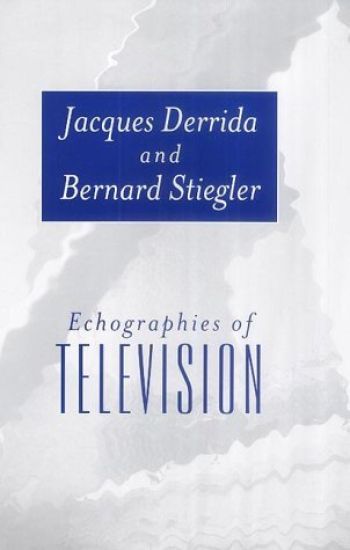
Echographies of Television

Echographies of Television

Jacques Derrida; Bernard Stiegler

JOHN WILEY AND SONS LTD
2002
nidottu
This work provides an extended interview with Derrida about the impact of tele-technologies on our private and public lives. The book contains important new theoretical insights, and includes a related essay by Derrida and a concluding piece by Stiegler.
Echographies of Television

Echographies of Television

Jacques Derrida; Bernard Stiegler

Polity Press
2002
sidottu
In this important new book, Jacques Derrida talks with Bernard Stiegler about the effect of teletechnologies on our philosophical and political moment. Improvising before a camera, the two philosophers are confronted by the very technologies they discuss and so are forced to address all the more directly the urgent questions that they raise. What does it mean to speak of the present in a situation of "live" recording? How can we respond, responsibly, to a question when we know that the so-called "natural" conditions of expression, discussion, reflection, and deliberation have been breached? As Derrida and Stiegler discuss the role of teletechnologies in modern society, the political implications of Derrida's thought become apparent. Drawing on recent events in Europe, Derrida and Stiegler explore the impact of television and the internet on our understanding of the state, its borders and citizenship. Their discussion examines the relationship between the juridical and the technical, and it shows how new technologies for manipulating and transmitting images have influenced our notions of democracy, history and the body. The book opens with a shorter interview with Derrida on the news media, and closes with a provocative essay by Stiegler on the epistemology of digital photography. In Echographies of Television, Derrida and Stiegler open up questions that are of key social and political importance. Their book will be of great interest to all those already familiar with Derrida's work, as well as to students and scholars of philosophy, literature, sociology and media studies.
Technics and Time, 1

Technics and Time, 1

Bernard Stiegler

Stanford University Press
1998
pokkari

Halvin toimitettuna 38,20 €

What is a technical object? At the beginning of Western philosophy, Aristotle contrasted beings formed by nature, which had within themselves a beginning of movement and rest, and man-made objects, which did not have the source of their own production within themselves. This book, the first of three volumes, revises the Aristotelian argument and develops an innovative assessment whereby the technical object can be seen as having an essential, distinct temporality and dynamics of its own. The Aristotelian concept persisted, in one form or another, until Marx, who conceived of the possibility of an evolution of technics. Lodged between mechanics and biology, a technical entity became a complex of heterogeneous forces. In a parallel development, while industrialization was in the process of overthrowing the contemporary order of knowledge as well as contemporary social organization, technology was acquiring a new place in philosophical questioning. Philosophy was for the first time faced with a world in which technical expansion was so widespread that science was becoming more and more subject to the field of instrumentality, with its ends determined by the imperatives of economic struggle or war, and with its epistemic status changing accordingly. The power that emerged from this new relation was unleashed in the course of the two world wars. Working his way through the history of the Aristotelian assessment of technics, the author engages the ideas of a wide range of thinkers—Rousseau, Husserl, and Heidegger, the paleo-ontologist Leroi-Gourhan, the anthropologists Vernant and Detienne, the sociologists Weber and Habermas, and the systems analysts Maturana and Varela.