Kirjojen hintavertailu – 12 870 288 kirjaa ja 27 kauppaa

Kirjailija

Berthold Delbrück

Kirjat ja teokset yhdessä paikassa: 45 kirjaa, julkaisuja vuosilta 1893–2025, suosituimpiin kuuluu Die neueste Sprachforschung. Vertaile teosten hintoja ja tarkista saatavuus suomalaisista kirjakaupoista.

Nimi esiintyy myös muodoissa: Berthold Delbruck

45 kirjaa

Kirjojen julkaisuvuodet: 1893–2025.

Einleitung in das Sprachstudium

Einleitung in das Sprachstudium

Berthold Delbrück

Cambridge University Press
2012
pokkari
In 1876 the Leipzig publisher Breitkopf und Härtel launched a series on Indo-European languages entitled 'Bibliothek Indogermanischer Grammatiken'. The first three volumes covered phonology, Greek and Sanskrit. This short introduction to the comparative method, published in 1880, was the fourth. It was highly successful, with six editions appearing between 1880 and 1919. Its author, Berthold Delbrück (1842–1922), Professor of Sanskrit at Jena, was a former student of the pioneering Indo-Europeanist Franz Bopp. Delbrück expanded the horizons of the field to cover syntax as well as phonology and morphology; his magisterial studies of Sanskrit and Indo-European syntax (also reissued in the Cambridge Library Collection) appeared between 1886 and 1900. This book, designed as a guide for readers of the Breitkopf series, includes a fascinating history of Indo-European philology from its founding fathers Jones and Bopp through Humboldt, Schleicher and Curtius to Delbrück's own time, and outlines the most recent developments.
Grundfragen der Sprachforschung

Grundfragen der Sprachforschung

Berthold Delbrück

Cambridge University Press
2012
pokkari
In this 1901 work, Berthold Delbrück (1842–1922), who is famous for his contribution to the study of the syntax in Indo-European languages, focuses on Wilhelm Wundt's understanding of speech. Wundt (1832–1920), often referred to as the 'father of experimental psychology', held that language was one of the most important aspects of mental processing. In order to account for Wundt's theories on the nature of the soul, and his belief that emotion and perception are acts of experience rather than objects, Delbrück compares Wundt's theories with those of psychologist and educationalist J. F. Herbart (1776–1841). Delbrück also pays attention to the explanation of such topics as the hand gestures used by actors (and the people of Naples), the sentence structure of the German language, and onomatopoeia, though he emphasises that he has not addressed those elements in Wundt's works which are founded in psychology rather than in grammar.
Die Grundlagen der Griechischen Syntax

Die Grundlagen der Griechischen Syntax

Berthold Delbrück

Cambridge University Press
2012
pokkari
In this fourth part of his general work on syntax, published in 1879, Berthold Delbrück (1842–1922), the German scholar remembered for his contribution to the study of the syntax in Indo-European languages (his three-volume Vergleichende Syntax der indogermanischen Sprachen is also reissued in this series), concentrates on the syntax of ancient Greek. His focus is deliberately broad as he seeks to engage classicists who are interested in linguistics or in how the Greek language was actually used, rather than in highly specialised case studies. In twelve chapters, Delbrück guides the reader through the gender and case of nouns, and explains some features seen as peculiarities of Homeric Greek which in fact demonstrate its kinship as an Indo-European language with the Vedic language of the Hindu scriptures. He also covers the tenses and moods of verbs, prepositions, pronouns and particles, and word order.
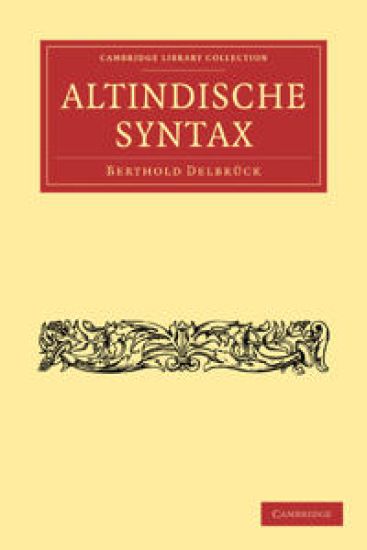
Altindische Syntax

Altindische Syntax

Berthold Delbrück

Cambridge University Press
2010
pokkari
The famous scholar of Indo-European syntax Berthold Delbrück (1842–1922) published this study of Sanskrit syntax in 1888. It focuses on the stage of the language that was termed 'Vedic' by the Indian grammarian Panini (c. 400 BCE). Delbrück's intention was to describe that material as clearly and thoroughly as possible in order to facilitate future comparative or in-depth studies. The book begins with chapters devoted to basic sentence structure and word order, before moving on to number, gender, case, declension of nouns, and then adjectives, adverbs, pronouns and verbs with their tenses, moods and conjugations. Prepositions and particles follow, and the book ends with discussion of subordinate clauses and other complex structures. The grammatical points are illustrated by numerous text examples, with references and translations into German, and there are thorough indexes of words and of textual passages cited.

Vergleichende Syntax der indogermanischen Sprachen

Vergleichende Syntax der indogermanischen Sprachen

Berthold Delbrück

Cambridge University Press
2010
pokkari
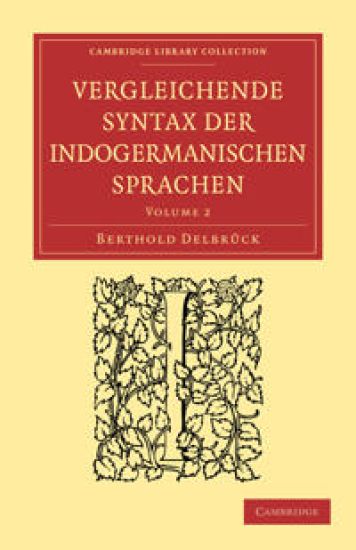
Karl Brugmann originally intended to include a volume on syntax in his comparative grammar of Indo-European, but as that ambitious project expanded, he and his publisher enlisted Berthold Delbrück (1842–1922) to take on the treatment of syntax. Delbrück's three volumes on inflection and phrase and sentence structure appeared between 1893 and 1900 and remain the fullest treatment of Indo-European syntax to this day. His second volume, published in 1897, is devoted to the verb. Delbrück, while referring to work by other linguists, largely relies on his own research. He pays particular attention to Greek and Sanskrit, but also discusses other sub-families including Germanic, Italic and Slavic. The volume provides thorough coverage of tense, mood, infinitives and participles.
Vergleichende Syntax der indogermanischen Sprachen

Vergleichende Syntax der indogermanischen Sprachen

Berthold Delbrück

Cambridge University Press
2009
pokkari
Karl Brugmann originally intended to include a volume on syntax in his comparative grammar of Indo-European, but as that ambitious project expanded, he and his publisher enlisted Berthold Delbrück (1842–1922) to take on the treatment of syntax. Delbrück's three volumes on inflection and phrase and sentence structure appeared between 1893 and 1900 and remain the fullest treatment of Indo-European syntax to this day. In this, his first volume, Delbrück gives an overview of the prevailing academic positions in the field of Indo-European comparative syntax of his day. He applies the Neogrammarian methodology used by Brugmann, and meticulously presents data relating to nouns, the case system, adjectives, pronouns, numerals, adverbs and prepositions, giving particular attention to the ablative and the dative in a number of Indo-European languages.
Vergleichende Syntax der indogermanischen Sprachen

Vergleichende Syntax der indogermanischen Sprachen

Berthold Delbrück

Cambridge University Press
2009
pokkari
Karl Brugmann originally intended to include a volume on syntax in his comparative grammar of Indo-European, but as that ambitious project expanded, he and his publisher enlisted Berthold Delbrück (1842–1922) to take on the treatment of syntax. Delbrück's three volumes on inflection and phrase and sentence structure appeared between 1893 and 1900 and remain the fullest treatment of Indo-European syntax to this day. In this final volume, Delbrück again explains that he has not treated the full range of Indo-European languages, nor tried to explain how the attested forms and usages arose. Even so, Delbrück marshalls an impressive range of material as he discusses a comprehensive range of structures from apposition and simple questions to complex sentences involving co-ordination and subordination. The volume ends with thorough indexes of words (100 pages), subjects, literary references, and authors to all three volumes on syntax.
Vergleichende Syntax der indogermanischen Sprachen

Vergleichende Syntax der indogermanischen Sprachen

Berthold Delbrück

Walter de Gruyter
1967
sidottu
This is a reproduction of a book published before 1923. This book may have occasional imperfections such as missing or blurred pages, poor pictures, errant marks, etc. that were either part of the original artifact, or were introduced by the scanning process. We believe this work is culturally important, and despite the imperfections, have elected to bring it back into print as part of our continuing commitment to the preservation of printed works worldwide. We appreciate your understanding of the imperfections in the preservation process, and hope you enjoy this valuable book.