Kirjojen hintavertailu – 12 903 725 kirjaa ja 27 kauppaa

Kirjailija

Bharathwaj Muthuswamy

Kirjat ja teokset yhdessä paikassa: 4 kirjaa, julkaisuja vuosilta 2015–2019, suosituimpiin kuuluu Introduction to Nonlinear Circuits and Networks. Vertaile teosten hintoja ja tarkista saatavuus suomalaisista kirjakaupoista.

4 kirjaa

Kirjojen julkaisuvuodet: 2015–2019.

Introduction to Nonlinear Circuits and Networks

Introduction to Nonlinear Circuits and Networks

Bharathwaj Muthuswamy; Santo Banerjee

Springer Nature Switzerland AG
2019
nidottu
This course-based text revisits classic concepts in nonlinear circuit theory from a very much introductory point of view: the presentation is completely self-contained and does not assume any prior knowledge of circuit theory. It is simply assumed that readers have taken a first-year undergraduate course in differential and integral calculus, along with an elementary physics course in classical mechanics and electrodynamics. Further, it discusses topics not typically found in standard textbooks, such as nonlinear operational amplifier circuits, nonlinear chaotic circuits and memristor networks. Each chapter includes a set of illustrative and worked examples, along with end-of-chapter exercises and lab exercises using the QUCS open-source circuit simulator. Solutions and other material are provided on the YouTube channel created for this book by the authors.
Introduction to Nonlinear Circuits and Networks

Introduction to Nonlinear Circuits and Networks

Santo Banerjee; Bharathwaj Muthuswamy

Springer International Publishing AG
2018
sidottu
This course-based text revisits classic concepts in nonlinear circuit theory from a very much introductory point of view: the presentation is completely self-contained and does not assume any prior knowledge of circuit theory. It is simply assumed that readers have taken a first-year undergraduate course in differential and integral calculus, along with an elementary physics course in classical mechanics and electrodynamics. Further, it discusses topics not typically found in standard textbooks, such as nonlinear operational amplifier circuits, nonlinear chaotic circuits and memristor networks. Each chapter includes a set of illustrative and worked examples, along with end-of-chapter exercises and lab exercises using the QUCS open-source circuit simulator. Solutions and other material are provided on the YouTube channel created for this book by the authors.
A Route to Chaos Using FPGAs

A Route to Chaos Using FPGAs

Bharathwaj Muthuswamy; Santo Banerjee

Springer International Publishing AG
2016
nidottu
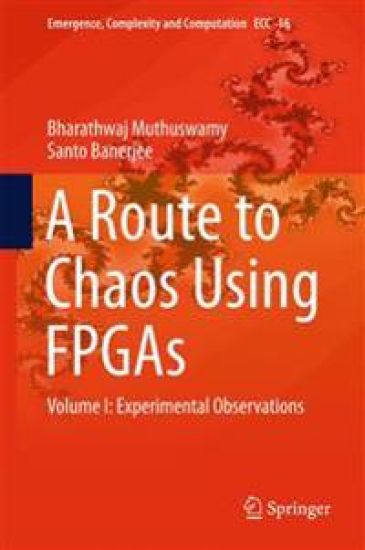
The purpose of this introductory book is to couple the teaching of chaotic circuit and systems theory with the use of field programmable gate arrays (FPGAs). As such, it differs from other texts on chaos: first, it puts emphasis on combining theoretical methods, simulation tools and physical realization to help the reader gain an intuitive understanding of the properties of chaotic systems. Second, the "medium" used for physical realization is the FPGA. These devices are massively parallel architectures that can be configured to realize a variety of logic functions. Hence, FPGAs can be configured to emulate systems of differential equations. Nevertheless maximizing the capabilities of an FPGA requires the user to understand the underlying hardware and also FPGA design software. This is achieved by the third distinctive feature of this book: a lab component in each chapter. Here, readers are asked to experiment with computer simulations and FPGA designs, to further their understanding of concepts covered in the book. This text is intended for graduate students in science and engineering interested in exploring implementation of nonlinear dynamical (chaotic) systems on FPGAs.
A Route to Chaos Using FPGAs

A Route to Chaos Using FPGAs

Bharathwaj Muthuswamy; Santo Banerjee

Springer International Publishing AG
2015
sidottu
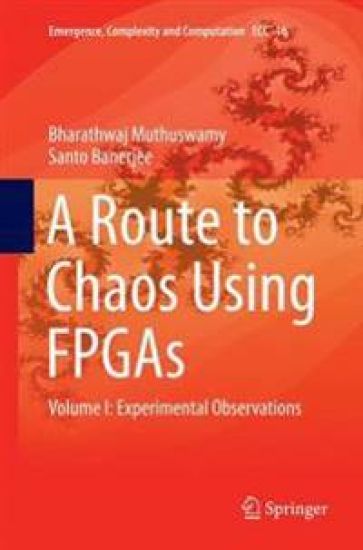
The purpose of this introductory book is to couple the teaching of chaotic circuit and systems theory with the use of field programmable gate arrays (FPGAs). As such, it differs from other texts on chaos: first, it puts emphasis on combining theoretical methods, simulation tools and physical realization to help the reader gain an intuitive understanding of the properties of chaotic systems. Second, the "medium" used for physical realization is the FPGA. These devices are massively parallel architectures that can be configured to realize a variety of logic functions. Hence, FPGAs can be configured to emulate systems of differential equations. Nevertheless maximizing the capabilities of an FPGA requires the user to understand the underlying hardware and also FPGA design software. This is achieved by the third distinctive feature of this book: a lab component in each chapter. Here, readers are asked to experiment with computer simulations and FPGA designs, to further their understanding of concepts covered in the book. This text is intended for graduate students in science and engineering interested in exploring implementation of nonlinear dynamical (chaotic) systems on FPGAs.