Kirjojen hintavertailu – 12 903 724 kirjaa ja 27 kauppaa

Kirjailija

Biao Huang

Kirjat ja teokset yhdessä paikassa: 5 kirjaa, julkaisuja vuosilta 1999–2016, suosituimpiin kuuluu Performance Assessment of Control Loops. Vertaile teosten hintoja ja tarkista saatavuus suomalaisista kirjakaupoista.

5 kirjaa

Kirjojen julkaisuvuodet: 1999–2016.

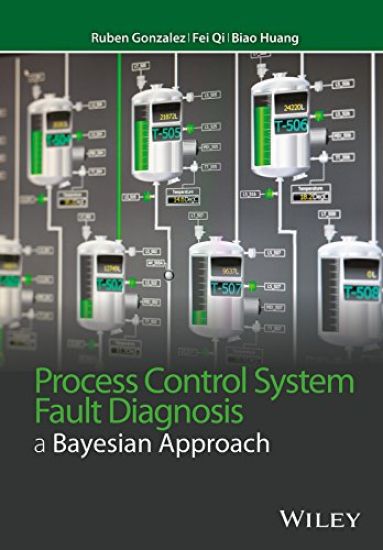
Process Control System Fault Diagnosis

Process Control System Fault Diagnosis

Ruben Gonzalez; Fei Qi; Biao Huang

John Wiley Sons Inc
2016
sidottu
Process Control System Fault Diagnosis: A Bayesian Approach Ruben T. Gonzalez, University of Alberta, Canada Fei Qi, Suncor Energy Inc., Canada Biao Huang, University of Alberta, Canada Data-driven Inferential Solutions for Control System Fault Diagnosis A typical modern process system consists of hundreds or even thousands of control loops, which are overwhelming for plant personnel to monitor. The main objectives of this book are to establish a new framework for control system fault diagnosis, to synthesize observations of different monitors with a prior knowledge, and to pinpoint possible abnormal sources on the basis of Bayesian theory. Process Control System Fault Diagnosis: A Bayesian Approach consolidates results developed by the authors, along with the fundamentals, and presents them in a systematic way. The book provides a comprehensive coverage of various Bayesian methods for control system fault diagnosis, along with a detailed tutorial. The book is useful for graduate students and researchers as a monograph and as a reference for state-of-the-art techniques in control system performance monitoring and fault diagnosis. Since several self-contained practical examples are included in the book, it also provides a place for practicing engineers to look for solutions to their daily monitoring and diagnosis problems. Key features: • A comprehensive coverage of Bayesian Inference for control system fault diagnosis. • Theory and applications are self-contained. • Provides detailed algorithms and sample Matlab codes. • Theory is illustrated through benchmark simulation examples, pilot-scale experiments and industrial application. Process Control System Fault Diagnosis: A Bayesian Approach is a comprehensive guide for graduate students, practicing engineers, and researchers who are interests in applying theory to practice.
Dynamic Modeling and Predictive Control in Solid Oxide Fuel Cells

Dynamic Modeling and Predictive Control in Solid Oxide Fuel Cells

Biao Huang; Yutong Qi; A. K. M. Monjur Murshed

John Wiley Sons Inc
2013
sidottu
The high temperature solid oxide fuel cell (SOFC) is identified as one of the leading fuel cell technology contenders to capture the energy market in years to come. However, in order to operate as an efficient energy generating system, the SOFC requires an appropriate control system which in turn requires a detailed modelling of process dynamics. Introducting state-of-the-art dynamic modelling, estimation, and control of SOFC systems, this book presents original modelling methods and brand new results as developed by the authors. With comprehensive coverage and bringing together many aspects of SOFC technology, it considers dynamic modelling through first-principles and data-based approaches, and considers all aspects of control, including modelling, system identification, state estimation, conventional and advanced control. Key features: Discusses both planar and tubular SOFC, and detailed and simplified dynamic modelling for SOFCSystematically describes single model and distributed models from cell level to system levelProvides parameters for all models developed for easy reference and reproducing of the resultsAll theories are illustrated through vivid fuel cell application examples, such as state-of-the-art unscented Kalman filter, model predictive control, and system identification techniques to SOFC systems The tutorial approach makes it perfect for learning the fundamentals of chemical engineering, system identification, state estimation and process control. It is suitable for graduate students in chemical, mechanical, power, and electrical engineering, especially those in process control, process systems engineering, control systems, or fuel cells. It will also aid researchers who need a reminder of the basics as well as an overview of current techniques in the dynamic modelling and control of SOFC.
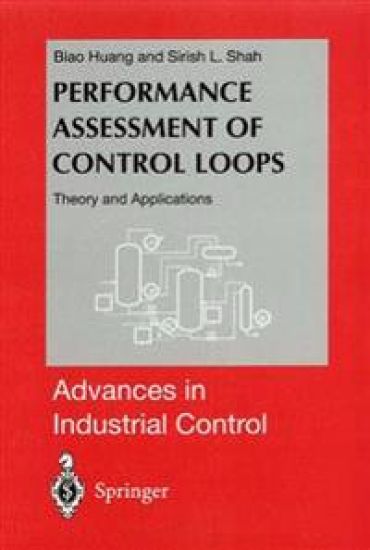
Performance Assessment of Control Loops

Performance Assessment of Control Loops

Biao Huang; Sirish L. Shah

Springer London Ltd
2012
nidottu
The series Advances in Industrial Control aims to report and encourage technology transfer in control engineering. The rapid development of control technology has an impact on all areas of the control discipline. New theory, new controllers, actuators, sensors, new industrial processes, computer methods, new applications, new philosophies. . . , new challenges. Much of this development work resides in industrial reports, feasibility study papers and the reports of advanced collaborative projects. The series offers an opportunity for researchers to present an extended exposition of such new work in all aspects of industrial control for widerand rapid dissemination. Benchmarking is a technique first applied by Rank Xerox in the late 1970s for business processes. As a subject in the commercial arena, benchmarking thrives with, for example, a European Benchmarking Forum. It has taken rather longer for benchmarking to make the transfer to the technical domain and even now the subject is making a slow headway. Akey research step in this direction was taken by Harris (1989) who used minimum variance control as a benchmark for controller loop assessment. This contribution opened up the area and a significant specialist literature has now developed. Significant support for the methodologywas given by Honeywell who have controller assessment routines in their process control applications software; therefore, it is timely to welcome a (first) monograph on controller performance assessment by Biao Huang and Sirish Shah to the Advances in Industrial Control series.
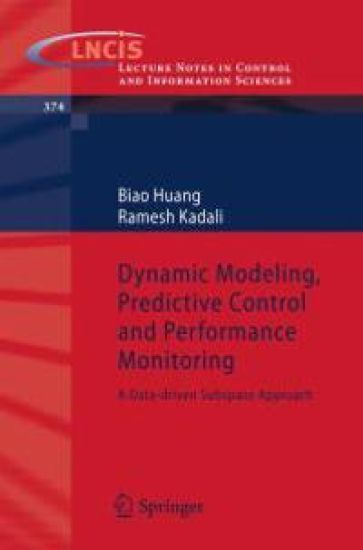
Dynamic Modeling, Predictive Control and Performance Monitoring

Dynamic Modeling, Predictive Control and Performance Monitoring

Biao Huang; Ramesh Kadali

Springer London Ltd
2008
nidottu
A typical design procedure for model predictive control or control performance monitoring consists of: 1. identification of a parametric or nonparametric model; 2. derivation of the output predictor from the model; 3. design of the control law or calculation of performance indices according to the predictor. Both design problems need an explicit model form and both require this three-step design procedure. Can this design procedure be simplified? Can an explicit model be avoided? With these questions in mind, the authors eliminate the first and second step of the above design procedure, a “data-driven” approach in the sense that no traditional parametric models are used; hence, the intermediate subspace matrices, which are obtained from the process data and otherwise identified as a first step in the subspace identification methods, are used directly for the designs. Without using an explicit model, the design procedure is simplified and the modelling error caused by parameterization is eliminated.
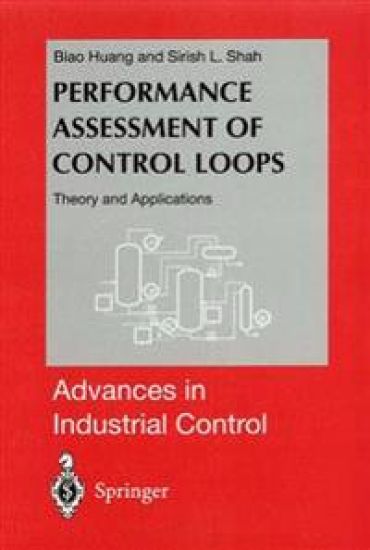
Performance Assessment of Control Loops

Performance Assessment of Control Loops

Biao Huang; Sirish L. Shah

Springer London Ltd
1999
sidottu
The series Advances in Industrial Control aims to report and encourage technology transfer in control engineering. The rapid development of control technology has an impact on all areas of the control discipline. New theory, new controllers, actuators, sensors, new industrial processes, computer methods, new applications, new philosophies. . . , new challenges. Much of this development work resides in industrial reports, feasibility study papers and the reports of advanced collaborative projects. The series offers an opportunity for researchers to present an extended exposition of such new work in all aspects of industrial control for widerand rapid dissemination. Benchmarking is a technique first applied by Rank Xerox in the late 1970s for business processes. As a subject in the commercial arena, benchmarking thrives with, for example, a European Benchmarking Forum. It has taken rather longer for benchmarking to make the transfer to the technical domain and even now the subject is making a slow headway. Akey research step in this direction was taken by Harris (1989) who used minimum variance control as a benchmark for controller loop assessment. This contribution opened up the area and a significant specialist literature has now developed. Significant support for the methodologywas given by Honeywell who have controller assessment routines in their process control applications software; therefore, it is timely to welcome a (first) monograph on controller performance assessment by Biao Huang and Sirish Shah to the Advances in Industrial Control series.